


Key Takeaways
- Kalshi’s trajectory from a niche event-contract venue to a multi-billion-dollar valuation was unlocked by foundational regulatory engineering: dual CFTC designations as a Designated Contract Market (DCM) and Derivatives Clearing Organization (DCO) established an unassailable institutional moat.
- The API-first distribution model — REST, WebSocket, and FIX 4.4 protocol support — turned Kalshi from a destination into rails. Robinhood, DriveWealth, and Tradeweb embed Kalshi’s contracts directly into their own products, meaning Kalshi captures volume without acquiring every end user itself. For operators, that’s the difference between building an audience and building infrastructure that other audiences plug into.
- The lesson isn’t to copy Kalshi’s specific stack. It’s that the infrastructure choices you make before your first major event window — venue model, custody architecture, clearing structure, API layer, and compliance posture — determine your ceiling when volume arrives. Operators who treat these as later-phase decisions consistently discover the constraint during the window they can’t afford to miss.
In May 2026, Kalshi closed a $1 billion Series F funding round led by Coatue Management, pushing its valuation to $22 billion. ARK Invest’s Cathie Wood described prediction markets as a powerful new layer of financial infrastructure, and Bernstein projects that trading volumes across the sector could approach $1 trillion by 2030.
Retail liquidity is scaling in tandem with institutional capital. During the 2026 FIFA World Cup alone, Kalshi onboarded three million new traders, cleared $53.53 billion in tournament volume between June 11 and July 19, and generated single-day fee revenues peaking at $13.5 million on June 24. These metrics dwarf historical benchmarks and confirm a lasting paradigm shift in how global markets price real-world uncertainty.
These figures signal a fundamental shift in how markets price uncertainty. But what makes the prediction market category especially worth studying right now is that its two dominant platforms, Kalshi and Polymarket, have achieved breakout scale through radically different infrastructure models.
One is a federally regulated, fiat-settled exchange embedded into mainstream finance. The other is a permissionless, crypto-native protocol built on Polygon. Understanding how these contrasting frameworks operate, and why Kalshi’s regulated approach has driven its meteoric rise, offers critical lessons for anyone building or operating in the digital asset exchange space.
How CFTC Regulation Became Kalshi’s Structural Advantage
At the foundation of Kalshi’s infrastructure sits its dual regulatory status. KalshiEX LLC operates as a Commodity Futures Trading Commission (CFTC) designated contract market, the same category governing CME Group and Cboe. In August 2024, Kalshi Klear LLC received separate registration as a derivatives clearing organization, giving the company full control over its own clearing and settlement.
This federal framework means Kalshi can operate nationwide across the United States without state-by-state licensing, a structural advantage over traditional sportsbooks and state-regulated gambling operators. The practical implication is significant.
While legacy sportsbooks must navigate a patchwork of 50 different state licensing regimes, Kalshi’s single federal designation gives it access to a far larger addressable audience from day one. It also enables mainstream financial partners to integrate Kalshi’s products without the jurisdictional ambiguity that plagues unregulated alternatives.
For businesses evaluating how to build institutional-grade digital asset infrastructure, Kalshi’s approach offers a clear lesson. Compliance infrastructure is not a barrier to scale. It is a prerequisite.
The Anatomy of an Event Contract: How Prediction Markets Price Risk
Before diving deeper into Kalshi’s architecture, it is worth understanding the product at the center of the platform.
An event contract is a binary financial instrument that pays out $1 if a specified real-world event occurs and $0 if it does not. The trading price between those two bounds, say $0.72, reflects the market’s collective estimate that the event has a 72% probability of happening.
This structure transforms subjective opinions about future outcomes into quantifiable, tradeable probabilities. Users can trade on anything from Federal Reserve rate decisions and CPI inflation readings to NFL game results and entertainment award outcomes.
The simplicity of the binary format makes event contracts accessible to retail traders, while the underlying price-discovery mechanism generates institutional-grade probability data that media outlets, hedge funds, and data providers use as a real-time signal layer.
It is this dual utility, serving both as a retail trading product and as a probability infrastructure layer, that makes prediction markets an entirely new asset class rather than simply another form of betting.
Inside Kalshi’s Exchange Architecture and Matching Engine
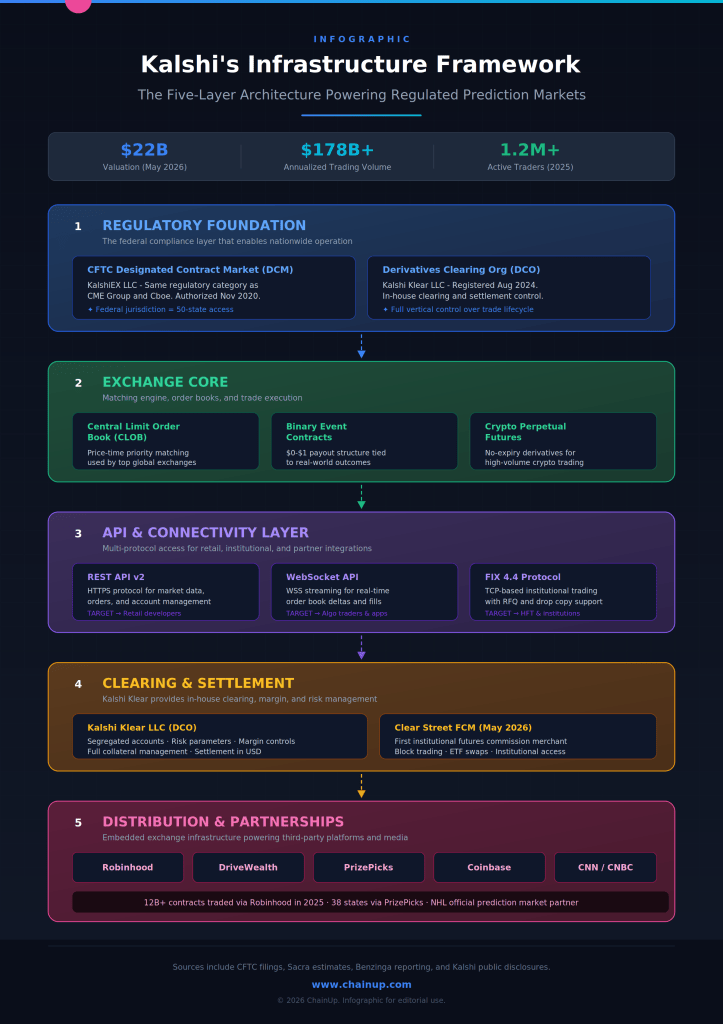
Kalshi runs on a Central Limit Order Book (CLOB) model, matching buy and sell orders continuously based on price-time priority. This is the same structure used by major equity and derivatives exchanges worldwide, and it stands in direct contrast to the Automated Market Maker (AMM) model used by most decentralized prediction platforms.
The CLOB architecture supports tighter spreads, more efficient price discovery, and a natural environment for professional market makers. A meaningful share of activity on Kalshi is algorithmic, with systematic quoting strategies keeping order books deep and liquid around the clock.
This is the infrastructure advantage that allows Kalshi to deliver the consistent market depth and execution quality that institutional participants expect, giving it a structural edge over AMM-based competitors where liquidity can fragment and spreads can widen unpredictably.
The platform has also expanded into perpetual futures on cryptocurrencies, adding a high-volume product class that complements its core event contract offering and demonstrates the modularity of its exchange infrastructure.
How Kalshi’s Multi-Layered API Powers Partner Integrations
Kalshi’s developer connectivity is built to serve everyone from retail app builders to institutional trading desks.
| API Layer | Protocol | Primary Use Case |
| REST API v2 | HTTPS | Market data, order management, account operations |
| WebSocket API | WSS | Real-time order book deltas, trade confirmations, streaming fills |
| FIX 4.4 | TCP | Institutional low-latency trading, Request for Quote (RFQ), drop copy recovery |
This multi-layered approach means Kalshi functions as an exchange infrastructure that external teams build on top of.
Robinhood launched its Prediction Markets Hub using KalshiEX as the underlying engine, and prediction markets quickly became Robinhood’s fastest-growing product line by revenue.
DriveWealth embedded Kalshi’s contracts into its brokerage stack, enabling global partner platforms to offer event contracts alongside traditional equities. The implication for the broader market is clear.
Kalshi’s API-first design has turned the platform into a distribution engine, allowing it to scale through partners’ existing user bases rather than acquiring every customer directly.
For exchange operators evaluating white-label trading solutions, this model demonstrates how standardized, multi-protocol connectivity can serve both retail and institutional audiences simultaneously while accelerating network growth.
Why Kalshi Built Its Own Clearinghouse
Owning the clearinghouse through Kalshi Klear is one of the platform’s most significant competitive advantages. Previously reliant on a third-party clearinghouse, Kalshi transitioned all open interest and collateral in-house in late 2024, gaining direct control over risk parameters, margin requirements, and settlement timelines.
What this means in practice is that Kalshi no longer depends on an external entity to define how fast trades settle, how margin is calculated, or how risk is managed during periods of high volatility.
This vertical integration gives the platform the speed and flexibility to tailor its clearing operations to the unique dynamics of event contracts, where settlement is tied to real-world outcomes rather than traditional market closes.
In May 2026, Clear Street became the first institutional futures commission merchant on Kalshi’s exchange, unlocking block trading, swap capabilities for ETF issuers, and regulated clearing infrastructure that extends far beyond retail.
This institutional on-ramp represents the kind of custody and compliance infrastructure that separates scalable financial platforms from consumer-only products. Without Kalshi Klear, none of these institutional workflows would be possible on the platform.
How Kalshi Scales Through Partners Instead of Direct Acquisition
One of the most underappreciated aspects of Kalshi’s infrastructure is its role as an embedded engine inside other platforms’ products. Rather than competing for every end user directly, Kalshi has built its exchange to function as the regulated backend that partners plug into and distribute through their own brands.
The economics of this model are compelling. Robinhood integrated Kalshi’s exchange and saw over 12 billion contracts traded through the partnership in 2025, making prediction markets its fastest-growing revenue line.
PrizePicks distributes Kalshi’s products across 38 states. Coinbase sources prediction market order flow directly from the exchange. On the media side, partnerships with CNN, CNBC, and Fox embed real-time probability data from Kalshi’s markets into television broadcasts and news coverage.
This white-label distribution strategy is the same infrastructure-as-a-service model that has powered growth in the digital asset exchange sector.
The exchange that wins is not necessarily the one with the most features, but the one that integrates most deeply into existing distribution networks. Kalshi’s partner-embedded approach has allowed it to scale its addressable market exponentially without bearing the full cost of customer acquisition.
Kalshi vs. Polymarket: Where Regulated and Decentralized Infrastructure Diverge

Both models are growing rapidly. Polymarket processed $425 million in a single day in February 2026, while Kalshi’s annualized volume surpassed $178 billion.
But the infrastructure differences directly explain why Kalshi has emerged as the larger and faster-growing platform. Its regulated status unlocks the institutional capital and mainstream distribution partnerships that crypto-native platforms cannot access.
Hedge funds, ETF issuers, and prime brokers require CFTC-regulated clearinghouses, Future Commission Merchant (FCM) connectivity, and fiat settlement to participate. Kalshi’s infrastructure delivers all three, which is why institutional trading volume on the platform grew 800% in the six months leading up to May 2026.
Polymarket’s permissionless architecture drives impressive single-day volume spikes around major events, but Kalshi’s regulated rails generate the consistent, daily liquidity that compounds over time.
The prediction market category is evolving into distinct regulated and decentralized corridors, each with its own infrastructure requirements. For a deeper technical comparison, our analysis of how crypto prediction markets work covers the full landscape.
Kalshi’s USP is complete federal regulation and institutional rails. Its status as a CFTC-designated contract market with an in-house clearinghouse allows it to operate legally nationwide, clear trades in fiat USD, and offer low-latency institutional protocols like FIX. It is built as the compliant plumbing that traditional fintech platforms can directly embed into their own apps.
Polymarket’s USP is global, permissionless liquidity and crypto-native scale. Running on the Polygon blockchain and settling in USDC, it offers frictionless access to a global audience without mandatory Know-Your-Customer (KYC) restrictions. This allows it to spin up niche and rapid-response markets incredibly fast, driving massive aggregate volume around high-profile events.
Because their core advantages are fundamentally different, these platforms naturally attract entirely different user segments.
Kalshi targets traditional finance and mainstream U.S. retail. This includes algorithmic trading desks, hedge funds, and ETF issuers who require regulated FCMs and clearinghouses. It also serves embedded B2B partners like Robinhood and DriveWealth looking to offer event contracts through a compliant white-label engine, and U.S. domestic retail investors who prefer trading in dollars under a federally protected framework.
Polymarket targets crypto-native and global audiences. This includes Web3 retail traders who already hold digital assets and prefer trading on-chain through DeFi infrastructure, as well as global speculators outside the United States who want immediate access to geopolitical and macroeconomic prediction markets without traditional banking constraints.
Five Infrastructure Decisions Operators Should Take From Kalshi
Kalshi’s trajectory distills into five infrastructure decisions that any operator entering the prediction market vertical should make deliberately and early:
- Regulatory posture before product launch. Kalshi’s CFTC designation wasn’t a compliance checkbox — it was the prerequisite for every institutional partnership and distribution deal that followed. Operators who defer regulatory positioning to a later phase consistently discover it’s the bottleneck when institutional capital tries to arrive.
- Vertical control over clearing and settlement. Building Kalshi Klear eliminated dependency on third-party clearing, giving the platform direct control over margin, risk parameters, and settlement speed. For operators licensing rather than building, the equivalent question is: where does your clearing dependency sit, and what does it cost you in flexibility?
- API-first distribution over destination-first acquisition. REST, WebSocket, and FIX 4.4 support turned Kalshi into embeddable infrastructure that partners build on, rather than a standalone destination competing for every user directly. The operator lesson: standardized multi-protocol connectivity is a distribution strategy, not a developer feature.
- Data infrastructure as a liquidity determinant. The fiber-optic multicast feed through DoubleZero Edge closed the 500–800ms latency gap that prevented institutional market makers from operating profitably on prediction markets. Infrastructure quality determines which liquidity providers can participate, which determines spread quality, which determines trader experience.
- Retention product roadmap for between-window periods. Kalshi’s volume is heavily event-concentrated, and post-event retention remains the unsolved problem across the category. Operators who treat a major event as a customer acquisition moment with a product roadmap for the quiet weeks capture more lifetime value than those who treat it as a volume moment.
Modernizing Exchange Architecture: From Kalshi’s Playbook to Your Own Market Deployment
Kalshi’s trajectory proves one thing clearly: in prediction markets, the infrastructure decisions made before volume arrives determine whether you capture it or watch it pass. Regulatory posture, clearing architecture, API distribution, data infrastructure quality, and a retention roadmap for between-window periods — these aren’t features you add later. They’re the foundation that every partnership, every institutional onboarding, and every event-window revenue spike is built on top of.
ChainUp’s white-label prediction market infrastructure is built around those same principles. The platform goes live in as little as 30 days, handles 100x traffic surges without degrading execution, and settles payouts instantly when an event concludes — not after the 1-to-6-hour delay that’s standard across the industry. For operators, that deployment speed is the difference between catching the window and missing it.
The prediction market layer is part of a full-suite infrastructure stack provided by ChainUp: white-label exchange software for trade execution, MPC wallet custody distributing signing authority across independent environments, liquidity technology aggregating depth across 2,000+ trading pairs, and Trustformer KYT screening transactions before settlement across 12,000+ tokens. Over 500 exchanges run on this stack globally — not because each piece is unavailable elsewhere, but because having them integrated from day one is what Kalshi spent years and hundreds of millions of dollars building from scratch.
Contact ChainUp’s team today to explore how our end-to-end solutions can power your next venture.


