

Key Takeaways
- Prediction market liquidity is the continuous two-sided availability of bids and asks. Without resting depth, even the most polished user interface suffers from wide spreads, high slippage, and rapid user abandonment.
- The standard scaling architecture begins by bootstrapping new or niche contracts via an Automated Market Maker (AMM), then migrating active flow to a Central Limit Order Book (CLOB) as volume matures. Polymarket followed exactly this path.
- Hybrid venues use AMMs as liquidity backstops and CLOBs for price-time priority matching, securing capital efficiency while preventing empty books.
- Long-term depth relies on taker-funded maker rebates, programmatic time-boxed rewards around major catalysts, and designated market maker (DMM) bilateral agreements.
- Budgeting for market making, spread subsidies, and adverse selection risk is an ongoing customer acquisition cost (CAC) rather than a one-time launch expense.
Prediction markets went from an academic curiosity to a roughly $44 billion industry in a single year. Combined monthly volume on the two leading venues climbed from under $5 billion in September 2025 to about $24 billion by April 2026. That growth hides a hard truth for anyone building a venue.
Prediction market liquidity, not clever questions or slick design, decides whether a platform survives. Liquidity represents the two-sided flow of buyers and sellers that keeps binary outcome contracts tradable at fair value. Operating an event exchange requires mastering how liquidity is seeded on day one, scaled through market maturity, and sustained during volatile news cycles.
What Prediction Market Liquidity Means in Practice
Liquidity in a prediction market is the constant availability of someone to take the other side of a trade. Every contract has a Yes and a No priced between $0 and $1, and both sides need willing counterparties for the market to work.
When a market has deep liquidity, spreads stay tight, prices move smoothly, and the venue becomes a trusted source of probability. When it is thin, spreads widen, prices jump, and traders leave.
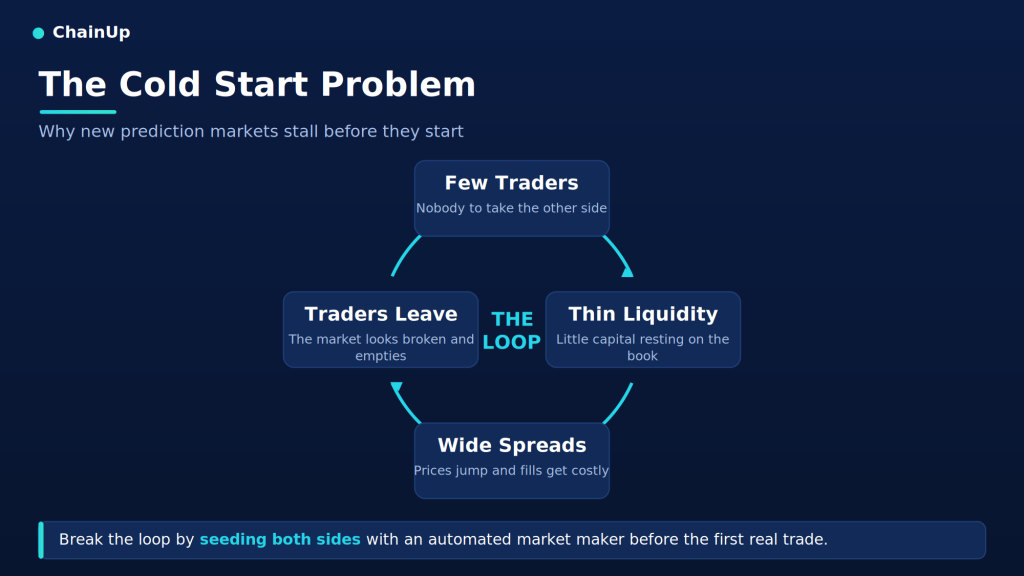
The challenge is structural. A prediction market is a two-sided marketplace, so it faces the same cold start problem as any marketplace. Traders won’t show up without liquidity.
Liquidity providers won’t show up without traders, and both sides need the market to be accurate before they trust it. Accuracy needs volume, volume needs both sides, and both sides need the market to already look active. Solving that loop is the first job of any operator.
How to Seed Liquidity for a New Market
A brand new market has no traders and no resting orders, the classic cold start problem, so there is nothing to trade against. Seeding fixes that by placing liquidity on both sides before the first real trader arrives.
The cleanest tool for this is an automated market maker, an engine that always stands ready to quote a price and fill an order. Liquidity is placed hours before the event goes live, so the very first visitor sees a populated order book with sensible prices on both sides.
Operators usually seed with one of three mechanisms. The most common approaches are described below.
- Logarithmic Market Scoring Rule. Designed by economist Robin Hanson, the logarithmic market scoring rule prices shares from a cost function and guarantees bounded loss for the market maker. It was built specifically for prediction markets and remains the reference automated market maker for event contracts.
- Internal Market-Making Bots. A budgeted market-making bot quotes both sides from treasury funds, with hard caps per market so it never risks more than allocated. This is cheap early on and stays fully under the operator’s control.
- Curated Launch Markets. The strongest early lever is choosing which markets exist. A few well-chosen questions concentrate thin demand into deep books instead of spreading it across hundreds of empty ones.
How to Scale Liquidity From an AMM to an Order Book
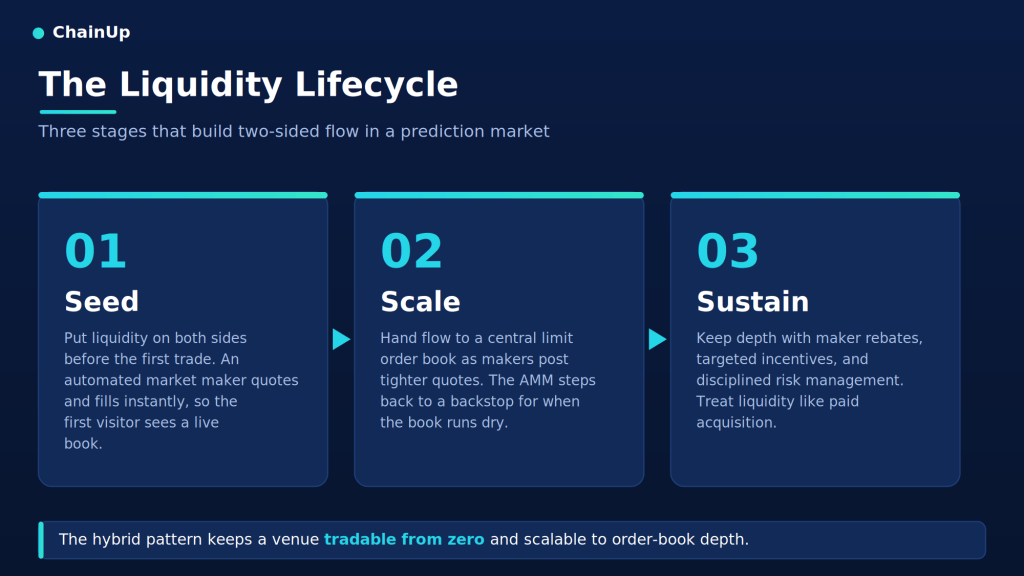
Scaling is the shift from subsidized liquidity to organic liquidity. In the early days the operator’s own automated market maker and market-making bots supply most of the flow, because a young market has no professional traders yet.
As volume and interest grow, incentivized makers arrive, and eventually professional and institutional market makers take over while the automated market maker steps back. The dominant production pattern among mature venues is a hybrid model, and it works in a clear sequence.
- The market launches with an automated market maker providing the opening quote, so it is tradable from zero.
- Market makers begin posting limit orders inside the AMM spread on a central limit order book, which tightens prices.
- As the order book deepens, the automated market maker becomes a backstop that fills only when the book has nothing better.
- At maturity, almost all flow runs through the order book, and the AMM stays as tail-risk insurance against the book emptying.
Polymarket is the clearest example of this path. It launched on an automated market maker, then moved its trading to a central limit order book as volume grew, and it now runs a hybrid setup that matches orders on an off-chain book and settles them on-chain. Kalshi ran an order book from the start under CFTC oversight.
Both giants now rely on order books for their busiest markets, while newer venues still lean on AMMs to bootstrap thin ones. The takeaway is that the order book is where a market ends up, not where it begins.
Performance at this stage leans heavily on a fast matching engine, since a fast book requires makers to continuously place limit orders on both sides, which demands low-latency infrastructure.
How to Sustain Two-Sided Flow With Incentives and Risk Controls
Sustaining liquidity is where most venues quietly fail. Seeded liquidity is a cost, and organic liquidity has to be earned every day. The operators that keep deep markets run liquidity as an ongoing program rather than a one-time launch task. Three levers do most of the work.
- Maker Rebates. Fund rebates for makers from taker fees, rewarding traders who post resting orders that add depth. Polymarket’s taker-fee-funded maker rebate program is the reference implementation.
- Targeted Incentives. Layer time-boxed rewards on high-priority markets around major events, the way election and World Cup markets get temporary boosts. Treat this budget like paid acquisition, with a named line item and a monthly review.
- Risk Management. Track maker exposure, position imbalance, and impermanent loss on a schedule, because a single news event can triple a market’s volume in a day and blow past a naive subsidy estimate.
Formal agreements add a fourth layer at scale. Designated market makers agree to provide consistent two-sided liquidity and satisfy quoting and volume requirements in exchange for reduced fees and higher position limits.
Reliable institutional market makers are what let a platform hold tight spreads through volatile events.
How AMM, Order Book, and Hybrid Models Fit Each Stage
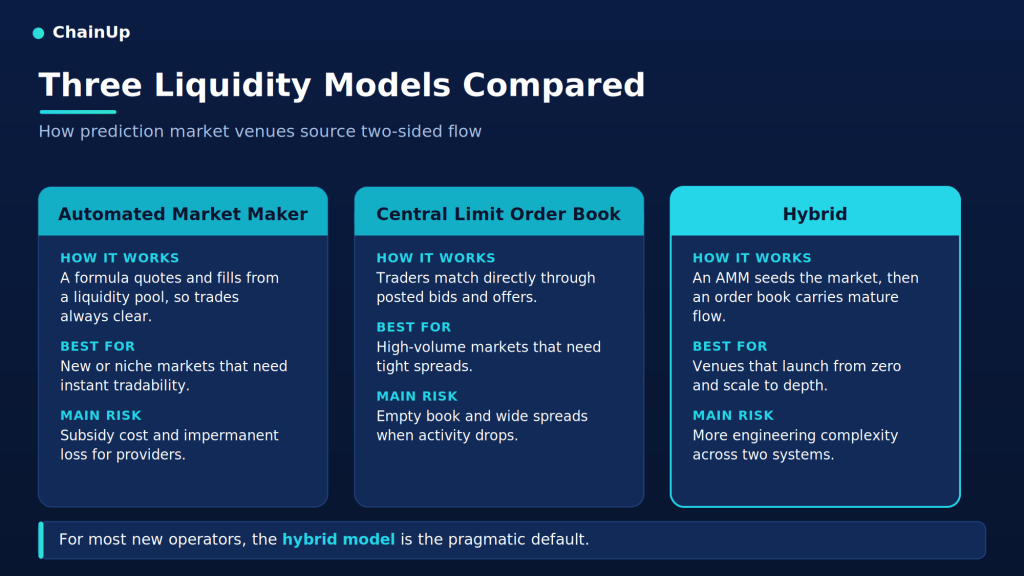
These three models are often pitched as rivals, but for a prediction market they work better as stages. An automated market maker seeds a market, an order book carries it at scale, and a hybrid runs both in sequence.
The logarithmic market scoring rule was created for prediction markets in the first place, so the question is not whether an AMM belongs, but when each model does its best work. The table below maps that out.
| Model | Role | Where It Fits Best | Watch-out |
| Automated Market Maker | Seeds and bootstraps a market | New and thin markets that need instant tradability | Subsidy cost and impermanent loss for providers |
| Central Limit Order Book | Carries mature, high-volume flow | Busy markets that need tight spreads and capital efficiency | Wide spreads and empty depth when activity drops |
| Hybrid | Bridges the two across the lifecycle | Venues that launch from zero and scale to real depth | More engineering complexity across two systems |
For most new operators, the hybrid model is the pragmatic default. It asks only for enough AMM subsidy to bootstrap the book, then leans on organic market making as volume grows.
Settlement matters as much as the trading layer, so many venues run stablecoin settlement to keep payouts fast and predictable.
Building a Prediction Market That is Sustainable & Scalable
Liquidity is the difference between a prediction market and a nice interface over empty books. Seed both sides before launch, sustain depth with rebates and disciplined risk management, and get the matching architecture right so price discovery follows. That sequence is the entire point of the product.
The harder part is the infrastructure underneath. ChainUp’s white-label prediction market platform delivers it out of the box:
- No cold start. Shared liquidity pools pull from a live market ecosystem so order books have depth from day one.
- Instant settlement. Automated smart contract payouts the moment an event concludes — no 1–6 hour oracle delays, no disputed float.
- Operator-grade controls. Granular fee engine, event creation wizard, lifecycle grouping for recurring markets, and role-based access with full audit logs.
- Non-custodial, gasless UX. Users trade from auto-deployed smart wallets with no gas fees, which is what captures the non-crypto audience that drives volume at scale.
Talk to ChainUp to launch a venue with deep liquidity from day one.