

Key Takeaways
- Stablecoin payments settle cross-border transfers in seconds to minutes for a network fee of cents, while international wire transfers take hours to days and carry stacked bank and FX charges.
- The true cost of a wire includes sending, intermediary, and receiving fees plus FX markups, so CFOs should compare all-in cost per payment instead of headline fees.
- Stablecoins work best as a second treasury rail alongside wires, not a full replacement — the right choice depends on corridor, counterparty, and recall needs.
The U.S. Office of the Comptroller of the Currency published its final GENIUS Act rules on October 21, 2026, ahead of the law’s January 18, 2027 effective date. For Chief Financial Officers (CFOs), that moves stablecoin payments out of the innovation budget and into treasury planning.
The comparison itself is clear. Stablecoin payments are faster and usually cheaper than international wire transfers because they settle directly on a blockchain, around the clock, without a chain of correspondent banks.
Wire transfers still lead on universal acceptance, familiar controls, and bank-mediated recall options.
How Stablecoin Payments and Wire Transfers Work
An international wire moves through the Swift messaging network. The sending bank passes payment instructions to one or more correspondent banks.
Each of those banks holds prefunded nostro and vostro accounts and debits or credits balances before the funds reach the beneficiary bank. Every hop adds a fee, a compliance check, and a possible delay.
A stablecoin payment moves the value itself. A company sends a dollar-backed token such as USDC or USDT from its wallet to the recipient’s wallet on a network like Ethereum, Solana, or Tron.
The transfer is final once it is confirmed on-chain. Licensed on-ramp and off-ramp providers convert between bank dollars and stablecoins at either end, which is why the right stablecoin payment infrastructure matters as much as the token.
Stablecoin vs. Wire Transfer Fees: What Companies Actually Pay
Headline wire fees understate the real cost because charges are spread across several parties. The table below breaks down the typical components of a cross-border B2B payment on each rail.
| Cost Component | International Wire Transfer | Stablecoin Payment |
| Sending Fee | $25 to $50 per wire | None or a platform fee |
| Intermediary Bank Fees | $10 to $30 per bank, often unannounced | None |
| Receiving Fee | $10 to $20 | None on chain |
| FX Markup | 1% to 3% above mid-market | Spread at on/off-ramp, often 0.1% to 1% |
| Network Fee | Not applicable | Cents to under $1 on most payment chains |

The FX markup is where most of the money goes. On an illustrative $250,000 supplier payment, a 1% to 3% markup adds $2,500 to $7,500 before any fixed fees. The same payment routed through a stablecoin rail with a 0.1% to 1% conversion spread costs roughly $250 to $2,500.
Smaller transfers show the same gap. The World Bank’s Remittance Prices Worldwide database puts the global average cost of sending $200 at above 6%, and banks remain the most expensive channel by a wide margin.
Businesses that pay many small invoices or contractors feel this cost on every transaction, a pattern that has pushed the growth of crypto remittance platforms.
Cross-Border Settlement Speed: Minutes on Chain vs. Days by Wire
Swift has made real progress on speed. Its own data shows that 90% of cross-border payments reach the beneficiary’s bank within an hour. However, only 43% reach the end customer’s account within an hour, because the final domestic leg still adds delay.
Several structural factors slow wires down beyond that first hop.
- Cut-off times. Payments sent after a bank’s daily cut-off wait until the next business day.
- Weekends and holidays. Wires do not settle when either country’s banks are closed.
- Compliance holds. Each correspondent may screen and pause the payment independently.
- Time zones. A payment from New York to Singapore can lose a full business day to office hours.
Stablecoins remove most of these constraints. Transfers confirm in seconds to minutes, 24 hours a day, 365 days a year. The off-ramp to local currency can add time where it is needed, but the core settlement no longer depends on banking hours.

Treasury and Working Capital Impact of Each Rail
Fees and speed are only part of the CFO case. Stablecoin rails also change how much cash a company must park around the world. The main treasury gains fall into four areas.
- Less trapped liquidity. Faster settlement reduces the need to prefund local bank accounts in every market.
- Real-time visibility. Every transfer has a public, timestamped record that simplifies cash positioning.
- Faster reconciliation. Finance teams match payments against one on-chain record instead of chasing multiple bank confirmations.
- Programmability. Smart contracts can trigger payouts on delivery or schedule, and agentic payments extend this automation to AI-driven workflows.
Business adoption already reflects these gains. McKinsey and Artemis Analytics estimate that B2B transactions account for about $226 billion, or roughly 60%, of real stablecoin payment volume. Global payroll is another fast-growing use case, especially for companies paying distributed teams across many countries.
Stablecoin Payment Risks, Compliance, and the GENIUS Act Timeline
Stablecoins are not risk-free, and CFOs should treat them with the same discipline as any new bank relationship. These are the risks that matter most for a treasury team.
- Issuer and reserve risk. A stablecoin is only as sound as its reserves and redemption process, so issuer due diligence comes first.
- Irreversibility. Confirmed transfers cannot be recalled, which raises the stakes on address verification and approvals.
- Custody and key management. Corporate funds need institutional controls such as a white label MPC wallet with policy-based approvals.
- AML and sanctions screening. Every inbound and outbound transfer should pass Know-Your-Transaction (KYT) monitoring.
- Regulatory alignment. Rules differ by market, from the GENIUS Act in the U.S. to MiCA in the European Union, so crypto compliance and licensing support is essential.
What the GENIUS Act Changes for U.S. Treasury Teams
The GENIUS Act takes effect on January 18, 2027, and establishes the first federal framework for payment stablecoins issued in the United States. The OCC published its final implementing rule on October 21, 2026, creating a new 12 CFR Part 15 that supervises stablecoin issuers on a bank-style cadence. For CFOs, this changes what “using stablecoins” means from a treasury governance standpoint.
Four provisions matter most for payment operations.
- Permitted issuers. From January 18, 2027, only a Permitted Payment Stablecoin Issuer (PPSI) can lawfully issue a payment stablecoin in the U.S. The three qualifying categories are subsidiaries of insured depository institutions, federally qualified nonbank issuers approved by the OCC, and state-qualified issuers operating under a state regime certified as “substantially similar” to the federal framework. State-qualified issuers above $10 billion in outstanding issuance must transition to federal oversight within 360 days or seek a waiver.
- 1:1 reserve and redemption rights. Reserves must equal or exceed 100% of outstanding stablecoins and are limited to a narrow list of assets, including U.S. cash, demand deposits at insured depository institutions, short-dated Treasuries, and overnight repos backed by Treasuries. Timely redemptions cannot exceed two business days, and issuers cannot impose discretionary redemption limits.
- Disclosure and reporting cadence. Issuers must publish monthly reserve compositions and submit weekly confidential reports to the OCC on Form PS-01, with the first weekly report due January 25, 2027.
- No interest or yield to holders. PPSIs and foreign payment stablecoin issuers cannot pay any form of interest or yield to stablecoin holders in connection with holding the stablecoin.
A separate AML and sanctions rulemaking from the OCC and Treasury is still pending.
The practical implication is that stablecoin selection moves from a product decision to a counterparty decision. Treasury policies that today list approved banks will need to list approved stablecoin issuers on the same basis, with the same due diligence cadence.
The GENIUS Act covers U.S. issuance. Payments into and out of other jurisdictions still fall under local frameworks, including MiCA in the European Union, the MAS stablecoin framework in Singapore, and emerging rules in the UAE and Hong Kong. A multi-corridor treasury program needs a view of all of them.
When CFOs Should Use Stablecoins vs. Wire Transfers
Most finance teams will not choose one rail over the other. They will route each payment to the rail that fits it best. The table below shows how common scenarios typically break down.
| Payment Scenario | Better Rail | Why |
| Frequent supplier payouts to emerging markets | Stablecoin | High FX and intermediary costs on wires |
| Intercompany treasury moves across time zones | Stablecoin | 24/7 settlement and less prefunding |
| Global contractor payroll | Stablecoin | Many small payments in many countries |
| Weekend or urgent settlement | Stablecoin | No dependency on banking hours |
| M&A, real estate, or loan closings | Wire Transfer | Established legal and escrow processes |
| Counterparty without an off-ramp | Wire Transfer | Recipient cannot accept stablecoins |
| Payments needing a recall path | Wire Transfer | Bank-mediated recall requests are available |
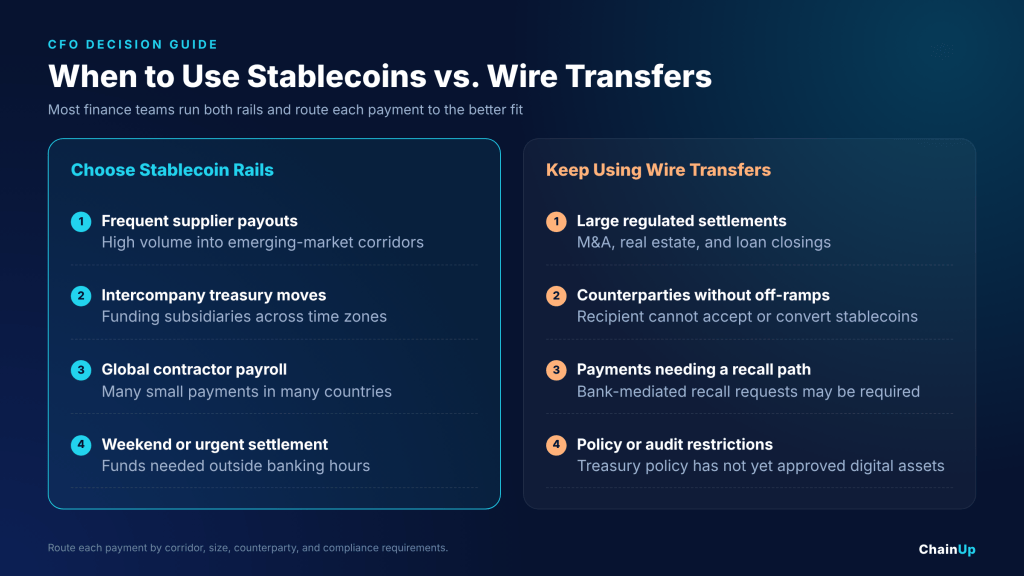
A practical starting point is a single high-cost corridor. Teams can run a small batch of supplier or intercompany payments through a stablecoin rail, then measure all-in cost and time to funds against the same payments sent by wire.
How to Build a Dual-Rail Treasury Strategy
Stablecoin payments beat international wire transfers on speed and, in most corridors, on total cost. Wires still have a place for large regulated settlements and counterparties that cannot accept digital dollars. The strongest strategy for CFOs is a dual-rail treasury that routes each payment to the rail that fits it, backed by secure custody and real-time compliance.
ChainUp provides the underlying technology stack to operationalize dual-rail settlement—including multi-party computation (MPC) custody, automated KYT risk monitoring, and turnkey compliance frameworks across major financial jurisdictions.
Contact ChainUp today to explore institutional infrastructure for modern cross-border treasury management.