

Key Takeaways
- Liquidity and liquidity infrastructure are two different things. Liquidity is the financial inventory (capital and order flow) that fills an order book. Liquidity infrastructure is the software engineering stack that sources, aggregates, and routes it.
- More than 1,000 spot venues compete for market share, yet roughly 80% of tracked exchange volume consolidates across the top five venues. Delayed launches directly cost market share in a hyper-concentrated landscape.
- Building a liquidity stack in-house typically takes 8–12 months of specialized development. Licensing enterprise infrastructure gets an exchange live in 4–8 weeks.
- A 10x development cost multiplier excludes ongoing overhead: continuous uptime monitoring, protocol upgrades, API maintenance, and security patching—none of which offer front-end differentiation to end users.
- In-house builds are justifiable only for mega-cap incumbents, proprietary exotic trading mechanisms, or pure technology vendors. For all other operators, licensing wins on speed, capital efficiency, and total cost of ownership (TCO).
In early 2026, more than 1,000 trading venues compete for spot flow, yet roughly four-fifths of tracked exchange volume now passes through just five of them, with Binance alone holding over a third of global market share. Fragmentation at the tail is intensifying while concentration at the top deepens.
When founders say they want to “build their own liquidity,” they usually mean two very different things at once, and the mix-up costs real money.
There is liquidity: the capital and order flow resting in your books. Then there is liquidity infrastructure: the distributed software that sources, aggregates, normalizes, and clears that depth. Clarifying that distinction resolves the build-versus-buy debate.
Liquidity vs Liquidity Infrastructure: Why the Difference Matters

Think of a city. Liquidity is the water, the actual resource people want. Liquidity infrastructure is the network of pipes, pumps, and valves that moves the water to the tap at the right pressure.
A venue can have access to plenty of water and still deliver a terrible experience if the pipes leak, and it can have beautiful pipes that sit empty if no water is flowing.
The table below breaks the two apart so the rest of the decision stays clear.
| Dimension | Liquidity | Liquidity Infrastructure |
| What it is | Capital and order flow | The technology that moves it |
| Where it comes from | Market makers and liquidity providers | Vendors or in-house engineering |
| How you measure it | Depth, spreads, volume | Latency, uptime, fill quality |
| Nature of the cost | Commercial agreements | Software and maintenance |
| Can it be switched off | Yes, flow can leave | Yes, but it is a rebuild |
Liquidity is a relationship you negotiate. Infrastructure is a system you operate. When people ask whether an exchange “builds its own liquidity,” what they are really asking is whether the exchange builds the liquidity technology that sources and routes it. The answer, for almost every venue on the planet, is no.
Core Components of the Crypto Liquidity Technology Stack
Before comparing build against buy, it helps to see what the stack contains. Liquidity infrastructure is not one product but a set of tightly coupled systems that have to work together in real time.
- A matching engine, the low-latency core that pairs buy and sell orders in microseconds and holds the central limit order book.
- A smart order router that decides where each order should go so it fills at the best available price.
- Liquidity aggregation that pools depth from many external books into a single unified order book.
- Market-making bots that quote both sides of the market to keep spreads tight from launch day.
- Venue connectivity, the pre-built API links that let flow move across cross-exchange liquidity pools without manual integration.
- Risk, monitoring, and compliance controls that watch the whole stack around the clock.
Each of these is a serious engineering discipline on its own. Stitching them into a resilient system that never stops is where the real difficulty lives.
Why Most Exchanges Buy Instead of Build
The reason so few venues build this stack is not a lack of ambition. It is arithmetic. Building means hiring specialist engineers who understand market microstructure, then keeping them for years, because a matching engine and router are never finished. They need constant tuning as volumes climb and as new venues appear to connect to.
There is also the cold-start problem. A brand new exchange has no volume, so its internal book is thin, so traders leave, which keeps the book thin.
Almost no venue in 2026 bootstraps depth from retail flow alone. They aggregate external liquidity and lean on dedicated market makers first, then grow an internal book once volume justifies it.
That path depends entirely on infrastructure that can plug into outside sources on day one, which is exactly the part that is hardest and slowest to build.
Finally there is focus. Every engineering hour spent on plumbing is an hour not spent on the product traders actually see, meaning the interface, the token listings, the fiat rails, and the crypto exchange infrastructure that differentiates one venue from the next. Building the pipes is invisible to users and rarely a source of competitive advantage.
The Build vs. Buy Math For Crypto Liquidity Infrastructure
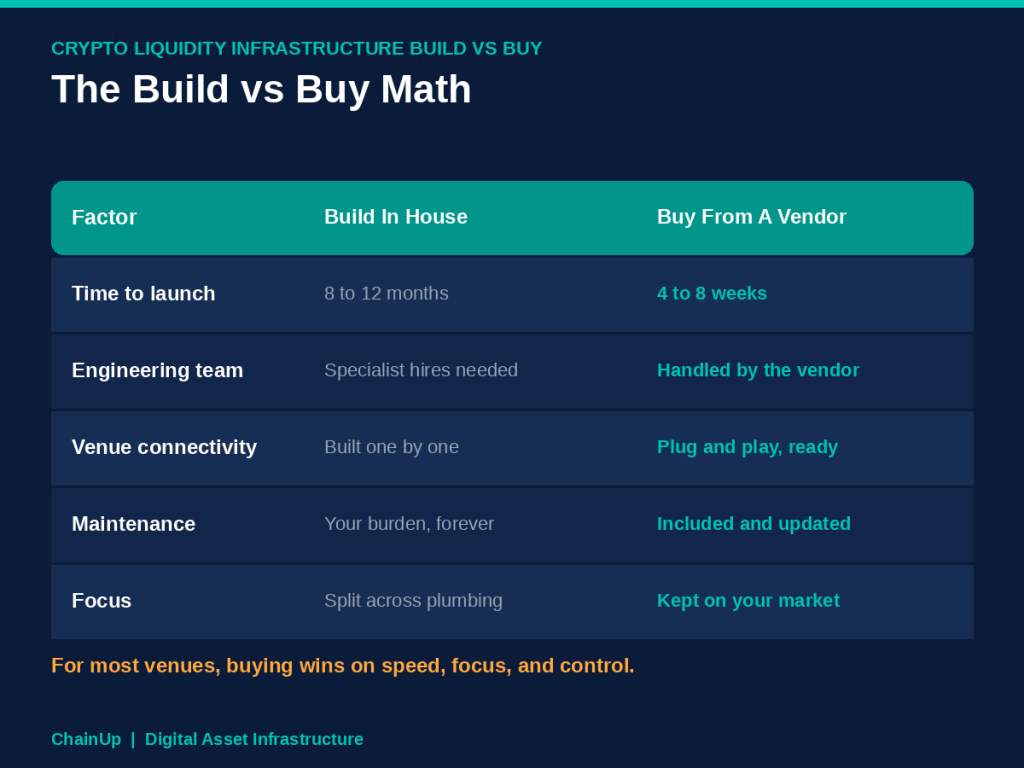
Numbers make the trade-off concrete. The comparison below reflects typical ranges reported across the industry in 2026.
| Factor | Build In House | Buy From A Vendor |
| Time to launch | 8 to 12 months | 4 to 8 weeks |
| Engineering team | Specialist hires required | Handled by the vendor |
| Venue connectivity | Built one integration at a time | Plug and play from day one |
| Maintenance | Your burden indefinitely | Included and continuously updated |
| Where focus goes | Split across the plumbing | Kept on your market and users |
Building can cost more than ten times as much and ship many months later, and the meter never stops running because maintenance is permanent. For a market growing at more than twenty percent a year toward a projected value well past 380 billion USD by 2033, per market size forecasts, those lost months are lost market share.
What A Liquidity Technology Vendor Actually Delivers
Buying does not mean surrendering control. A capable liquidity technology vendor hands over the entire stack as a managed system while leaving the commercial and product decisions with you.
In practice the stack breaks down into six working parts, and it is worth seeing each one in plain terms.
- Matching engine, the low-latency core that pairs buy and sell orders in microseconds and holds the central limit order book.
- Smart order router, which sends each order to the venue offering the best available price so fills stay sharp.
- Liquidity aggregation, which pools depth from many exchanges into one deep book so your market never looks empty.
- Market-making bots, which quote both sides of the market to keep spreads tight from the very first trade.
- Venue connectivity, the pre-built API links to a network of liquidity providers that would otherwise take months to wire up one by one.
- Risk and monitoring, the round-the-clock controls, security patching, and uptime work that keep the whole system healthy.

The vendor owns the parts nobody enjoys building, and keeps adding new venue connections as the market shifts. This is the same logic that drives operators toward a white label crypto exchange rather than a from-scratch platform. You get proven infrastructure and spend your energy on the market you are trying to win.
When Building In-House Infrastructure Makes Sense
To be fair, buying is not automatic for everyone. A small number of venues have a genuine reason to build, and it is worth naming them so the decision stays honest.
- Exchanges operating at the very largest scale, where microsecond advantages translate into meaningful revenue and a custom engine can pay for itself.
- Venues with a truly novel trading model that no existing infrastructure supports, so off-the-shelf systems simply cannot express the product.
- Firms whose core competitive edge is the technology itself rather than the marketplace around it.
For these operators, owning the stack is a strategy, not overhead. For everyone else, the same money spent on building buys far more growth when it is aimed at users and liquidity relationships instead.
Choosing well starts with understanding how to evaluate a partner, which is why it pays to study how to choose a liquidity provider before signing anything.
Launch Faster with ChainUp Liquidity Technology
The confusion between liquidity and liquidity infrastructure quietly drains budgets and delays launches. Once you separate the water from the pipes, the build-versus-buy question answers itself: you license proven plumbing from an infrastructure specialist, then pour your capital into customer acquisition and regional market share.
For operators launching a venue, this does not require coordinating between separate software vendors and liquidity brokers. Launching with ChainUp’s white-label crypto exchange includes enterprise liquidity aggregation natively pre-integrated into the platform. Having launched more than 500 digital asset exchanges worldwide, ChainUp solves the day-one cold-start problem at the architectural level.
Rather than deploying a blank order book and scrambling for market makers, ChainUp connects your exchange directly to aggregated Tier-1 depth—including Binance, Coinbase, OKX, HTX, Gate.io, and MEXC, alongside institutional market makers. From your opening trade, your platform quotes tight spreads and deep order books automatically.
Key capabilities built natively into the turnkey deployment include:
- Cross-venue aggregation paired with in-engine market making, which holds spreads tight from launch instead of chasing depth later.
- A-book and B-book hedge routing with a
- utomated position management, so risk is governed inside the engine rather than bolted on afterward.
- A 30-vector risk matrix across four tiers that fires real-time alerts on LP outages, quote deviation, hedge failures, and unhedged exposure.
- An admin dashboard built for operations and compliance oversight, not only engineering reporting.
Instead of spending quarters building an engine and months negotiating LP agreements, operators launching with the ChainUp exchange solution get an institutional-grade trading platform and day-one market liquidity in a single deployment.
Schedule a technical demo with the ChainUp team to see how turnkey exchange infrastructure and embedded liquidity can accelerate your launch.