

Key Takeaways
- Externally Owned Accounts (EOAs) rely on a single private key, making them simple to integrate but highly vulnerable, as one compromised key results in the total loss of funds.
- Smart contract wallets execute programmable on-chain logic, making them ideal for consumer applications, DAOs, and DeFi protocols requiring gas sponsorship, atomic batching, or programmatic recovery.
- Multi-Party Computation (MPC) wallets distribute private key shares across independent endpoints without ever assembling the complete key, making them the standard choice for exchanges, custodians, and payment platforms managing high-volume, multi-chain operations.
Crypto security failures are rarely about broken code anymore. According to first-half 2026 hack data from TRM Labs, attacks compromising private keys, seed phrases, and administrative signing credentials accounted for only 15% of total security incidents, yet they drove 76% of the $972 million stolen in the first half of the year alone.
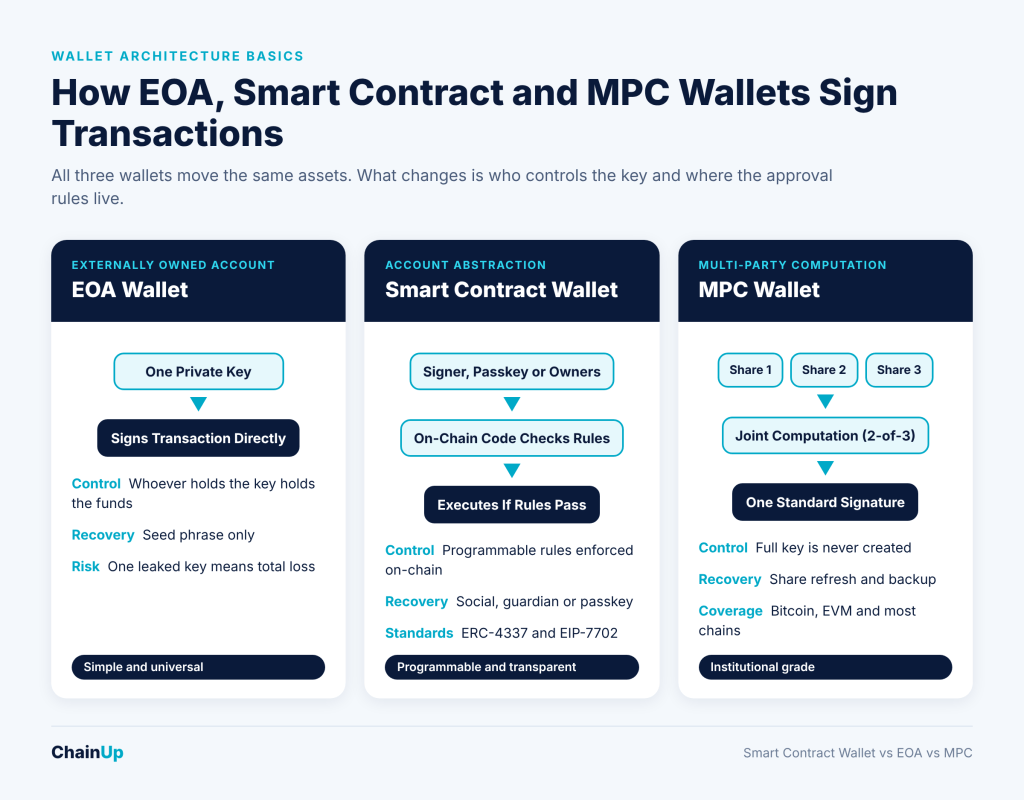
Selecting a wallet architecture is an operational risk decision. An Externally Owned Account (EOA) relies on a single private key to sign transactions. A smart contract wallet replaces that single key with programmable code enforced on-chain. An MPC wallet splits the key into distributed shares so no single entity or device ever holds the full secret. Because each architecture addresses distinct security and performance requirements, enterprise teams frequently combine all three.
What Is an EOA Wallet and How Does It Work
An EOA is the original, native account structure on Ethereum and EVM-compatible blockchains. A single private key,typically generated from a 12- or 24-word BIP-39 mnemonic seed phrase, directly controls the account address and authorizes every outgoing transaction. Popular web3 interfaces like MetaMask and Rabby, as well as standard hardware wallets, function as EOAs.
As EOAs are foundational to the base layer, they are universally supported by decentralized applications (dApps),exchanges, and block explorers with zero integration overhead. For this reason, EOAs frequently serve as basic external signers within multi-tier architectures, such as an individual key holder on a multi-signature wallet.
However, EOAs present critical structural vulnerabilities:
- Single Point of Failure: Whoever controls the private key controls all associated assets, with no native mechanism for transaction limits, recovery, or policy governance.
- No Fee Abstraction: Transactions must pay gas in the network’s native token (such as ETH), creating operational friction during user onboarding.
- Irreversible Compromise: A single phishing attempt or compromised credential exposes the entire balance immediately.
What Is a Smart Contract Wallet and How Does Account Abstraction Power It
A smart contract wallet is an on-chain account governed by custom contract logic rather than a standalone cryptographic keypair. As the code dictates what constitutes a valid transaction, development teams can program granular business rules directly into the wallet: multi-party approvals, automated spending caps, counterparty allowlists, and guardian-based account recovery. Safe represents the benchmark for treasury management, while passkey-driven solutions on networks like Base provide smooth consumer onboarding.
Two Ethereum standards drive this category. ERC-4337 smart accounts brought account abstraction to Ethereum without a protocol change, using bundlers and paymasters to let apps sponsor gas and batch actions. EIP-7702, activated in the Pectra upgrade in May 2025, lets an existing EOA temporarily act like a smart contract wallet without changing its address.
Adoption is already measurable. As of May 2026, Base processed about 747,000 EIP-7702 smart account transactions in 30 days, ahead of Ethereum mainnet.
The trade-offs are cost and chain coverage. Every rule runs on-chain, so transactions use more gas, and smart contract wallets work only on chains that support them. The contract code also becomes an attack surface that needs regular audits.
What Is an MPC Wallet and Why Do Institutions Rely On It
An MPC wallet utilizes Multi-Party Computation to replace the traditional private key with encrypted, distributed key shares held across distinct servers, devices, or administrative parties. When authorizing a transaction, these parties participate in a cryptographic Threshold Signature Scheme (TSS)—such as a 2-of-3 or 3-of-3 configuration—to co-sign the payload. The complete private key is never generated, stored in memory, or reassembled at any point in its lifecycle.
To the underlying blockchain, the resulting signature appears identical to a standard single-key signature. This architecture delivers three key advantages for enterprise operations:
- Chain-agnostic coverage. MPC works on Bitcoin, Ethereum, Solana, Tron, and other chains without custom contracts.
- Lower and predictable fees. Signing happens off-chain, so there is no extra contract logic to pay for.
- Key rotation without address changes. Shares can be refreshed after a breach or staff change while the wallet address stays the same.
The primary consideration is that policy enforcement (such as spending thresholds, role-based access, and whitelists) operates off-chain within the platform’s orchestration layer rather than directly on a public blockchain ledger. Organizations must therefore partner with audited providers that demonstrate rigorous SOC 2 compliance, robust role-based access controls (RBAC), and disaster recovery protocols.
Smart Contract Wallet vs EOA vs MPC Wallet Compared Side by Side
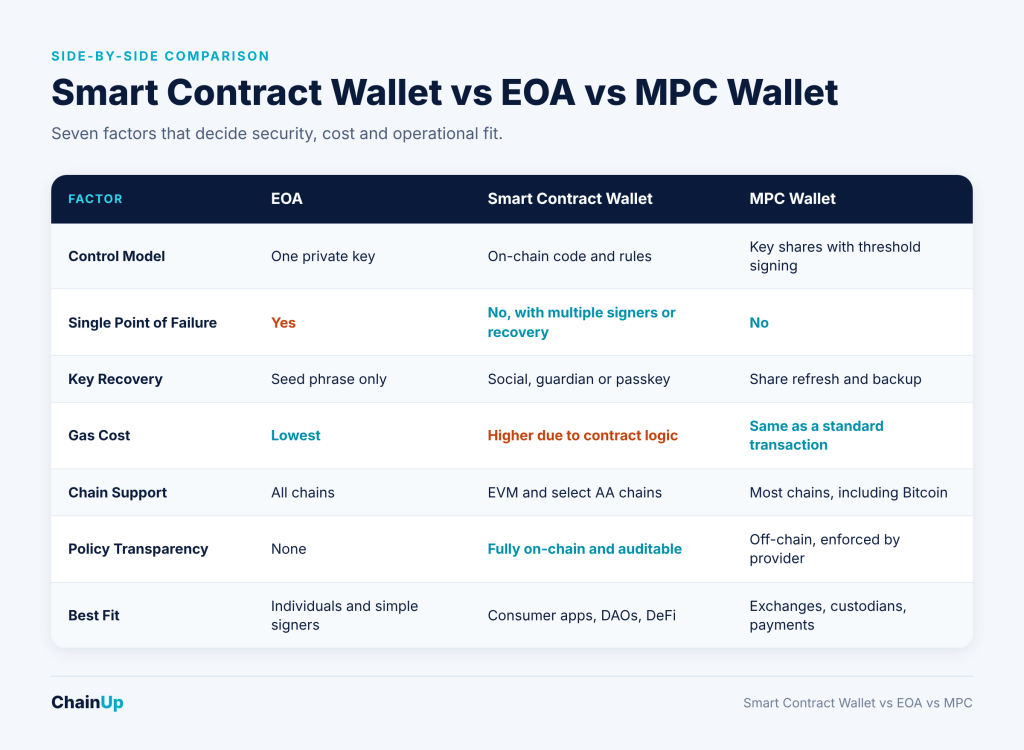
The table below outlines the core differences between the three wallet architectures across security, performance, and infrastructure requirements:
| Comparison Factor | Externally Owned Account (EOA) | Smart Contract Wallet | MPC Wallet |
| Control Model | Single private key | On-chain contract logic | Distributed key shares via threshold signing |
| Single Point of Failure | Yes (compromised key results in total loss) | No (mitigated by multisig or recovery modules) | No (distributed across independent nodes) |
| Recovery Options | Seed phrase or private key backup only | Guardian recovery, secondary signers, passkeys | Key share refresh, backup shares, and quorum recovery |
| Gas Cost Profile | Baseline standard transaction fee | Higher (incurs smart contract execution overhead) | Baseline standard transaction fee |
| Cross-Chain Support | Universal across native chains | EVM chains and select smart contract networks | Chain-agnostic (supports Bitcoin, Solana, Tron, EVM) |
| Policy Execution | None at the wallet layer | Transparent, immutable, and on-chain | Off-chain, governed by institutional policy engine |
| Primary Fit | Individual users and basic signer roles | Consumer dApps, DAOs, and on-chain treasuries | Exchanges, custodians, payment rails, and fintechs |
Which Crypto Wallet Architecture Fits Your Business Model?
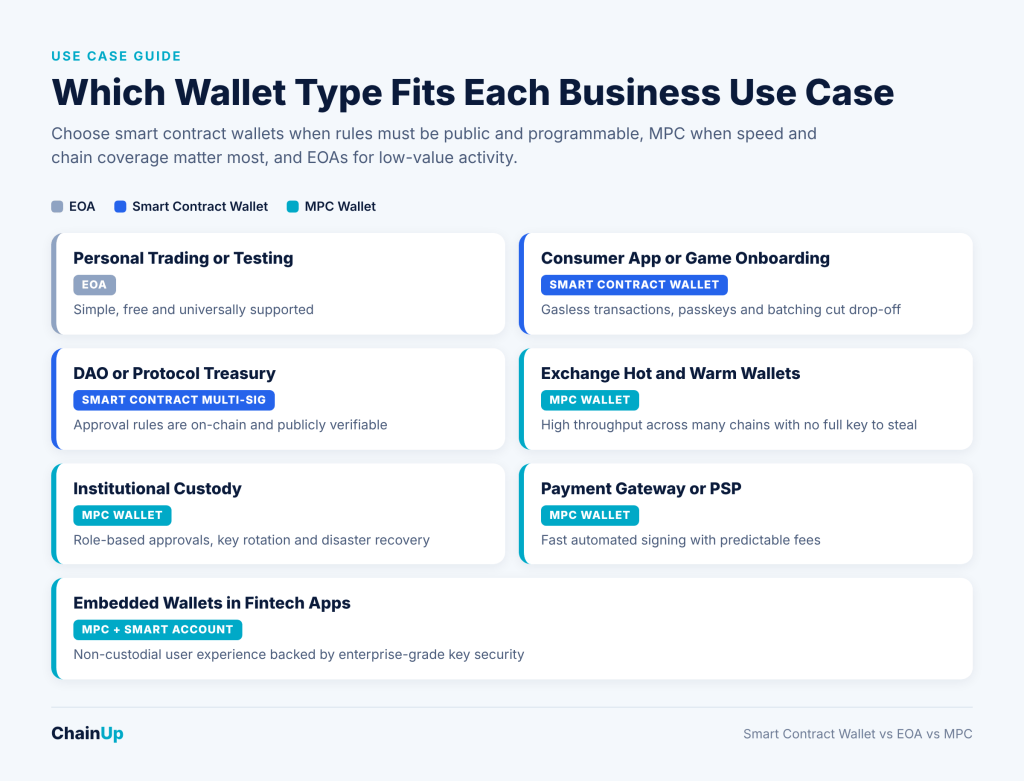
Selecting a wallet framework depends on transaction volume, chain diversity, and regulatory requirement:
| Enterprise Use Case | Recommended Architecture | Implementation Rationale |
| Developer Testing & Basic Operations | EOA | Minimal setup overhead with universal protocol compatibility. |
| Consumer Application & Gaming Onboarding | Smart Contract Wallet | Gas sponsorship (paymasters), passkey logins, and batched interactions minimize onboarding drop-off. |
| DAO & On-Chain Governance Treasuries | Smart Contract Multi-Sig | Financial disbursements and approval thresholds are executed and audited transparently on-chain. |
| Exchange Hot, Warm, and Cold Liquidity | MPC Wallet | High-throughput multi-chain signing, zero key exposure, and automated programmatic withdrawals. |
| Regulated Institutional Custody | MPC Wallet | Institutional governance, role-based access controls (RBAC), SOC 2 compliance, and key share rotation. |
| Payment Service Providers (PSPs) | MPC Wallet | Automated, low-latency transaction signing with predictable network gas fees across diverse payment rails. |
| Embedded Fintech & Neobanking Wallets | Hybrid (MPC + Smart Account) | Combines enterprise-grade key custody off-chain with programmable account abstraction rules on-chain. |
As a general guideline: deploy a smart contract wallet when governance rules and approval policies must remain publicly verifiable on-chain. Choose an MPC wallet when transaction throughput, diverse cross-chain coverage, and private key security are paramount. Restrict standalone EOAs to small testing balances or secondary signer inputs.
How Enterprises Build a Hybrid Multi-Tier Custody Stack
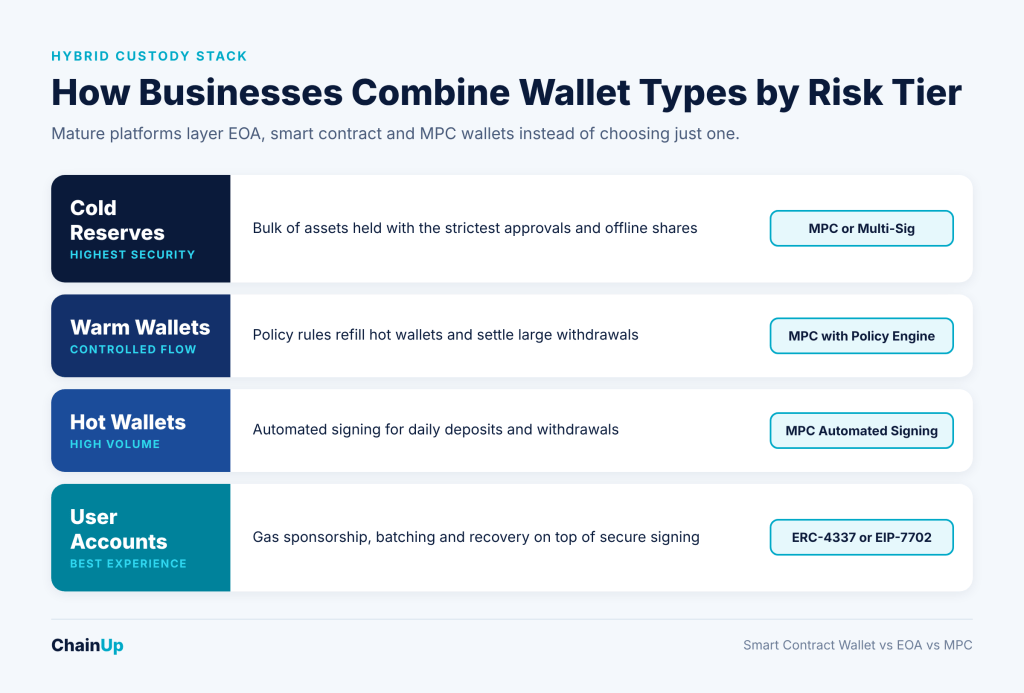
Mature digital asset institutions rarely rely on a single wallet architecture. Instead, they structure their operations across risk-segmented tiers:
- Cold reserves hold the bulk of assets in MPC or multi-sig wallets with the strictest approvals and offline shares.
- Warm wallets use MPC with policy rules to refill hot wallets and settle large withdrawals.
- Hot wallets use MPC with automated signing for daily deposits and withdrawals.
- User accounts layer ERC-4337 or EIP-7702 features on top for gas sponsorship, batching, and recovery.
The line between categories is also blurring. An MPC wallet can now sit behind a smart account as its signer, combining off-chain key security with on-chain programmability. Platforms that want this without building it in-house can use crypto wallet-as-a-service to access the infrastructure through APIs. Our hot, cold, and MPC custody guide explains how to size each tier.
Build the Right Wallet Architecture With ChainUp
Selecting an appropriate wallet framework involves balancing private key security, chain compatibility, and operational throughput. While basic signers manage direct transfers and smart contract wallets offer programmatic execution, MPC systems address the operational risk of private key theft in high-volume environments.
To support multi-tier custodial setups, infrastructure providers like ChainUp deliver institutional technology designed for regulated entities:
- MPC Custody Rails: Uses a Threshold Signature Scheme (TSS) to eliminate single points of failure across key generation, signing, and recovery, operating natively across 200+ EVM and non-EVM blockchains.
- Granular Governance: Integrates off-chain policy engines that enforce role-based access control (RBAC), multi-party approval quorums, and transaction velocity limits.
- Compliance & Monitoring: Connects wallet operations directly with Trustformer KYT for automated on-chain risk scoring, counterparty screening, and Travel Rule data exchange.
- White-Label Integration: Provides modular APIs and software development kits (SDKs) enabling exchanges,payment processors, and fintech platforms to deploy institutional-grade custody or consumer-facing wallets without maintaining custom cryptographic infrastructure in-house.
Whether you are establishing an exchange hot wallet, integrating user-facing embedded accounts, or structuring an institutional treasury, our team can help you benchmark the right security model. Schedule an architecture review with ChainUp to assess deployment models across MPC, smart contract accounts, and hybrid custody stacks.