

Key Takeaways
- USDC for Regulated Reserves & Western Banking: Backed by cash and short-dated U.S. Treasuries managed by BlackRock with monthly Deloitte attestations, USDC fits U.S. and EU banking relationships, institutional settlement, and audit-heavy reporting.
- USDT for Emerging-Market Liquidity & Low-Cost Transfers: Driven by deep exchange order books and low-cost transfers on the Tron network, USDT remains the standard for cross-border supplier payments, OTC settlement, and emerging-market corridors.
- Adopt a Dual-Stablecoin Treasury Policy: Most corporate treasuries benefit from holding both tokens, governed by a formal treasury policy that assigns USDC or USDT based on jurisdiction, counterparty requirements, and settlement rails.
Eighteen percent of corporates now run stablecoins in live production, twice the share from a year earlier, according to the EY-Parthenon 2026 Blockchain Payments Survey. As stablecoins move from pilot programs into payroll, supplier disbursements, and working capital management, corporate finance teams face a practical decision: which stablecoin should hold the company’s liquidity?
The answer depends on the operational role. USDC is structured for regulated reserves and compliance-heavy workflows,whereas USDT is built for global trading liquidity and emerging-market payment corridors.
Together, USDT and USDC make up about 85% of the $290 billion stablecoin market, based on DefiLlama stablecoin data as of November 8, 2026. This guide examines how both tokens compare across reserve transparency, regulatory compliance, and network costs,and outlines how to deploy them together in a corporate treasury strategy.
What Are USDT and USDC? Stablecoin Basics for Treasury Teams
USDT and USDC are both fiat-backed stablecoins designed to maintain a 1:1 peg with the U.S. dollar. Each token represents a claim on underlying reserve assets held by its issuer, relying on direct redemption mechanisms to maintain price stability. Despite serving similar functions as digital cash, they differ across three core dimensions:
- Issuer structure. Tether issues USDT as a privately held company headquartered in El Salvador. Circle issues USDC as a publicly traded company listed on the New York Stock Exchange (NYSE: CRCL).
- Market scale. USDT leads the market with approximately $176.8 billion in circulating supply, followed by USDC at roughly $70.6 billion.
- Regulatory oversight. USDC is built around U.S. and European regulatory frameworks. USDT operates primarily in offshore markets, with Tether serving U.S. institutional clients through a separate regulated token.
Both tokens rank among the safest stablecoins in 2026, but they serve very different treasury needs.
USDT vs. USDC Comparison Table for Business Treasury
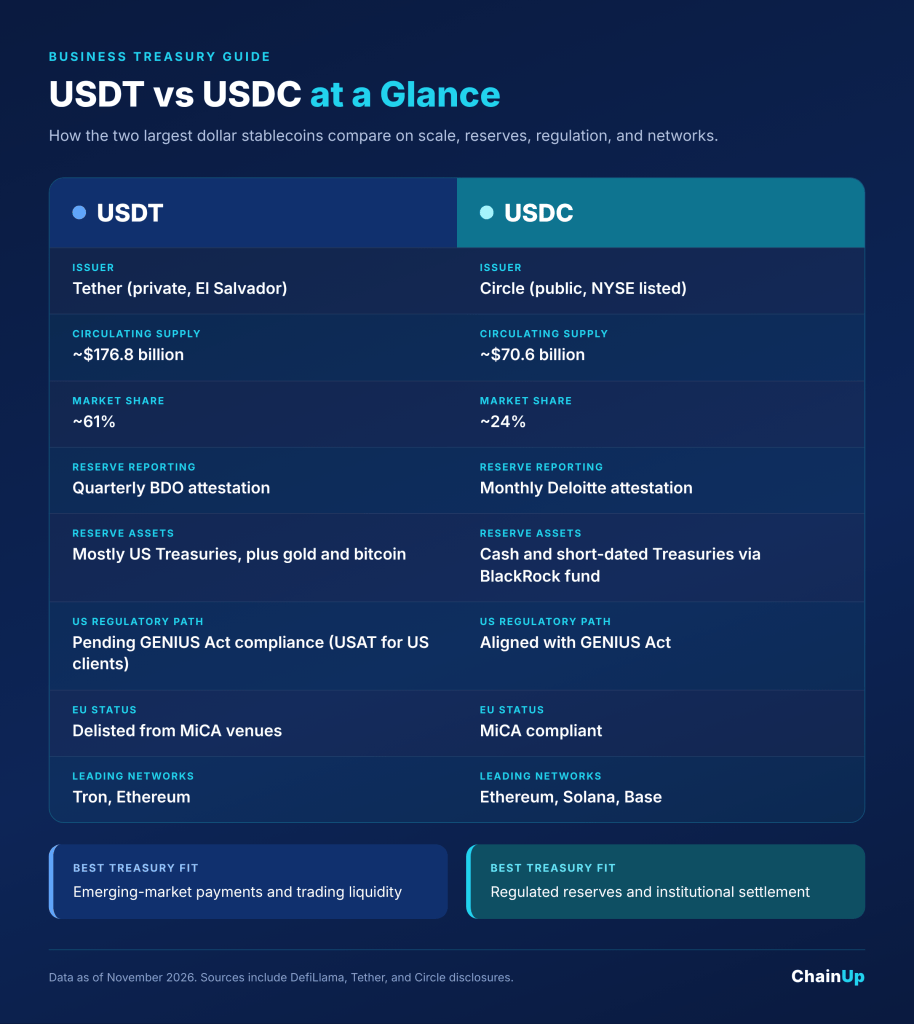
The table below shows how USDT and USDC compare on the factors that treasury and finance teams check most often.
| Comparison Factor | USDT (Tether) | USDC (Circle) |
| Issuer | Tether (private, El Salvador) | Circle (public, NYSE listed) |
| Circulating Supply (Nov 2026) | ~$176.8 billion | ~$70.6 billion |
| Stablecoin Market Share | ~61% | ~24% |
| Reserve Reporting | Quarterly BDO attestation | Monthly Deloitte attestation |
| Reserve Assets | Mostly US Treasuries, plus gold and bitcoin | Cash and short-dated Treasuries via a BlackRock fund |
| US Regulatory Path | Pending GENIUS Act compliance, with USAT for US clients | Aligned with GENIUS Act requirements |
| EU Status | Delisted from MiCA-regulated venues | MiCA compliant |
| Leading Networks | Tron, Ethereum | Ethereum, Solana, Base |
| Best Treasury Fit | Emerging-market payments and trading liquidity | Regulated reserves and institutional settlement |
USDT vs. USDC Reserve Transparency and Redemption Risk
Reserve composition determines whether a corporate treasury can redeem digital dollars rapidly and at par during periods of market stress. While both issuers report full reserve backing, their asset allocations and reporting cadences differ significantly.
Circle holds roughly 86% of USDC reserves in the Circle Reserve Fund (USDXX), an SEC-registered government money market fund managed by BlackRock, with the remainder held in cash at regulated U.S. banking partners. Deloitte issues monthly attestation reports verifying these balances, while BlackRock publishes daily portfolio holdings.
Tether’s Q3 2026 reserve attestation by BDO showed $191.45 billion in assets against $183.5 billion in liabilities. That leaves $7.95 billion in excess reserves. Treasury exposure totaled $132.4 billion. Tether also holds about $19.1 billion in gold and $8.4 billion in bitcoin. These assets add an equity buffer, but they also carry price risk that cash-only reserves avoid.
For corporate treasury policies mandating strict cash-equivalent backing and monthly third-party verification, USDC typically clears internal risk committees and external Big Four audits with minimal friction.
How the GENIUS Act and MiCA Shape USDT vs USDC Compliance
Regulatory alignment has become the sharpest dividing line between the two stablecoins. Under the US GENIUS Act, permitted payment stablecoin issuers must obtain federal or qualified state licensing, back tokens 1:1 with high-quality liquid assets, and refrain from paying direct yield to token holders. USDC was structured directly around this framework.
Tether took a different route. In January 2026, it launched USAT through Anchorage Digital Bank as a dedicated, GENIUS Act-compliant stablecoin for U.S. institutions. Meanwhile, flagship USDT remains offshore and must qualify under foreign issuer equivalence provisions before the law’s statutory transition window closes in mid-2028.
A similar divergence defines the European market. USDC holds full Markets in Crypto-Assets (MiCA) authorization, coming under direct European Banking Authority (EBA) supervision on November 12, 2026. Conversely, USDT has been delisted from MiCA-regulated European exchanges.
What this means for finance leaders is straightforward. Companies with US or EU entities, Big Four auditors, or traditional bank partners face less friction with USDC or USAT. Companies operating across Asia, Latin America, Africa, and the Middle East continue to rely on USDT due to widespread local counterparty acceptance. Tracking global stablecoin regulation helps treasury teams see where this balance will shift next.
USDT vs USDC Liquidity and Network Costs for Global Payments
USDT maintains the deepest global exchange liquidity and circulating supply. Approximately 45% of all USDT resides on the Tron blockchain, where network transaction fees cost fractions of a cent. These low fees make Tron-based USDT the primary payment rail for cross-border remittances, OTC settlement desks, and B2B supplier payments across Southeast Asia, Latin America, and Africa. Enterprise adoption reflects this utility: Hyundai Card utilized USDT for a $20,000 intercompany cross-border settlement between the U.S. and Mexico that cleared in seven minutes.
USDC leads in institutional settlement velocity and multi-chain interoperability. In June 2026, USDC accounted for roughly 70% of a record $1.79 trillion in adjusted stablecoin settlement volume. Circle’s Cross-Chain Transfer Protocol (CCTP) natively burns and mints USDC across roughly 30 blockchains, eliminating third-party bridge risk. Enterprise treasury management systems, such as Kyriba, increasingly display USDC balances alongside traditional fiat bank accounts.
Which Stablecoin for What Use Case? A Business Treasury Decision Guide
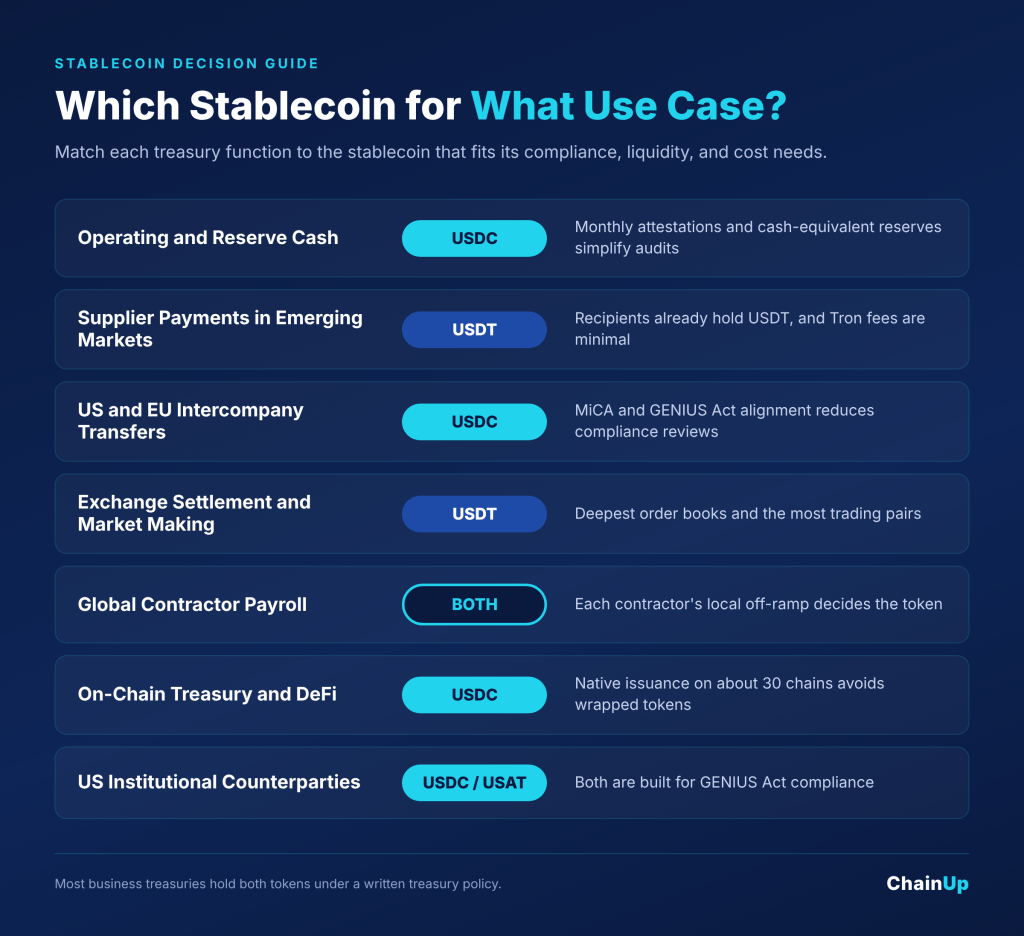
Assigning each stablecoin to a specific treasury function removes guesswork and keeps policies auditable. The guide below matches common corporate use cases to the token that fits best.
| Treasury Use Case | Best Fit | Why It Works |
| Operating and Reserve Cash | USDC | Monthly attestations and cash-equivalent reserves simplify audits |
| Supplier Payments in Emerging Markets | USDT | Recipients already hold USDT, and Tron fees are minimal |
| US and EU Intercompany Transfers | USDC | MiCA and GENIUS Act alignment reduces compliance reviews |
| Exchange Settlement and Market Making | USDT | Deepest order books and the most trading pairs |
| Global Contractor Payroll | Both | Each contractor’s local off-ramp decides the token |
| On-Chain Treasury and DeFi Integrations | USDC | Native issuance on about 30 chains avoids wrapped tokens |
| US Institutional Counterparties | USDC or USAT | Both are built for GENIUS Act compliance |
Each of these flows depends on reliable stablecoin payment infrastructure that connects wallets, on-ramps, and accounting systems.
How to Build a Dual-Stablecoin Treasury Strategy
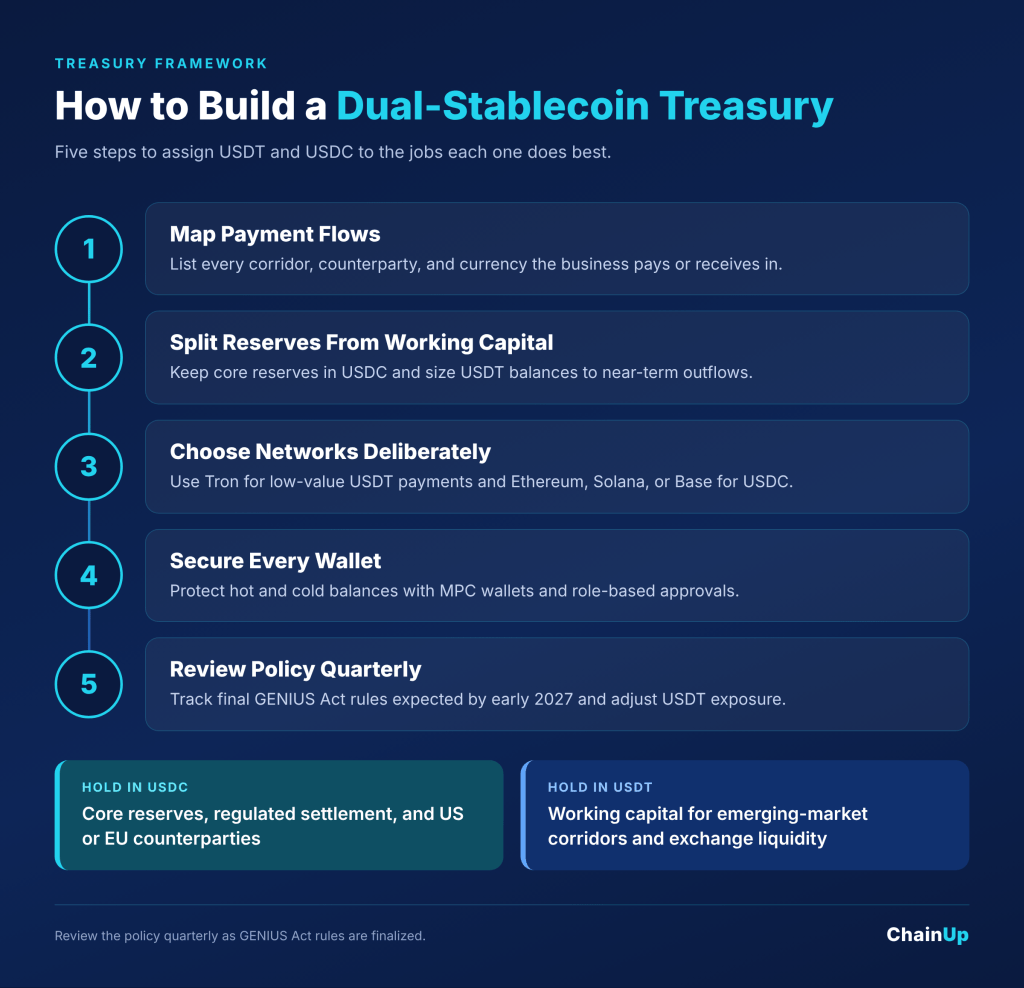
Managing both USDT and USDC works best when governed by clear internal controls. Treasury teams can establish a dual-stablecoin framework in five steps:
- Map payment flows. List every corridor, counterparty, and currency the business pays or receives in.
- Split reserves from working capital. Keep core reserves in USDC and size USDT balances to near-term outflows in USDT-heavy corridors.
- Choose networks deliberately. Use Tron for low-value USDT payments and Ethereum, Solana, or Base for USDC settlement.
- Secure every wallet. Protect hot and cold balances with MPC wallet technology and role-based approval workflows.
- Review policy quarterly. Final GENIUS Act rules from the US Treasury, FinCEN, and OFAC are expected by early 2027 and may change USDT’s US status.
Build an Institutional Custody and Treasury Infrastructure with ChainUp
USDT and USDC are not rivals inside a well-run treasury. USDC anchors regulated reserves and institutional settlement. USDT powers emerging-market payments and trading liquidity. The strongest strategy assigns each token to the use case where it performs best and backs both with secure infrastructure.
To manage multi-stablecoin operations without fragmenting security or compliance, enterprises require custody technology built for regulated workflows. ChainUp Custody provides institutional self-custody infrastructure engineered for corporate treasuries, payment providers, and exchanges:
- Multi-Chain MPC Security: Protects digital asset balances across Tron, Ethereum, Solana, Base, and 200+ networks using Threshold Signature Schemes (TSS) that eliminate single points of key failure.
- Automated Policy & Approval Engines: Enforces role-based access controls (RBAC), transaction velocity limits, and multi-tier sign-offs aligned with internal treasury policies.
- Integrated Compliance & KYT Screening: Connects directly with Trustformer KYT to screen counterparty wallet addresses, monitor transaction risk in real time, and automate Travel Rule compliance.
Whether you are streamlining cross-border vendor payouts or segregating institutional treasury reserves, explore how ChainUp Custody supports scalable, compliant digital asset operations. Request an architecture consultation with ChainUp’s specialists.