

Key Takeaways
- Dollar-pegged stablecoins hold their $1 value because each token is backed one-to-one by cash and short-term U.S.Treasuries that eligible holders can redeem directly from the issuer.
- Attestations confirm that reserves cover token supply on a specific date, while full financial audits evaluate the broader financial statements, systems, and internal controls behind those figures.
- The GENIUS Act makes monthly attested reserve reports mandatory for U.S. payment stablecoins starting January 18,2027, turning reserve transparency into a statutory compliance requirement.
A dollar-pegged stablecoin works on one simple promise: every token in circulation is matched by at least one dollar of safe, liquid assets that holders can redeem from the issuer. Reserves are what back that promise, and attestations and audits are how the market verifies that the promise is being kept.
That verification is about to become federal law in the United States. The Office of the Comptroller of the Currency (OCC) finalized its GENIUS Act payment stablecoin rule on October 21, 2026, with an effective date of January 18, 2027.
The stakes are massive. Total stablecoin market capitalization stands at roughly $300 billion, anchored by USDT at approximately $182 billion and USDC at approximately $72 billion. For exchanges, payment firms, and fintechs holding or settling in digital dollars, understanding how reserves are structured and verified is now fundamental risk management.
How Do Dollar-Pegged Stablecoins Maintain Their $1 Peg?
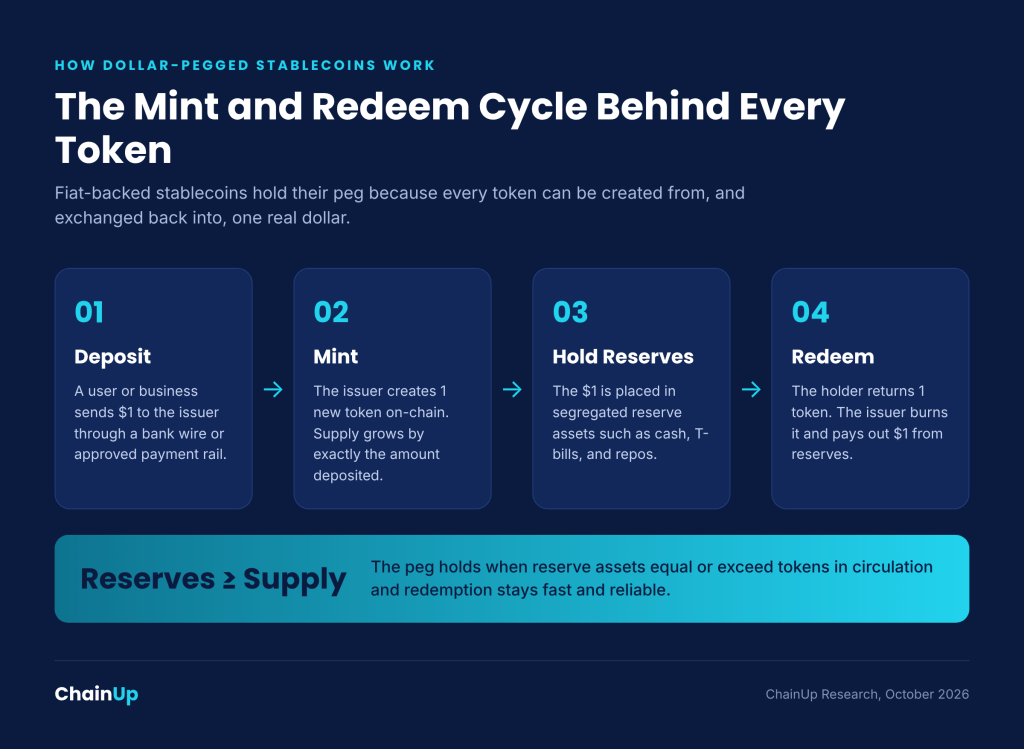
A fiat-backed stablecoin keeps its value through a closed-loop mechanism between the issuer and its customers. Capital comes in, tokens go out, and the process runs in reverse when holders want their fiat dollars back. This loop is the foundation of every stablecoin peg.
The cycle works in four steps.
- Deposit. A business or user sends dollars to the issuer through a bank wire or approved payment rail.
- Mint. The issuer creates the same number of new tokens on-chain, so supply grows by exactly the amount deposited.
- Hold reserves. The issuer places those dollars in segregated reserve assets such as cash and short-term Treasury bills.
- Redeem. A holder returns tokens, the issuer burns them, and dollars are paid out from reserves.
Redemption is also what keeps market prices anchored to $1 via arbitrage. When a stablecoin trades below $1, traders can buy it cheaply and redeem it at $1, and when it trades above $1, they can mint new tokens and sell them, which pulls the price back toward the peg. The loop only works if reserves are real, liquid, and available on demand.
What Assets Qualify as Permitted Stablecoin Reserves?
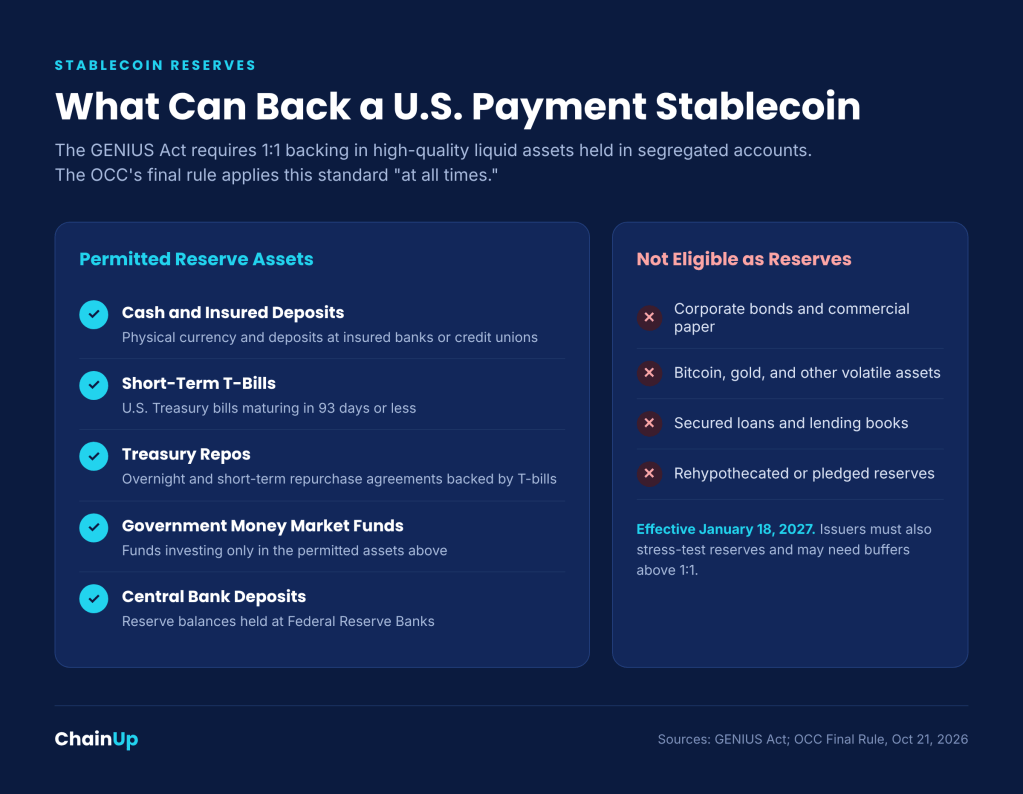
Not every dollar-equivalent asset carries the same risk profile. A reserve portfolio weighted toward long-dated bonds, commercial paper, or volatile assets can lose value or become illiquid during sudden surges in redemption demand. For this reason, regulatory standards strictly define eligible reserve categories.
Under the GENIUS Act framework, permitted reserve assets are restricted to a defined list of high-quality liquid assets:
| Reserve Asset | Why It Qualifies |
| Cash and insured bank deposits | Immediately available for redemptions |
| U.S. Treasury bills maturing in 93 days or less | Low credit risk and minimal price swings |
| Short-term repos backed by Treasury bills | Overnight liquidity with government collateral |
| Government money market funds | Hold only the permitted assets above |
| Federal Reserve deposits | Central bank balances with no credit risk |
The law lists cash, insured deposits, T-bills of 93 days or less, short-term repos on T-bills, approved money market funds, and Fed deposits as eligible reserve assets. Reserves must also sit in separate, bankruptcy-remote accounts.
Many issuers already lean heavily on short-term government debt, which is why tokenized U.S. Treasuries and stablecoin reserves increasingly share the same underlying assets.
Real portfolios still differ. Tether’s reserves are dominated by U.S. Treasury bills but have also included smaller allocations to secured loans, bitcoin, and gold. Assets like these sit outside the GENIUS Act’s permitted list, which is one reason Tether launched a separate U.S.-regulated token, USAT.
Stablecoin Attestation vs. Audit Explained
Reserves only build market trust when verified by independent third parties. Two distinct reporting mechanisms serve this function, and they are frequently confused:
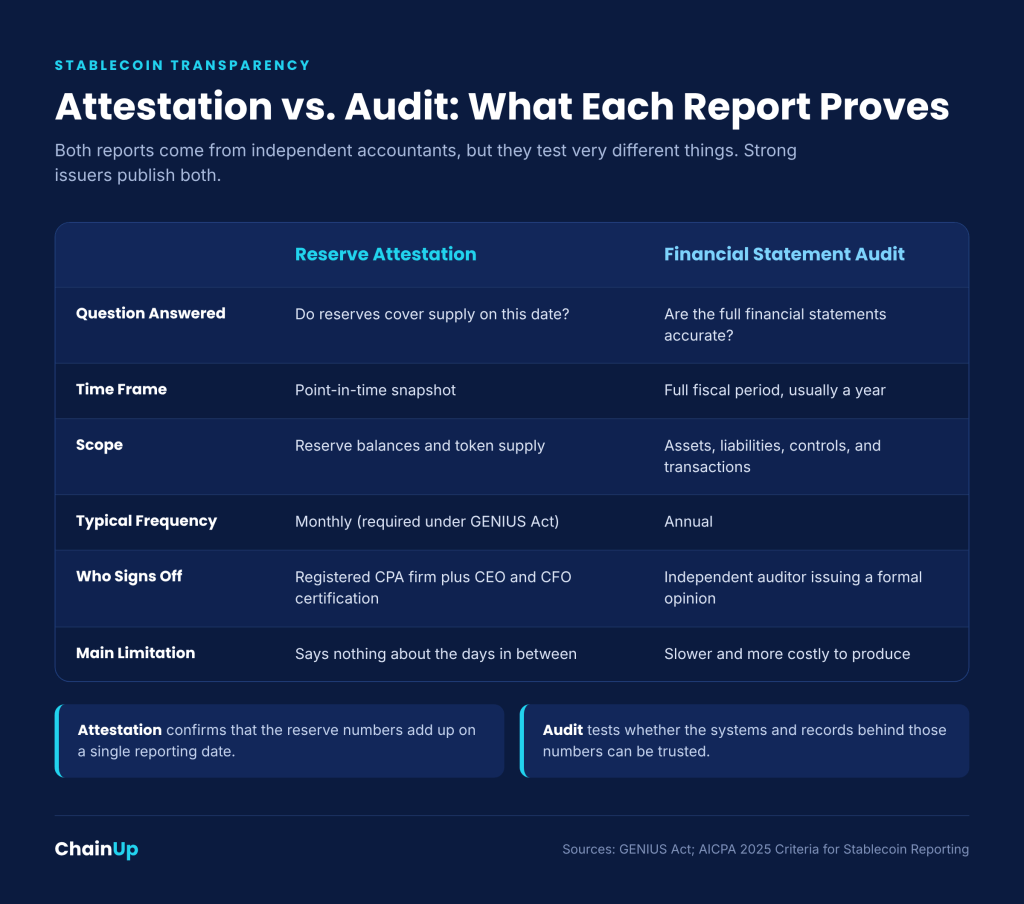
- Reserve Attestation: A targeted, point-in-time examination performed by an independent certified public accounting (CPA) firm. It verifies whether an issuer’s reserve assets equaled or exceeded circulating token supply at a specific date and time.
- Financial Statement Audit: A comprehensive evaluation of the issuer’s broader financial health. A full audit tests historical transactions, corporate balance sheets, accounting controls, and operational systems across an entire fiscal year.
| Comparison Factor | Reserve Attestation | Financial Statement Audit |
| Primary question | Do reserves cover supply on this date? | Are the full financial statements accurate? |
| Timeframe | Single reporting date | Full fiscal period |
| Scope | Reserve balances and token supply | Assets, liabilities, controls, transactions |
| Typical frequency | Monthly | Annual |
| Main limitation | Silent on the days in between | Slower and costlier to produce |
The market’s two largest issuers illustrate these approaches: USDC publishes monthly reserve attestations from Deloitte, while Tether has relied on quarterly assurance reports from BDO Italia alongside periodic independent audits verifying reserve surpluses over liabilities.
Tether recently closed its biggest credibility gap. KPMG completed the first independent Big Four audit of Tether’s reserves, confirming a $6.8 billion surplus over liabilities.
How the GENIUS Act Changes Stablecoin Reserve Reporting
Before the GENIUS Act, U.S. issuers chose their own reporting cadence and standards. State money transmitter licenses imposed no specific requirements for reserve composition, attestation, or redemption. The new federal stablecoin framework replaces that patchwork with fixed rules.
Here are the reporting obligations that matter most for businesses that hold or integrate U.S. payment stablecoins.
- Monthly public reports. Reserve composition is published monthly, examined by a registered public accounting firm, and certified by the issuer’s CEO and CFO.
- Standardized criteria. The AICPA’s 2025 Criteria for Stablecoin Reporting covers reserve composition, token population, redemption terms, and custody arrangements.
- Continuous backing. The OCC’s final rule moves reserve and capital requirements to an “at all times” standard and requires disclosures stating that payment stablecoins are not legal tender, deposits, or federally insured.
- Stress testing. The final rule also introduces stress testing of reserves and, where necessary, reserve buffers.
The full text is available in the OCC’s final rule bulletin. Similar disclosure regimes already apply abroad, as covered in our guide to global stablecoin regulation.
How to Evaluate a Stablecoin’s Reserve Report
Reading a reserve report takes a few minutes once you know where to look. Treasury, risk, and listings teams can use the same checklist before adding a stablecoin to their platform or balance sheet.
- Reserve ratio. Confirm that total reserves equal or exceed tokens outstanding, and note the size of any surplus.
- Asset mix. Check what share sits in cash and short-dated T-bills versus riskier or less liquid holdings.
- Report type and cadence. Look for monthly attestations at minimum, plus an annual audit opinion.
- Accounting firm. Confirm the firm is registered and independent, and note whether a Big Four firm is involved.
- Custody and segregation. Verify where reserves are held and whether they are legally separated from the issuer’s own funds.
- Redemption terms. Review minimum amounts, fees, and processing times, since these decide how well the peg holds under stress.
These factors also explain why some tokens rank higher than others in our list of the safest stablecoins. Strong reserves only help your business if your own infrastructure is equally sound, from the MPC wallets that hold your tokens to the payment workflows that move them.
Institutional Custody and Infrastructure for Stablecoins
Dollar-pegged stablecoins are only as reliable as the reserves behind them and the reports that verify those reserves. Attestations confirm the backing figures on a given date; audits confirm that the financial systems and operational controls can be trusted. Beginning January 2027, federal regulation under the GENIUS Act will mandate this transparency across all permitted U.S. issuers.
For fintechs, payment providers, and exchanges, standardized rules make evaluating stablecoins more straightforward. However, the operational risk shifts directly to your own infrastructure—including key management, wallet architecture, and transaction screening.
Deploying resilient payment rails requires pairing transparent reserve assets with institutional-grade custody. ChainUp provides the core digital asset infrastructure required to issue, accept, and manage stablecoins securely at scale. With white-label non-custodial MPC wallet, automated policy and approval workflows, integrated KYT and AML compliance screening, and segregated custody architectures, ChainUp enables financial institutions and Web3 platforms to navigate evolving regulatory baselines with confidence.
Request a demo with ChainUp’s solutions team to explore institutional custody and infrastructure built for the regulated stablecoin economy.