

Key Takeaways
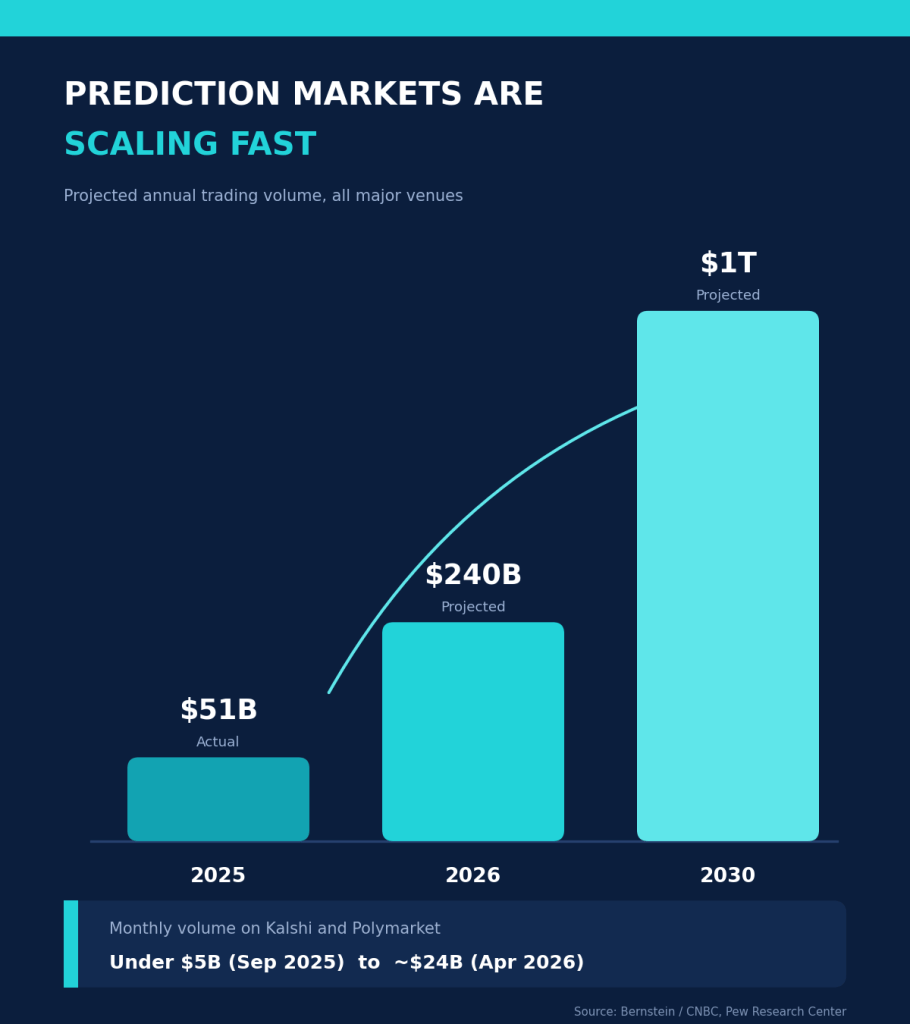
- Prediction market trading volume is projected to reach $240 billion in 2026 and approach $1 trillion annually by 2030, driven by the institutionalization of event derivatives.
- Top-tier exchanges are rapidly consolidating retail liquidity. Operators launching now capture captive market share before multi-product distribution channels close.
- An institutional exchange stack requires an ultra-low-latency matching engine, shared liquidity networks, Multi-Party Computation (MPC) custody, fiat on-ramps, and dynamic Know-Your-Transaction (KYT) compliance.
- Developing an in-house exchange stack requires 12 to 18+ months and millions in upfront capital expenditure, whereas turnkey white label deployment delivers an operational exchange in 4 to 8 weeks.
- White label infrastructure minimizes exposure to evolving cross-border frameworks (CFTC event contract rules, MiFID II, MiCA) by providing configurable jurisdictional perimeters out of the box.
Prediction markets have evolved from niche decentralized experiments into one of the fastest growing sectors in global finance. Wall Street research firm Bernstein projects the sector will reach $240 billion in volume for 2026 and roughly $1 trillion a year by 2030.
A prediction market enables market participants to trade binary outcome contracts priced between $0.00 and $1.00, where clearing prices reflect real-time implied probability.
For sportsbooks, brokerages, and fintech platforms, event contracts provide a high-frequency, risk-neutral fee revenue line. The strategic imperative for operators is no longer conceptual validation, but implementation speed.
Market Consolidation: The Window for New Exchange Operators
The prediction market race is already crowded at the top. Kalshi controls more than 90% of US volume, and combined monthly volume on Kalshi and Polymarket jumped from under $5 billion in September 2025 to about $24 billion by April 2026. For an operator, that creates a hard problem.
Demand is high and the category is still young, so the instinct is to launch as fast as possible, yet a working venue needs a full infrastructure stack before it can take a single trade. The operators who capture this market will be the ones who close that gap quickly.
A slow launch does not just cost time. It cedes users, liquidity, and mindshare to venues that are already live.
Technical Architecture: What Goes Inside a Prediction Market Stack
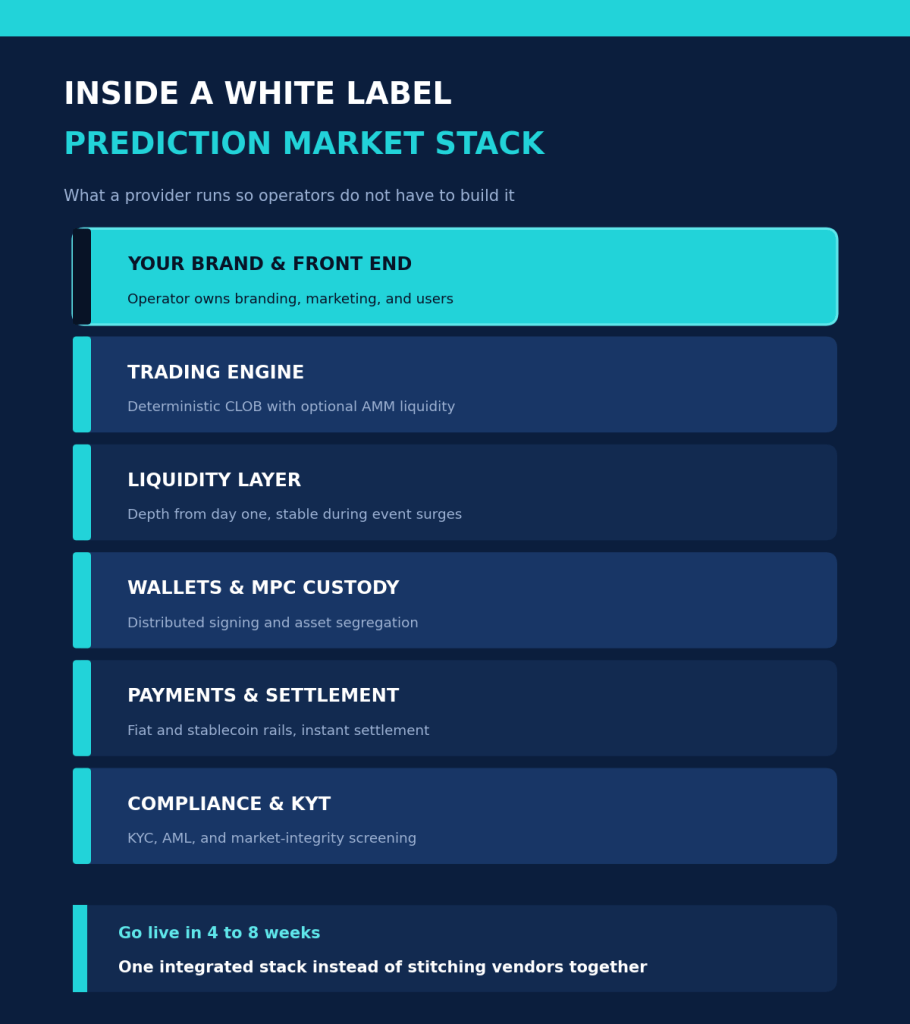
Every prediction market runs on the same core components, no matter which path an operator chooses. Understanding them explains why sourcing the stack is a strategic decision rather than a technical one. A complete stack has several layers that all have to work together from day one.
- A trading engine, usually a central limit order book to match and price contracts.
- A liquidity layer that holds depth so spreads stay tight during event surges.
- User wallets and a white label exchange front end for the trading experience.
- MPC wallet custody, payments, and settlement to move and secure funds.
- Know-Your-Customer (KYC), Anti-Money Laundering (AML), and market-integrity tooling to keep the venue compliant.
Building all of this in-house is the reason a launch can take a year or more. That is why most operators focus less on whether they need the stack and more on how to source it quickly.
Build or White Label at a Glance
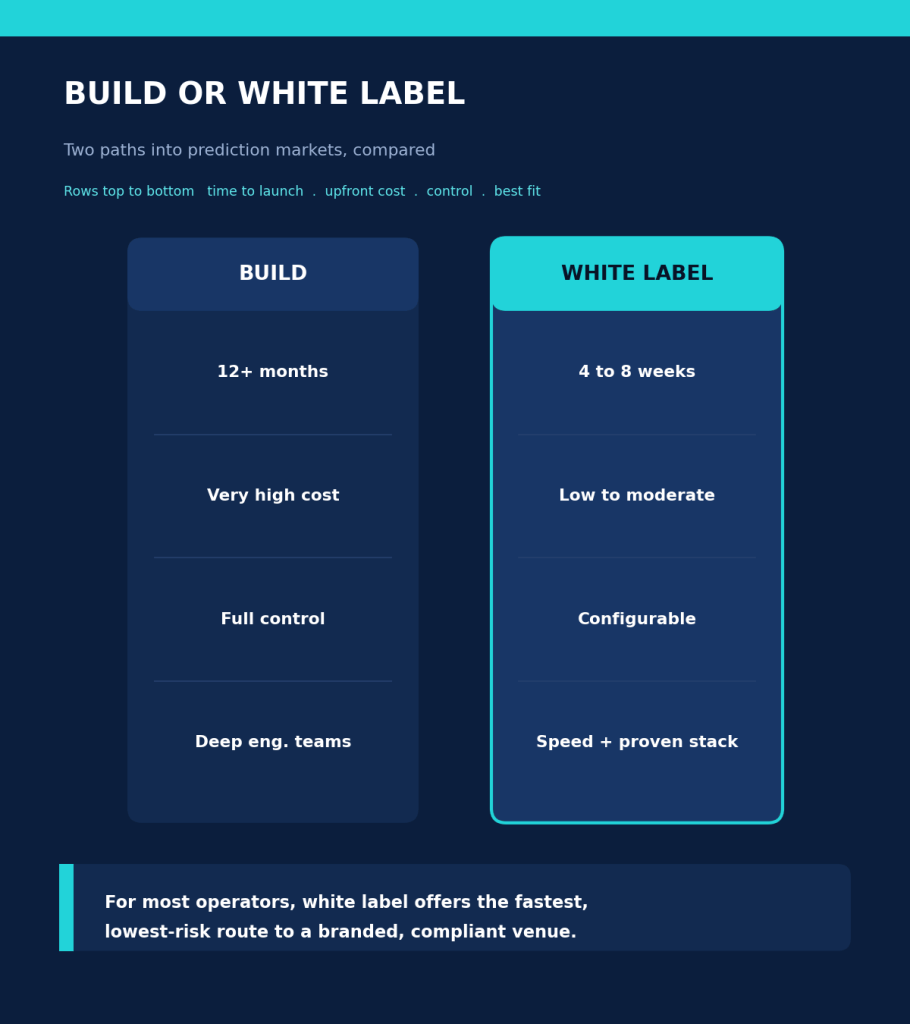
The two paths differ most on time to launch, upfront cost, and how much control you keep. The table below sums up the trade-offs before the deeper breakdown of each route.
| Path | Time to Launch | Upfront Cost | Control | Best Fit |
| Build | 12 months or more | Very high | Full ownership | Large operators with deep engineering teams |
| White Label | 4 to 8 weeks | Low to moderate | Configurable | Operators wanting speed and a proven stack |
Building In-House: High Ownership, High Capital Friction
Building means your team develops the matching engine, settlement logic, oracle resolution, risk tooling, and compliance from the ground up. It offers the most control and no revenue share, which appeals to operators that treat infrastructure as a core asset.
The cost is time and risk, since exchange-grade infrastructure can take years of engineering, testing, and operational tuning before it handles real volume.
The core trade-offs of building are clear.
- Full ownership of the roadmap, data, and margins.
- The slowest route to market, often a year or longer.
- Ongoing cost for security, uptime, and settlement accuracy that never ends.
Building suits large, well-funded operators with mature engineering teams and a long horizon. Most operators entering the outcome economy do not have that window.
Launching via White-Label: Compressed Timelines, Turnkey Execution
White label is the direct alternative to building from scratch. You launch a branded prediction market on infrastructure that a provider builds and maintains, so your team controls the brand, marketing, and customer relationships while the core engine, liquidity, and settlement run underneath.
A white label prediction market platform can go live in as little as four to eight weeks using tested infrastructure, with a central limit order book, optional AMM liquidity, risk tooling, payments, and compliance already in place.
A strong white label stack delivers several things out of the box.
- A deterministic order book with optional AMM support for depth from day one.
- Instant settlement and stable execution during the traffic surges that event climaxes create.
- Compliance integrations and market controls that are already tuned for live venues.
White label suits exchanges, brokers, sportsbooks, and fintech apps that want event contracts without a multi-year build. It is the route most operators take to catch the current demand window.
Financial Breakdown of Each Path
Cost is not only the price tag. It is the mix of upfront spend, time to revenue, and ongoing burden. The estimates below are directional, since real figures depend on scope, region, and event mix, but the relative pattern holds across the two paths.
| Path | Upfront Spend | Time to First Revenue | Ongoing Cost |
| Build | Highest, often into the millions | 12 months or more | Full engineering, security, and compliance payroll |
| White Label | Lowest, a setup fee plus revenue share | 4 to 8 weeks | Shared with the provider, scales with volume |
For most operators, white label shifts the largest cost from fixed upfront capital to a variable fee that tracks revenue, which lowers the risk of entering a new market.
Licensing and Regulatory Requirements by Region
Regulation is where prediction market launches most often stall or fail. Rules differ sharply by region and change quickly, so a compliant model in one market can be illegal in the next. Getting this wrong does not just slow a launch. It can end it.
Here is how the landscape looks across major regions.
- United States. The CFTC has moved toward accommodating event contracts, with an advance notice of proposed rulemaking and a June 2026 proposed rule, while several states keep challenging sports contracts in court. The result is a patchwork that rewards operators who can adapt fast.
- European Union. There is no unified framework. MiFID II and ESMA binary options limits apply, MiCA constrains the crypto rails underneath, and countries including France and Poland have restricted access while Gibraltar issued an early license.
- Rest of the world. Licensing ranges from open to prohibited, so each market needs its own review of gambling, derivatives, and crypto rules.
As rules keep moving, federal regulatory clarity is expanding the addressable market in some regions while enforcement tightens in others. That is the strongest reason to build on infrastructure that already understands the market, with real-time monitoring and market-integrity screening built in rather than bolted on later.
How to Choose the Right Prediction Market Solution
The right path depends on your timeline, your capital, and how much of the stack you want to own. Beyond the build, buy, or white label choice, a few factors decide whether a launch succeeds.
Weigh these factors before you commit to a solution.
- Time to market. Event windows are short, so a launch that slips by months can miss the demand entirely.
- Liquidity model. Ask any provider how depth is sourced and what happens when a pricing source goes offline.
- Market integrity. As volume grows, insider trading and manipulation controls move from a nice-to-have to a survival requirement.
- Custody and security. Distributed signing and institutional-grade custody protect user funds and platform reputation.
- Provider fit. When you evaluate white label providers, favor a full ecosystem over a single tool, and study what Kalshi’s infrastructure teaches about operating at scale.
For most operators, white label wins because it compresses time to market while covering liquidity, custody, and compliance in one stack.
The Bottom Line for Operators Entering Prediction Markets
Prediction markets are scaling toward a trillion-dollar opportunity, and the operators who capture it will be the ones who launch while demand is high and the rules still favor fast movers. Building offers control at the cost of years, while white label offers the fastest, lowest-risk path to a branded, compliant venue. For most teams, that makes white label the clear starting point.
ChainUp built its Hermes prediction market infrastructure for exactly that path, backed by a full infrastructure stack of exchange software, MPC wallet, deep liquidity, and KYT compliance. Operators get differentiators that matter from day one.
- A four-week go-to-market with zero R&D overhead, so your team focuses on brand and user acquisition instead of engineering.
- A shared liquidity pool from launch that removes the cold-start problem most new venues face.
- Four built-in revenue streams, spanning trade and settlement fees, market-making spreads, yield on locked collateral, and B2B listing fees.
- A non-custodial design on the high-throughput Monad chain, with a CLOB engine, advanced order types, gasless trading, and instant payouts that skip the usual one to six hour oracle delay.
- Operator controls that run the business, including a granular fee engine, an event creation wizard, role-based staff access, and automated risk workflows.
Talk to the ChainUp team to launch your branded prediction market in weeks, not years.