

Key Takeaways
- Crude oil perpetuals let you trade long or short on WTI or Brent spot benchmarks without contract expirations, traditional brokers, or physical delivery.
- Positions are fully collateralized, margined, and settled in stablecoins (primarily USDT) under pairs like CL/USDT or OIL/USDT.
- To start trading, choose a crypto exchange offering commodity perps (CL/USDT or OIL/USDT), fund with USDT, select leverage and margin mode, and set a stop-loss before opening.
- Price parity with spot oil is maintained via periodic funding payments calculated on the notional position size, not just your margin.
- Trade continuous commodity volatility around high-impact events like OPEC+ meetings and EIA inventory releases without weekend trading halts.
- Oil volatility can surge rapidly during geopolitical conflict. Always set a hard stop-loss and use lower leverage than crypto-native pairs.
When crude oil implied volatility hit 78% on average following geopolitical conflict earlier in 2026, traders scrambled for faster and more flexible instruments to react. Daily Brent crude implied volatility reached as high as 106% on a single day in March 2026, levels not seen since the onset of COVID-19.
That kind of environment helps explain why perpetual futures continue gaining traction across asset classes. More traders are turning to them because they offer round-the-clock access, leverage, and continuous exposure without the rollover burden of expiring contracts.
This matters because it shows how perpetuals are evolving from a crypto-native product into a broader trading format for fast-moving global markets, including commodities like oil.
What Are Crude Oil Perpetual Futures?

Crude oil perpetual futures (perps) are non-expiring, crypto-settled derivative contracts that track the spot prices of West Texas Intermediate (WTI) or Brent crude oil. By replacing traditional physical delivery mechanics with synthetic on-chain pricing logic, crude oil perps grant traders continuous commodity price exposure directly within the digital asset ecosystem.
Core Operating Mechanics
At their core, crude oil perpetual futures rely on stablecoin margining rather than traditional physical delivery mechanics or fiat clearinghouses. Positions are fully collateralized, calculated, and settled in stablecoins—most commonly USDT—and typically listed under tickers such as CL/USDT or OIL/USDT. To maintain precise valuation, exchange pricing, margin requirements, and automated liquidation triggers depend on real-time price feeds (oracles) linked directly to underlying benchmark spot prices.
This synthetic structure enables continuous 24/7/365 market availability without the overnight or weekend halts characteristic of legacy commodity exchanges. Consequently, market participants can hedge against high-impact macroeconomic catalysts—including Organization of the Petroleum Exporting Countries (OPEC) output quotas, U.S. Energy Information Administration (EIA) inventory reports, or supply-chain disruptions—in real time, eliminating the severe gap risks associated with traditional market closes.
Crude Oil Perps vs. Traditional Commodity Futures
- Contract Expiration & Rollover: Traditional futures require monthly or quarterly contract rollovers, incurring execution costs and calendar spread risks. Perpetual futures have no expiry date, allowing traders to hold positions indefinitely provided margin requirements are met.
- Settlement Mechanism: Traditional contracts settle via physical delivery of crude oil barrels or fiat clearinghouses. Perps are strictly cash-settled in USDT stablecoins.
- Price Anchoring Method: Traditional futures converge to the physical spot price at contract expiry. Perpetual futures maintain price parity with spot benchmarks via a periodic funding rate mechanism, typically calculated every 8 hours to balance long and short positions.
- Market Hours & Access: Traditional oil trading is restricted to specified exchange operating hours on venues like CME and ICE via regulated brokerage accounts with strict KYC. Perps trade 24/7/365, accessible via crypto wallets and exchange accounts with stablecoin margin.
- Institutional Liquidity & Volatility: Traditional futures liquidity is fragmented across multiple monthly contract expiration dates and bound by session hours. Perpetual futures aggregate continuous global liquidity into a single non-expiring contract allowing immediate execution during peak macro volatility, such as when Brent crude implied volatility surged to 106%.
How Funding Rates Work in Oil Perps
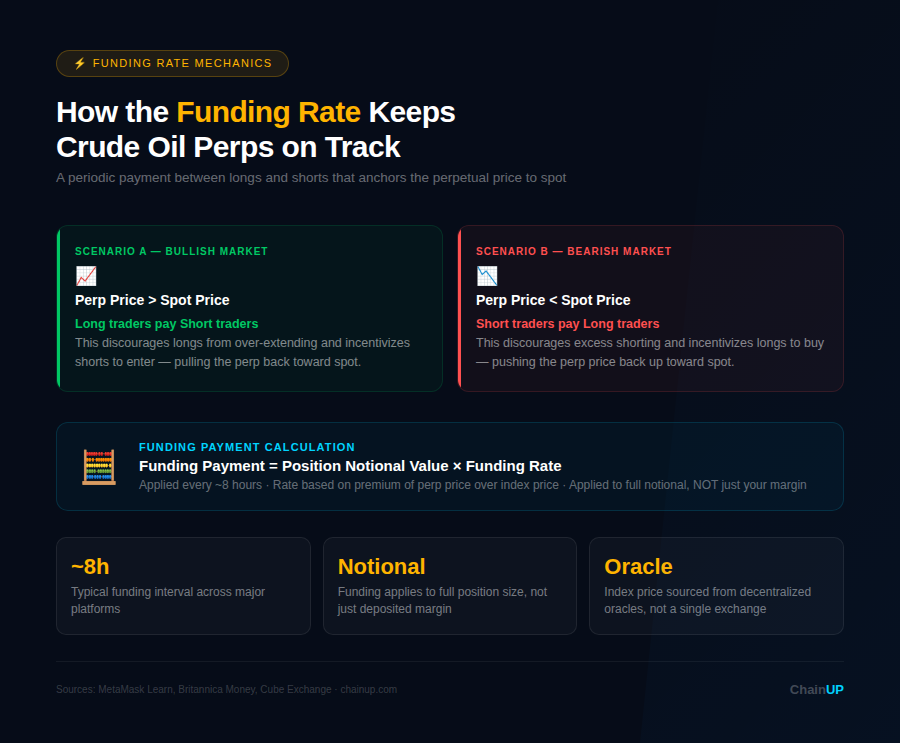
As a perpetual contract never expires, exchanges use a mechanism called the funding rate to keep the perp price aligned with the underlying spot price. It’s a small recurring payment exchanged directly between traders on opposite sides of the market — not a fee paid to the exchange — settled every 8 hours on most platforms.
The direction of the payment depends on where the perp is trading relative to spot:
| Condition | Who Pays | Who Receives |
| Perp trades above spot | Long traders | Short traders |
| Perp trades below spot | Short traders | Long traders |
The logic is simple. When the perp trades at a premium to spot, longs pay a fee to hold their position, which discourages new longs and encourages new shorts — pulling the perp price back down toward spot. The opposite happens when the perp trades at a discount.
The Detail Most Traders Miss: Funding Applies to Notional Value, Not Margin
This is where holding costs quietly erode profits. The funding rate is charged on your position size (notional value), not the collateral you posted.
Example: You open a $50,000 long WTI crude perp position using $5,000 of margin at 10x leverage. If the current funding rate is 0.01% every 8 hours (a typical figure during aligned markets):
- Funding cost per 8 hours = $50,000 × 0.01% = $5
- Daily cost (3 funding periods) = $15
- Weekly cost = $105
- Annualized = ~10.95%
If the funding rate spikes to 0.05% per 8 hours during a strong bullish trend — common when everyone piles into the same side — that same position costs $75/day or $525/week. On $5,000 of margin, that’s 10.5% of your collateral per week just to hold the position.
Why This Matters for Crude Oil Perps Specifically
Crude oil markets move on scheduled catalysts — OPEC meetings, EIA inventory reports, geopolitical announcements — and traders often want to hold positions through these events. But when sentiment is one-sided ahead of a catalyst (e.g., everyone long ahead of an expected OPEC supply cut), funding rates can climb sharply. You can be directionally right on the trade and still lose money if you underestimated the funding cost of holding through the event.
Before entering any perp position, check three things:
- The current funding rate for the pair
- The recent funding rate history (has it been spiking or stable?)
- Your expected holding period, then multiply the funding rate through it
If the annualized funding cost eats more than a third of your expected profit, the trade isn’t worth the leverage.
What Moves the Crude Oil Market

Trading crude oil perps effectively means understanding what moves oil prices. These are the primary catalysts that drive significant volatility:
- OPEC production decisions — supply cuts or increases directly shift the supply-demand balance
- EIA weekly inventory data — larger-than-expected stockpiles typically push prices down
- Geopolitical tensions — conflict in oil-producing regions drives supply risk premiums
- U.S. dollar strength — oil is priced in USD, so a stronger dollar generally pressures prices lower
- China demand outlook — as the world’s largest crude importer, shifts in Chinese demand move global prices
Monitoring these events in real time gives traders a structural edge, particularly around high-impact data releases where crude oil volatility tends to spike.
Step-by-Step: How to Trade Crude Oil Perpetual Futures
The process is straightforward once you understand the basics. Here is a step-by-step overview:
- Choose a platform that offers commodity perpetual futures with USDT-margined contracts
- Fund your account with USDT or another supported stablecoin
- Navigate to the futures market and search for the WTI crude contract (CL/USDT or similar)
- Select your leverage and margin mode before opening any position
- Set a stop-loss to cap downside, particularly given oil’s tendency for sharp intraday moves
- Monitor your funding rate exposure, especially if holding positions overnight or across multiple days
Platforms that support perpetual contract DEXes have made this process increasingly accessible, removing the brokerage infrastructure that traditional futures require.
Real-World Asset (RWA) Perpetuals Explained
If you’ve followed the steps above, you now know how to trade crude oil perps. What’s worth understanding is that crude oil is just one example of a much broader category emerging in crypto derivatives: perpetual futures that track real-world assets (RWAs) rather than crypto-native tokens.
Alongside oil, the same instrument type now covers gold, natural gas, equities and stock indices, foreign exchange pairs, and tokenized Treasury yields — with more markets launching each quarter. The mechanics you just learned for trading crude carry over directly to any of them.
For traders, the appeal is straightforward. Traditional futures on these assets are gated by geography, market hours, broker approvals, and minimum account sizes. Getting exposure to WTI crude or the S&P 500 through a regulated broker means paperwork, capital requirements, and trading only during exchange hours. RWA perpetuals collapse all of that — anyone with a stablecoin balance and a wallet can take long or short exposure, 24/7, without going through an intermediary.
How RWA Perpetuals Actually Work
An RWA perp does not deliver the underlying asset. A trader holding a long WTI perp isn’t accumulating barrels of oil; they’re holding a contract that tracks the price of oil using an oracle feed, with all settlement happening in stablecoins. The same is true for a long S&P 500 perp — the contract references the index, but there’s no equity being bought or delivered.
Three structural models are emerging:
- Synthetic perps — the most common. The contract references off-chain prices through an oracle (Chainlink, Pyth, or similar), with stablecoin settlement. This is how most crude oil, gold, and equity perps work on major exchanges today, including the CL/USDT contract you’d trade for WTI.
- Token-backed perps — the contract uses tokenized real-world assets as collateral or as the reference basis (for example, using a tokenized Treasury fund like BlackRock’s BUIDL as margin).
- Hybrid models — trade execution stays on-chain while pricing and matching rely on external market data or institutional liquidity providers.
The practical trading experience is identical across all three, and identical to what you’d do for crude oil: deposit stablecoins, choose leverage, open a long or short position, pay or receive funding, close when done.
What This Opens Up for You
Once you’re comfortable with the crude oil workflow, the same account gives you access to a much wider menu. Three practical implications:
- Cross-asset strategies get simpler. Long crude, short an oil-sensitive currency, hedge with gold — all from one account, one collateral pool. Previously this would have required separate accounts at multiple brokers across multiple asset classes.
- Hedging expands. A crypto portfolio can be hedged against macro shocks (dollar strength, commodity spikes, equity drawdowns) using perps on the same platform, without moving capital into a traditional brokerage.
- Your skills transfer directly. Funding rates, margin modes, liquidation math — everything you learned for crude oil perps works identically for a gold perp, an S&P perp, or a EUR/USD perp. Only the catalysts and volatility patterns change.
What to Watch Out For
RWA perps introduce a few risks that do not exist in pure crypto perps. Worth understanding before you size up beyond crude oil:
- Oracle risk is amplified. Because the reference asset trades on external venues (CME for WTI, NYSE for equities), the perp depends entirely on the oracle accurately reflecting that off-chain price. Feed delays, outages, or manipulation can trigger unfair liquidations — especially during major news events when the underlying is moving fastest.
- Weekend and off-hours gaps. Traditional markets close overnight and on weekends, but the perp keeps trading. When the underlying reopens, gap moves can trigger sudden funding rate spikes or liquidation cascades before you can react. Equity index perps are especially exposed to this every Sunday night into Monday open.
- Liquidity is thinner than crypto pairs. Even the biggest RWA perps (WTI crude, gold, S&P) trade at a fraction of BTC or ETH perp volume. Slippage on larger orders and wider spreads during volatile periods are still common. Test with smaller size before committing meaningful capital.
- Regulatory availability varies. RWA perps referencing equities or FX pairs may be restricted in certain jurisdictions, particularly the US, UK, and parts of Europe. Always check platform terms before depositing.
The Future of On-Chain Commodity Trading
The convergence of commodity markets and crypto derivatives infrastructure is accelerating. Binance’s crude oil perpetual futures amassed over $1 billion in trading volume within their first 24 hours of trading, with the WTI pair (CL/USDT) alone driving $760 million of that volume. That kind of debut signals real appetite from both institutional and retail participants looking for crypto-native commodity exposure — and the same growth pattern is repeating across gold, natural gas, and equity index perps as more venues list them.
For traders, the question isn’t whether crude oil perps are here to stay. It’s which platforms can actually handle them well. Matching engine performance, oracle reliability during scheduled catalysts like OPEC meetings and EIA releases, insurance fund depth, and liquidation logic are what separate a venue that gives you fair fills during volatility from one that liquidates you on a bad price print.
How to Evaluate a Commodity Perp Platform
Before allocating margin to trade oil perps, ensure the venue meets these operational standards:
- Robust Engine Throughput: Zero order rejections during high-traffic news releases.
- Aggregated Mark Pricing: Resilient oracles that reference composite spot feeds to buffer against manipulation or stale quotes.
- Graduated Liquidation: Tiered liquidation models that close positions incrementally rather than wiping entire collateral pools at once.
Pro Tip: Look into the exchange’s underlying tech stack. Venues built on recognized institutional-grade white-label providers—such as ChainUp, which powers derivatives systems and risk controls across hundreds of platforms globally—typically deliver the execution speed, deep order-book connectivity, and oracle stability required for fast-moving commodity markets.


