


Key Takeaways
- Prediction markets are now an exchange-grade product vertical. Kalshi earned $430M in fees during a six-week World Cup window, Polymarket crossed $1B in annualized revenue, and New York Stock Exchange (NYSE), Intercontinental Exchange (ICE), and CME have all entered the category.
- Volume is seasonal and unforgiving; revenue concentrates around major events, and operators who are not live before a window opens miss it entirely. The next window is U.S. midterms on November 3, 2026.
- Six components make up the stack, but two of them, oracle resolution and collateral custody, are where incidents actually concentrate and where failure is unrecoverable. Everything else fails gracefully; these don’t.
- Most operators are launching on white-label prediction market infrastructure rather than building from scratch, because a 12-to-24-month custom build with a full audit cycle doesn’t align with a fixed event calendar that a 4-to-12-week white-label deployment does.
Prediction markets have rapidly evolved from niche trading venues into an exchange-grade product vertical. The 2026 FIFA World Cup served as the industry’s major breakout moment, shattering all previous volume and revenue records.
Key market leaders Kalshi and Polymarket both experienced exponential growth during this event:
- Kalshi: Generated over $430 million in fee revenue during a single six-week tournament window, far exceeding its cumulative revenue since launch.
- Polymarket: Reported annualized revenue exceeding $1 billion, with daily platform volume quadrupling during the event.
For exchange operators, these figures signal a critical shift: prediction markets now represent a high-value opportunity, provided infrastructure can handle event-driven surge capacity.
What Are Prediction Markets?
A prediction market is a trading venue where participants trade event-based outcome tokens to forecast future results. These platforms provide real-time, price-based probability estimates for a wide range of real-world events, from elections to macro-economic data.
Key Mechanics:
- Outcome Tokens: Participants buy and sell tokens that represent shares in specific event outcomes.
- Implied Probability: Share prices function as probability estimates. A contract trading at $0.72 reflects a market-consensus 72% probability of that outcome occurring.
- Settlement: Upon event resolution, winning tokens redeem at $1.00. Losing tokens expire at zero.
- Settlement Rails: On-chain markets use smart contracts to automate payouts, while regulated centralized exchanges manage settlement under official oversight (e.g., Commodity Futures Trading Commission CFTC).
The Importance of Event Contracts
The core instrument in any prediction market is the “event contract.” These define the resolution question, source, expiry, and collateral. Because contract wording dictates whether settlement is seamless or disputed, precise contract drafting is a critical operational task, not just a product detail.
The Scale of the Opportunity and Upcoming Catalysts
Sector-level volume gives the clearest picture of trajectory. Total prediction market volume crossed $130 billion through June 2026, against roughly $50 billion across all of 2025. Bernstein projects the full-year 2026 figure at approximately $240 billion.
Capital markets have priced that trajectory. Kalshi raised $1 billion in May 2026 at a $22 billion valuation and has publicly weighed an IPO. Polymarket was valued at $15 billion in a March 2026 round, with NYSE investing $600 million. Rothera, a Susquehanna and Robinhood joint venture, launched in June 2026 and captured roughly 7% of U.S. prediction market volume within its first month, which is the clearest available signal that a well-capitalized entrant can take share quickly in this category.
The honest constraint: event windfalls do not automatically retain
Post-tournament data complicates the growth story, and operators should model it. Polymarket’s daily revenue fell more than 40% after the final. Across all three major platforms, the World Cup surge behaved like a short-term event windfall rather than a permanent step-change in baseline activity. Of roughly 194,000 wallets that traded the tournament on Polymarket, about 130,000 finished at a loss, a 66.7% loss rate that creates a real retention problem heading into the next cycle.
The operator implication is direct: acquisition during an event window is cheap and retention after it is expensive. Platforms that treat a major event as a customer acquisition moment, with a product roadmap ready to hold those users through the quieter weeks, capture materially more lifetime value than platforms that treat it as a volume moment.
Next window: the U.S. midterm elections, November 3, 2026
The midterms represent the next potential event window at World Cup scale, and they’re structurally different from a sports tournament in ways that could favor prepared operators.
- Longer runway. A tournament concentrates volume into six weeks. An election cycle can build across months, with primaries, debates, polling releases, and redistricting rulings each capable of repricing contracts. Kalshi and Polymarket already list more than 500 active midterm markets.
- Genuine two-sided uncertainty. Senate control has traded close to a coin flip, with Democrats crossing above Republicans for the first time in the contract’s history. Contested outcomes tend to generate far more volume than lopsided ones.
- Depth beyond the headline contracts. Beyond House and Senate control sit 435 House races, 35 Senate seats, 36 governorships, plus ballot measures — a long tail of contracts that could suit operators with efficient market-creation tooling.
- Higher resolution risk. This is the part that matters architecturally. A soccer match has an unambiguous result within 90 minutes. An election can involve recounts, certification delays, litigation, and independents whose caucus decision isn’t known on election night. Election contracts have the potential to stress the oracle and dispute layer in ways sports contracts don’t.
Category expansion may continue past November. Elections were a comparatively small share of Kalshi’s May 2026 volume, roughly $174 million against $10.44 billion in sports. The growth categories operators are exploring include macro data events (CPI prints, Federal Reserve decisions), earnings outcome contracts, and regulatory decision markets — categories that could attract institutional traders with the capital and analytical framework to price complex distributions.
How Prediction Markets Work: The Six-Component Architecture Stack
Understanding prediction markets at a product level is one thing. Building or licensing the infrastructure is another. The stack has six interdependent components, and each requires an explicit architectural choice. But those choices are downstream of one decision that has to come first.
First decision: which venue model
Before any component is specified, an operator selects a venue model. That choice determines who holds custody of collateral, who has authority to resolve a contract, where liquidity comes from, and how long licensing takes. Every subsequent decision in this section inherits from it.
Two live implementations anchor the spectrum, and they are worth understanding as engineering approaches rather than as competitors.
Polymarket represents the decentralized model. Collateral sits in smart contracts rather than on an operator balance sheet, so the platform is non-custodial. Resolution runs through a decentralized oracle, historically UMA’s optimistic oracle, where a proposed outcome stands unless a bonded party disputes it within a defined window. Liquidity is sourced from independent LPs and protocol incentives. The operator does not have unilateral authority to overturn a resolution, which is a design feature, not an omission.
Kalshi represents the regulated centralized model. It operates as a CFTC-designated contract market in the United States. Collateral is custodial, held by the exchange under regulatory capital and segregation requirements. Resolution authority sits with the exchange, applying published rules to a designated source. Liquidity comes substantially from contracted market makers rather than open Liquidity Provider (LP) participation. Its scale is a direct product of this posture: $53.53 billion in World Cup volume, and three million new users during the tournament, flowed through a venue that U.S. institutions could touch without regulatory ambiguity.
A hybrid model sits between them: on-chain settlement rails with an oracle that has an administrative override path, used by operators who want on-chain transparency while retaining the ability to intervene in a contested resolution. Most operators licensing infrastructure today land here or in the regulated centralized column.
Neither model is technically superior. They optimize for different constraints, and the comparison below is the practical decision matrix.
| Dimension | Decentralized (Polymarket-style) | Regulated Centralized (Kalshi-style) | Hybrid |
|---|---|---|---|
| Custody model | Non-custodial, collateral held on-chain in smart contracts | Custodial, operator-held under regulatory segregation rules | Mixed; on-chain collateral with operator-controlled reserve |
| Resolution authority | Decentralized oracle with bonded dispute window (e.g. UMA) | Exchange-controlled against published resolution rules | Oracle-first with documented admin override |
| Regulatory posture | Varies by jurisdiction; active CFTC and state-level scrutiny in the U.S. | CFTC-regulated designated contract market in the U.S. | Jurisdiction-dependent; commonly offshore licensing |
| Liquidity source | Independent LPs and protocol incentives | Contracted market makers and operator market-making | Combination of seeded AMM and contracted makers |
| Revenue model | Protocol fee share on trading and redemption | Per-contract transaction fees and spread capture | Multiple streams; fee share plus transaction fees |
| Recourse for users | Limited; dispute resolution is protocol-level | Exchange complaint process plus regulatory recourse | Operator-defined, contractually specified |
| Time to launch | 3 to 6 months to build; weeks to license | 12 to 24 months including licensing | 6 to 12 months; 4 to 12 weeks if licensing |
The trade-off stated plainly: decentralized venues have fewer regulatory touch points but carry more oracle risk and thinner user recourse. Regulated centralized venues carry licensing cost and ongoing compliance overhead but offer cleaner operator control over resolution and access to institutional flow. The World Cup numbers suggest the regulated path currently captures more volume; the decentralized path currently reaches more jurisdictions.
1. Smart contracts
Smart contracts handle market creation, collateral custody, outcome token issuance, and automated payout. While the logic is straightforward in principle, the implementation surface area is large. Contracts must handle collateral deposits securely, mint and burn outcome tokens correctly, and execute payouts without failure at resolution.
Audit cost belongs in the launch budget. A single unaudited contract vulnerability can result in fund loss and platform closure. Operators building from scratch should budget for at least one independent security audit before going live. Operators licensing white-label infrastructure inherit audited contract infrastructure, which materially compresses both risk and timeline.
Model difference: Decentralized venues carry the full contract surface, since the contract is the platform. Regulated centralized venues run much of the matching and custody logic off-chain in conventional exchange systems, shifting risk from contract exploit toward operational and regulatory failure. Hybrid builds carry both.
2. Oracles and resolution
An oracle is the data feed that tells the settlement layer what happened in the real world; it is the highest-risk dependency in the stack.
Operators must decide which data sources to designate, how to aggregate multiple independent feeds, what dispute window to allow before resolution finalizes, and what procedure applies when sources disagree. A single oracle source creates a single point of failure. Aggregating independent feeds improves settlement integrity but requires more complex contract logic and a longer settlement path.
Ambiguous resolution wording compounds oracle risk. Resolution criteria must be written to be objectively verifiable—naming the specific source and timestamp—rather than interpretable.
Model difference: Decentralized venues resolve through bonded dispute mechanisms where economic incentives police accuracy. Regulated centralized venues resolve by exchange determination against published rules, which is faster and more predictable but places reputational and regulatory liability squarely on the operator.
3. AMMs, order books, and liquidity
Thin liquidity is an operator problem, not a market problem. Wide spreads reduce trader incentive, which reduces volume, creating a self-reinforcing cycle. How an operator structures liquidity at launch determines whether the market bootstraps.
There are two primary models:
- Automated market makers (AMMs): Pool liquidity and price outcomes along a bonding curve, enabling trading without a deep order book on day one.
- Order book matching: Requires sufficient two-sided participation to generate tight spreads, but scales better at institutional size and supports more complex order types.
Model difference: Decentralized venues typically bootstrap with an AMM and LP fee incentives, accepting wider spreads early. Regulated centralized venues contract designated market makers from launch, producing tighter spreads and better institutional execution but carrying fixed costs regardless of volume.
4. Settlement assets and custody
The default settlement asset for most crypto-native prediction markets is a fiat-pegged stablecoin, typically USDC or USDT. Stablecoin settlement removes the risk of volatile collateral dropping in value before resolution.
Custody of collateral during the trading window is a heavy operational decision. For platforms holding user funds, wallet infrastructure must meet strict security standards, including key management and segregation of operational funds. White Label MPC Wallet infrastructure can address this without requiring operators to build from the ground up.
Model difference: Non-custodial venues avoid the custody obligation almost entirely. Custodial venues take on segregation requirements, capital adequacy rules, and audit obligations.
5. Matching, market operations, and surge capacity
Order-book venues need a matching engine capable of handling concentrated load. Capacity planning must target the peak of your biggest event, not your monthly average.
Market operations tooling is the adjacent gap: bulk market creation, parameter templating, and a documented manual intervention path for contracts that need to be halted or voided. Doing this by hand during an event window introduces wording errors that cause resolution disputes later.
6. Compliance, risk, and surveillance
The compliance layer covers Know-Your-Customer (KYC) onboarding, jurisdictional geofencing, transaction monitoring, and market surveillance. Know-Your-Transaction (KYT) monitoring handles the on-chain fund-flow side.
Market surveillance handles the harder problem: detecting insider trading, wash trading, and coordinated manipulation in contracts where some participants may have privileged information. Geofencing and jurisdictional controls are a launch requirement, not a later-phase feature.
Which Component Causes the Most Operational Issues?
Not every component in the stack carries equal risk. Some fail gracefully and recover; others end the platform. Ranked by the combination of likelihood and severity, here is where operator incidents actually concentrate.
| Risk area | Severity | How it typically fails | Mitigation |
|---|---|---|---|
| Oracle and resolution disputes | Critical, highest frequency | Ambiguous contract wording meets a contested real-world outcome; the oracle has no clean input; users on both sides claim they won | Objectively verifiable resolution criteria; named source and read timestamp; multiple independent feeds; a defined dispute window with a documented escalation path |
| Collateral custody | Critical, lower frequency, catastrophic severity | Key compromise, insufficient withdrawal controls, or commingled operational and user funds; recovery is usually impossible | MPC or institutional custody; strict segregation; multi-party withdrawal approval; independent custody audit |
| Surge capacity during event windows | High | Matching engine, API layer, or withdrawal queue degrades at the exact hour volume peaks; users cannot exit positions | Load-test against your largest projected event, not your average; auto-scaling; independent capacity for withdrawals and trading |
| Compliance and jurisdictional exposure | High and rising | Serving users in a blocked jurisdiction, or insufficient surveillance for insider activity in contracts where insiders exist | Geofencing at launch; KYC and KYT from day one; market surveillance tooling; ongoing legal monitoring by state and country |
| Liquidity and spread management | Moderate | Thin depth produces wide spreads, traders leave, depth thins further; or fixed maker costs outrun seasonal volume | Seeded AMM or contracted makers at launch; model maker cost against trough volume, not peak |
| Smart contract vulnerability | Critical severity, low frequency if audited | Unaudited or under-audited logic exploited during a high-collateral window | Independent audit before launch; or inherit audited contracts from an infrastructure provider |
How Does a Prediction Market Resolve and Settle?
Settlement follows a defined lifecycle. Operator risk is present at each stage, and the diagram below maps where it concentrates.
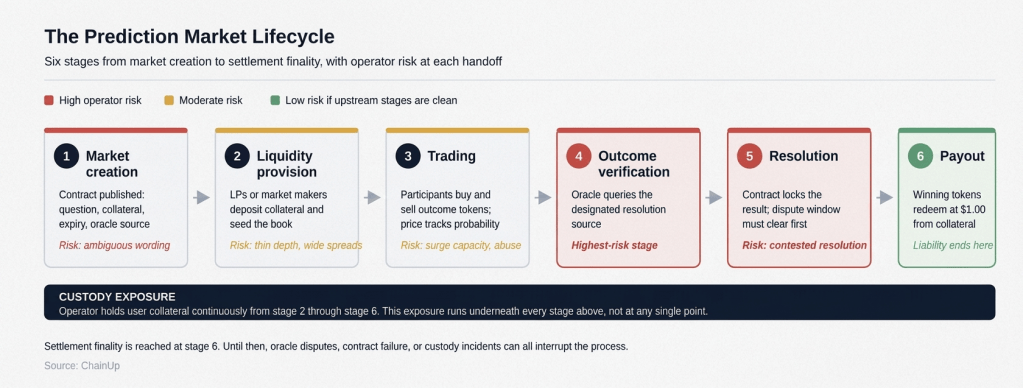
- Market creation. The operator or protocol publishes the contract, defining the resolution question, collateral asset, expiry date, and oracle source. Ambiguous wording at this stage is the root cause of most downstream disputes, and it cannot be fixed after trading opens without voiding the market.
- Liquidity provision. LPs or contracted market makers deposit collateral, enabling trading to begin. Thin initial liquidity produces wide spreads, which suppress early volume and can strand a market that would otherwise have found interest.
- Trading. Participants buy and sell outcome tokens. Price movement reflects changing probability assessments as new information enters. This is the stage that tests surge capacity and surveillance tooling.
- Outcome verification. After the event occurs, the oracle queries the designated data source. This is the highest-risk stage in the lifecycle, particularly for single-feed oracle configurations and for events where the underlying result is itself contested.
- Resolution. The settlement layer receives the confirmed outcome and locks the result. Dispute windows, where built in, must complete before the contract advances to payout. Resolution is where a verification problem becomes a user-facing problem.
- Automated payout. Winning token holders redeem at $1.00 per token from the collateral pool. Execution proceeds without operator intervention when resolution is clean. Withdrawal infrastructure is load-tested here whether the operator planned for it or not.
Settlement finality is the point at which operator liability ends. Until then, oracle disputes, contract failures, or custody issues can all interrupt the process. Note that custody exposure is not confined to a single stage: the operator holds user collateral continuously from stage two through stage six.
How Do Prediction Market Operators Generate Revenue?
Revenue is generated through four primary mechanisms.
Transaction fees. A fee taken on each trade regardless of outcome. This is the dominant mechanism at scale and the one that produced Kalshi’s $430.4 million World Cup figure. The standard range across major platforms is 0.5% to 2% per transaction, though fee formulas often vary by contract type. Kalshi’s parlay fees, for example, represent a lower percentage of notional volume than its single-contract fees, which is why its revenue rose less steeply than its volume during the tournament.
Spreads. The difference between implied buy and sell prices. Wider spreads improve operator or market-maker economics but reduce trader incentive, and in a category where users can compare prices across venues in seconds, spread is a competitive variable.
Liquidity pool fee share. Operators who seed or facilitate LP pools capture a portion of fees generated by AMM activity.
Market creation fees. On platforms allowing third-party market creation, a fee charged at the point of creation. Minor as a revenue line, useful as a spam control.
Revenue scales with volume, and volume is event-driven rather than linear. Kalshi’s fee revenue was under $50,000 per day at the start of 2025 and peaked at $13.5 million in a single day during the World Cup. That is the shape of the business: long flat stretches punctuated by windows where a prepared platform earns a disproportionate share of the year’s revenue. Infrastructure readiness before a major event is therefore an operational priority, not just a commercial one.
What Does It Take to Launch a Prediction Market?
The build-versus-buy decision is primarily a question of time, cost, and audit burden, measured against a fixed event calendar that does not adjust to development schedules.
| Dimension | Build from scratch | License white label platform |
|---|---|---|
| Development timeline | 12 to 24 months | 4 to 12 weeks |
| Estimated cost band | $800K to $3M+ | $50K to $300K setup |
| Engineering headcount | 8 to 15 engineers | 2 to 4 integration engineers |
| Audit burden | Full independent audit required pre-launch | Inherited from provider |
| Ongoing oracle costs | Operator-managed, including source licensing | Provider-managed or shared |
| Customization ceiling | Full | Provider-defined limits |
| Time to first revenue | 12 to 24 months | 4 to 12 weeks |
The customization trade-off is real. Licensed platforms, including White Label Prediction Market Software, have configuration limits that a custom build does not. Operators with highly specific market mechanics or proprietary resolution logic will encounter those limits. For most operators entering the vertical for the first time, the audit burden and development timeline of a custom build are prohibitive relative to the event-window opportunity, and a 12-to-24-month build means missing both the midterms and the cycle after it.
Where Are Prediction Markets Heading?
Two trends are materially reshaping the operator landscape.
The first is institutional integration. Intercontinental Exchange acquired a minority stake in Polymarket in early 2026, with NYSE investing $600 million. CME Group partnered with FanDuel, and Interactive Brokers rolled out event contracts. Kalshi’s $22 billion valuation and IPO consideration place it in the same conversation as established exchange operators. These are not speculative signals; regulated financial institutions are treating event contracts as a product category rather than a niche.
The second is category expansion coupled with regulatory divergence. Sports and politics drove volume through 2026, but operator interest is shifting toward macro data events, earnings outcomes, and regulatory decision markets, which attract institutional traders. At the same time, the U.S. regulatory picture is fragmenting by state, with eighteen states moving to block prediction markets and Minnesota criminalizing operation. Operators should expect the jurisdictional map to be an ongoing operational input rather than a one-time launch checklist.
The full institutional trend analysis is covered in the Exchange Operator’s Intelligence Report 2026.
Ready to Launch Before the Next Event Window?
White Label Prediction Market Software from ChainUp is built for operators who need to go live before the next major event cycle, with audited smart contracts, configurable oracle integrations, and a compliance-ready infrastructure layer already in place. The platform deploys in as little as 30 days, maintains sub-millisecond execution during traffic surges, and settles payouts the exact second an event concludes — bypassing the 1-to-6-hour industry delay that costs operators users at the moment it matters most.
The event calendar does not wait. The midterms are on November 3, 2026. A licensed platform can be configured and deployed in 4 to 12 weeks; a custom build cannot.
The ChainUp stack also includes White Label MPC Wallet for custody, Liquidity Technology for spreads and price discovery, and KYT for automated transaction monitoring.
Contact us to see White Label Prediction Market Software configured for your market and regulatory environment.


