
Key Takeaways
- Crypto cards achieve sustainable profitability by layering crypto-to-fiat conversion spreads, cross-border FX markups,stablecoin float yields, and subscription tiers on top of baseline merchant interchange.
- Gross interchange revenue is distributed across payment networks, sponsor banks,and technical processors before reaching the platform operator.
- Leading programs such as Coinbase and Crypto.com deploy cards primarily as balance-gathering and churn-reduction engines, funding user cashback through ancillary trading and conversion margins.
Crypto card purchase volume topped $1.1 billion in September 2026, marking a new monthly record driven primarily by stablecoin settlement rails. Visa leadership noted that stablecoin-linked cards have moved into a phase of rapid mainstream adoption, transitioning from speculative trading perks into daily payment tools.
For crypto exchanges, neobanks, and Web3 platforms, the central question is no longer whether consumer demand exists.The strategic challenge is identifying how a branded card program builds durable gross margins and covers rewards liabilities.
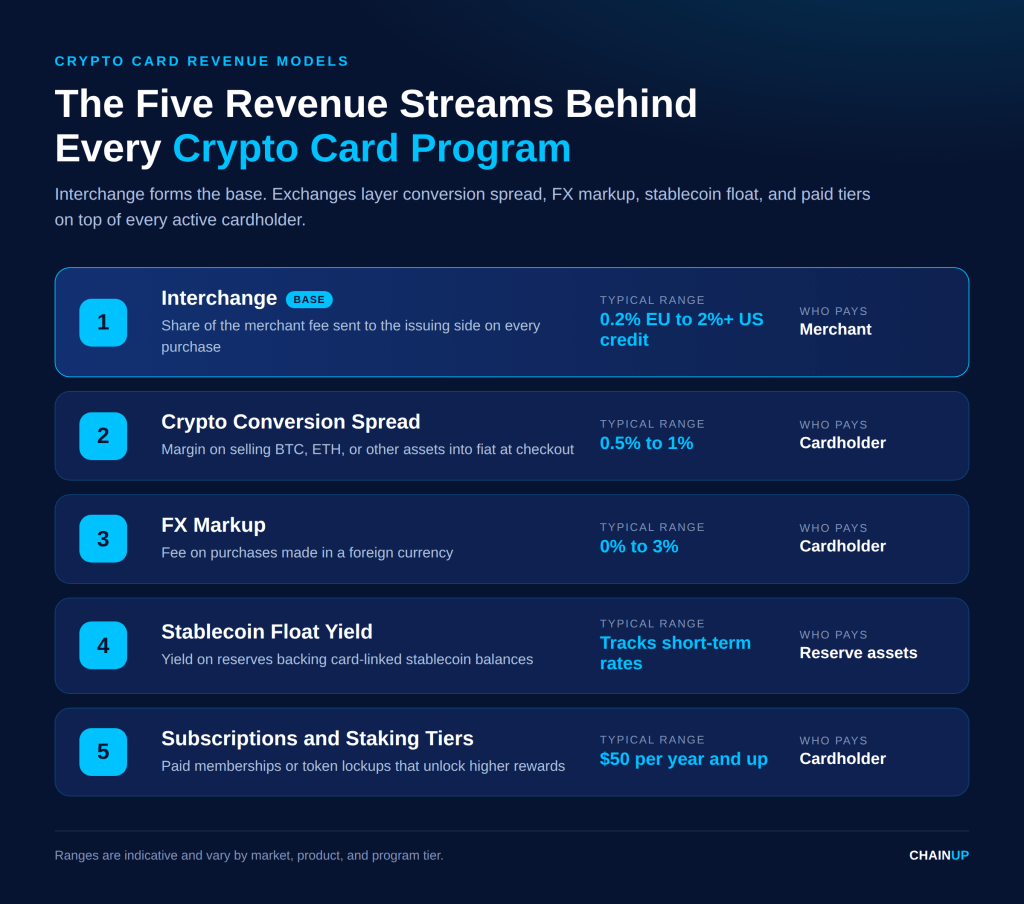
A viable card program generates cash flow across five distinct channels. Merchant interchange establishes the transaction baseline, while conversion spreads, foreign exchange (FX) fees, reserve float, and tiered membership models drive operational profit.
The Five Revenue Streams Behind Every Crypto Card Program
The table below shows how each crypto card revenue stream works and who pays for it.
| Revenue Stream | How It Works | Typical Range | Who Pays |
| Interchange | Share of the merchant fee sent to the issuing side on every purchase | About 0.2% in the EU to 2% or more on US credit | Merchant |
| Crypto Conversion Spread | Margin on selling BTC, ETH, or other assets into fiat at checkout | 0.5% to 1% | Cardholder |
| FX Markup | Fee on purchases made in a foreign currency | 0% to 3% | Cardholder |
| Stablecoin Float Yield | Yield on reserves backing card-linked stablecoin balances | Tracks short-term rates | Reserve assets |
| Subscriptions and Staking Tiers | Paid memberships or token lockups that unlock higher rewards | $50 per year and up | Cardholder |
Interchange is the only channel where costs are absorbed entirely by the merchant. The remaining four streams capitalize on the native strengths of digital asset platforms: liquidity management, on-chain custody, and internal exchange order books.
Crypto Card Interchange Economics and Who Keeps the Swipe Fee
When an end user spends $100 at a checkout counter, the acquiring merchant pays a Merchant Discount Rate (MDR) to its bank. The majority of this fee constitutes interchange, which the payment network routes to the issuing side of the transaction.
Regulation sets the ceiling. In the US, the Federal Reserve’s Regulation II debit interchange cap limits issuers with more than $10 billion in assets to 21 cents plus 0.05% per debit transaction. Smaller issuers are exempt, which is why most fintech card programs partner with smaller sponsor banks.
The EU caps consumer debit at 0.2% and credit at 0.3%, so European programs work with a thinner base. Credit products earn the most, which is one reason Coinbase and Crypto.com both launched US credit cards.
Gross interchange is then split across the issuing chain before the brand sees its cut.
- Card network. Visa or Mastercard charges assessment and processing fees.
- Issuer or BIN sponsor. The licensed bank or principal member keeps a share for carrying the regulatory liability.
- Program manager and processor. These partners run authorization, card lifecycle, and fraud tools for a per-transaction fee or revenue share.
- Brand operator. The exchange or fintech keeps what remains and funds cardholder rewards from it.

Capturing Margin via Conversion Spreads and FX Markups
Crypto debit cards require programmatic liquidation of digital assets into fiat within the 1-to-2 second authorization window at the point of sale.
When a user funds a transaction with volatile collateral like Bitcoin or Ether, the platform liquidates the asset with an embedded spread of 0.5% to 1.5% over institutional spot rates. As centralized exchanges operate their own internal matching engines and deep liquidity pools, this conversion spread converts directly into platform gross profit.
Foreign exchange (FX) markups provide a complementary margin layer. Cross-border retail transactions often carry a 1% to 3% FX markup on standard tiers. Tiered card programs frequently waive this fee for premium cardholders, turning foreign exchange terms into an upgrade lever for higher-tier accounts.
Stablecoin Settlement Rails and Float Yield
Stablecoins are reshaping the back end of card programs. USDC funded about 58% of crypto card spending in July 2026 and USDT about 26%. Visa’s stablecoin-linked card spend reached a $3.5 billion annualized run rate in late 2025, about 19% of total crypto card volume, according to Artemis research on crypto card spending.
Stablecoin rails give card operators two economic benefits beyond interchange.
- Faster settlement. Issuers that settle with Visa in stablecoins every day free up working capital that would otherwise sit in prefunded fiat accounts.
- Float yield. Card-linked balances held in stablecoins generate yield on reserves when the operator issues its own stablecoin or partners with an issuer.
Both benefits depend on a reliable stablecoin peg. They also require secure infrastructure for stablecoin payments that can hold balances, check them, and release funds inside the authorization window.
Coinbase Card and Crypto.com Card Revenue Models Compared
Coinbase and Crypto.com run two of the most visible exchange card programs. The table below compares how each structure rewards and accesses.
| Feature | Coinbase | Crypto.com |
| Card Products | Coinbase Card (Visa debit) and Coinbase One Card (Amex credit) | Prepaid Visa (global) and Visa Signature credit card (US) |
| Issuing Model | Coinbase One Card issued by First Electronic Bank through Cardless | Visa principal member issuing through its own regulated entities |
| Rewards | Up to 4% bitcoin back, scaling with assets held on Coinbase | 0% on Basic, 2% on Plus, 3% on Pro, higher on Private tiers |
| Paid Access | Coinbase One membership from $49.99 per year | Monthly subscription or 12-month CRO lockup |
| Strategic Goal | Grow platform assets and paid memberships | Drive token demand and ecosystem lock-in |
Neither program treats the physical card swipe as an isolated profit center. Coinbase leverages high card rewards to incentivize users to maintain qualifying deposit balances on the exchange. Crypto.com uses monthly spending caps on cashback tiers (e.g., capping eligible rewards at $1,250 to $2,500 monthly) to prevent reward payout liabilities from exceeding combined interchange and subscription earnings.
The Stablecoin Card Enabler Ecosystem Explained
Most exchanges do not become Visa principal members themselves. They launch through enablers that bundle issuing, processing, and crypto settlement, and two models dominate the market.
- Full-stack issuers. Platforms such as Rain and Reap hold Visa principal membership directly, so fewer intermediaries share the interchange.
- Program managers. These providers issue through sponsor banks and compete on speed to market, trading some margin for a simpler launch.
Visa carries more than 90% of onchain crypto card volume, largely because it partnered early with crypto-native issuers. That concentration is one reason the Visa crypto card boom has moved so quickly.
Unit Economics Example for a 50,000-Cardholder Program
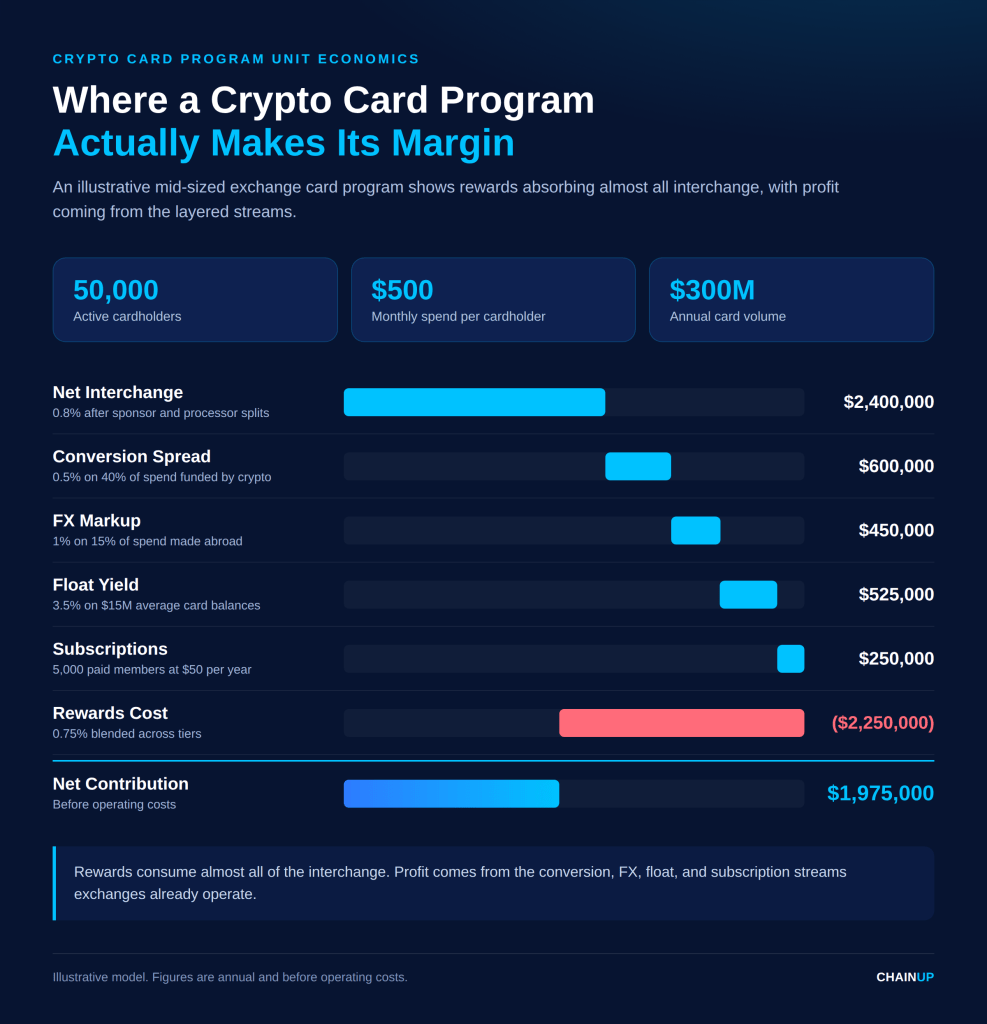
The table below uses illustrative assumptions for a mid-sized exchange program. It assumes 50,000 active cardholders spending $500 per month, or $300 million in annual card volume.
| Line Item | Assumption | Annual Amount |
| Net Interchange | 0.8% after sponsor and processor splits | $2,400,000 |
| Conversion Spread | 0.5% on the 40% of spend funded by volatile crypto | $600,000 |
| FX Markup | 1% on the 15% of spend made abroad | $450,000 |
| Float Yield | 3.5% on $15 million in average card balances | $525,000 |
| Subscriptions | 5,000 paid members at $50 per year | $250,000 |
| Rewards Cost | 0.75% blended across tiers | ($2,250,000) |
| Net Contribution | Before operating costs | $1,975,000 |
Rewards consume almost all of the interchange in this model. Profit comes from the layered streams exchanges already operate, which is why they can fund richer card programs than most neobanks.
What Exchanges Need to Launch a Profitable Crypto Card
A card program only earns these margins when its stack supports real-time crypto spending. Operators should confirm five components before launch.
- Issuing partner. A BIN sponsor or principal member with an approved crypto card program in each target market.
- Real-time conversion engine. Liquidity that converts assets into fiat inside the authorization window.
- Secure custody. MPC wallet custody that protects card-linked balances with policy controls.
- Compliance layer. KYC, sanctions screening, and KYT transaction monitoring on every funding flow.
- Rewards and tier engine. Logic that ties reward rates to spend caps, subscriptions, or asset balances.
Build a Profitable Crypto Card Program With ChainUp
Crypto cards make money by stacking interchange, conversion spreads, FX markups, stablecoin floats, and paid tiers. Exchanges start ahead because they already own the liquidity, custody, and balances behind that margin.
ChainUp White-Label Crypto Card Infrastructure is purpose-built for exchanges, wallets, fintechs, and Web3 operators launching crypto-funded card programs. Users top up with USDT or USDC and spend globally with virtual and physical cards. Its aggregated issuer network removes the setup complexity most operators hit when they build this stack themselves.
- Multi-chain stablecoin support. USDT (TRC20 and ERC20), USDC, and other major stablecoins are spendable at any Visa or Mastercard merchant.
- Acceptance in 180+ countries. Cards support Apple Pay, Google Pay, and ATM withdrawals.
- Ultra-low fees. Transaction costs stay competitive, with no top-up fees for end users.
- Flexible launch models. Choose direct issuance, full white label, co-branded partnerships, or dual-BIN infrastructure for B2C and B2B card products.
- Compliance built in. KYC, KYB, KYT, and AML integrations come with the program from day one.
Contact ChainUp today to launch a crypto card program built around your economics.