
Key Takeaways
- White-label crypto card programs keep only a fractional net share of gross merchant interchange ($0.20 to $0.70 on a $100 swipe) after card schemes, issuing banks, and BIN sponsors take their cuts.
- Crypto-to-fiat conversion spreads (0.5% to 1.5%) and cross-border FX margins (1% to 3%) generate up to four times more gross profit than base interchange on the exact same swipe.
- Sustainable unit economics rely on stacking three engines: base interchange, conversion spread, and recurring tier subscriptions.
In April 2026, Visa introduced revised interchange and operational frameworks for cryptocurrency transactions under merchant category codes (MCC) 6012 and 6051. This move signaled that payment networks now treat digital asset spending as an established, permanent payment category.
For crypto exchanges, Web3 protocols, and neobanks considering card issuance, this shift brings up a practical commercial question: how much net revenue does a white-label crypto card program actually generate when an end user taps their card?
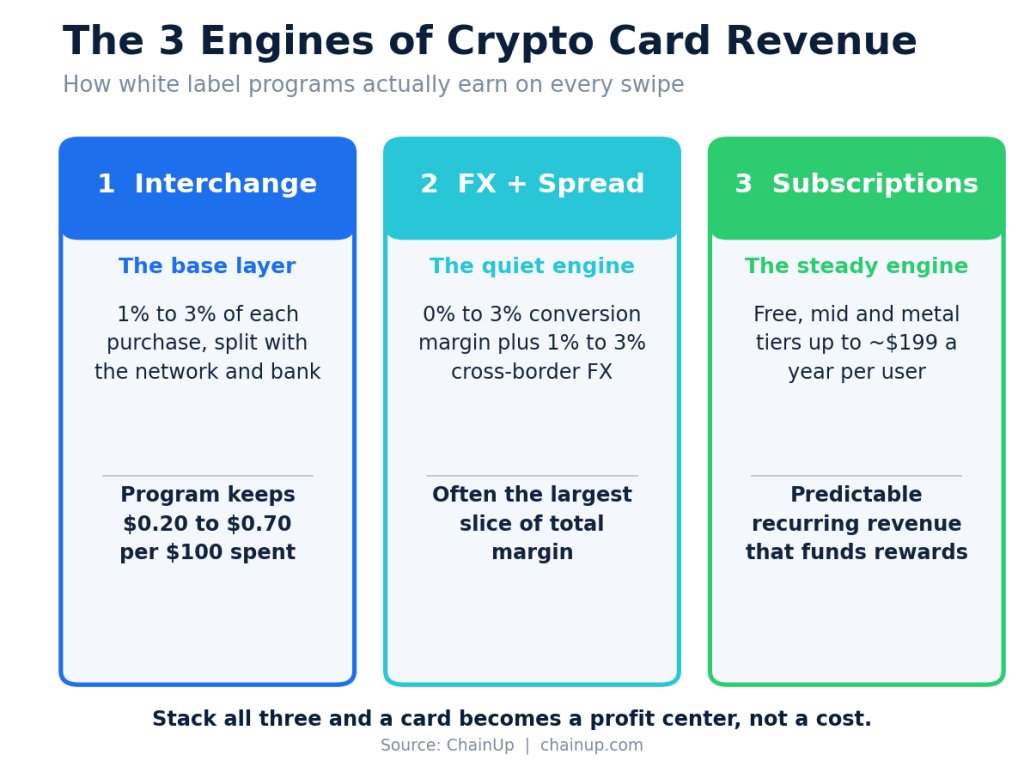
No single transaction fee carries the entire business model. Real profitability depends on how three distinct revenue streams stack together. Understanding this breakdown is the difference between running an expensive loyalty perk and operating a self-funding growth engine.
What is Interchange and How Is It Split on Crypto Cards?
Interchange is the baseline fee a merchant’s acquiring bank pays to the card-issuing bank on every card swipe. On standard global payment networks, gross interchange typically ranges from 1% to 3% of the transaction value.
The catch for a white-label card program is that you never keep the full amount. The merchant fee is split between the card network, the issuing bank or BIN sponsor, the processor, and finally your program. What reaches you is the net interchange share, and that share is what you build a business on.
Most crypto cards are prepaid or debit products, which sit at the lower end of the interchange scale, so the program share is thinner than many founders expect before they run the math.
How a $100 Crypto Card Swipe is Divided
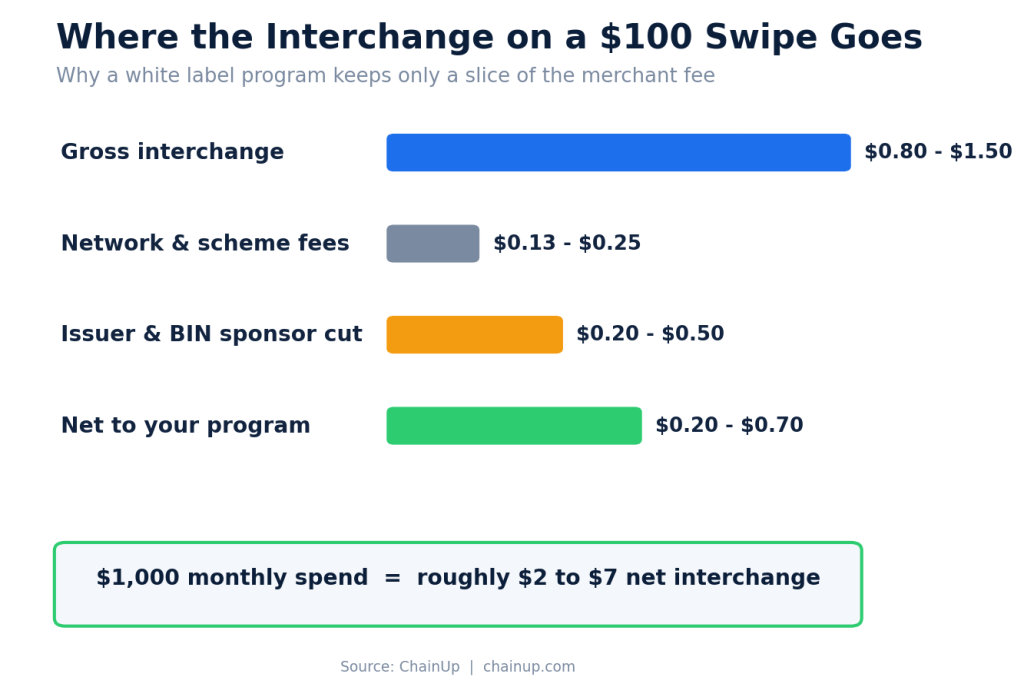
Before comparing numbers, it helps to see how a single swipe gets divided. The table below shows rough ranges for a typical prepaid crypto card in a mature market, using an illustrative purchase to keep things concrete.
| Settlement Layer | Share Of A $100 Purchase | Who Takes It |
| Gross interchange | $0.80 to $1.50 | Set by the network |
| Network and scheme fees | $0.13 to $0.25 | Visa or Mastercard |
| Issuer and BIN sponsor cut | $0.20 to $0.50 | Partner bank providing license & BIN rails |
| Net program revenue | $0.20 to $0.70 | Your card program |
If an active cardholder spends $1,000 monthly, that user yields roughly $2 to $7 in net interchange.
As customer onboarding, KYC verification, and user support can quickly outstrip those single-digit margins, sustainable programs never treat interchange as their primary source of income.
FX Spread and Conversion Margins: The Hidden Revenue
The largest revenue contributor in a crypto card transaction is often the least visible to the consumer: the conversion spread. Every time digital assets liquidate into local fiat currency at checkout, the platform clears the swap with an integrated spread over the wholesale spot price.
This spread does not show up as a line-item fee on the cardholder’s receipt, but it frequently generates two to four times more margin than the underlying interchange on the exact same transaction.
| Margin Type | Typical Range | When It Applies |
| Crypto-to-fiat conversion spread | 0% to 1% for stablecoins, up to 3% for volatile assets | Every crypto-funded swipe |
| Cross-border FX spread | 1% to 3% | Purchases outside the card’s base currency |
Put those side by side with interchange and the picture changes. On a $100 cross-border transaction funded by digital assets, the combined liquidation spread and foreign exchange fee can yield $1.50 to $4.00 in gross margin.
That is why stablecoin funding, cross-border spend, and travel-heavy user bases are so valuable to a card program, and why the underlying wallet and conversion infrastructure deserves as much attention as the plastic itself.
Subscription Tiers That Build Recurring Revenue
Interchange and spread both depend on spending. Subscriptions do not, which is what makes them the steadiest part of the model.
A monthly or annual fee turns an unpredictable transaction business into recurring revenue you can forecast, and it doubles as a way to fund richer rewards for the users who spend the most.
The market has settled into a familiar ladder, visible across leading consumer crypto cards. A short look at how the tiers are usually built shows the pattern.
- A free virtual tier that earns only interchange and spread, designed to acquire users at low cost and prove the habit.
- A mid tier with a modest monthly fee, higher limits, and better cashback, aimed at regular spenders.
- A premium metal tier priced near $199 a year, often with elevated cashback on early spend and zero FX fees, which appeals to heavy users and travelers.
The premium tier is doing quiet double duty. The annual fee is pure recurring margin, and the perks it funds, such as the richer cashback structures reviewed across the market, push exactly the behavior that generates more interchange and spread.
Good subscription design is not a fourth revenue line bolted on. It is the flywheel that makes the other two spin faster.
Modeling Blended Revenue Per Active Cardholder
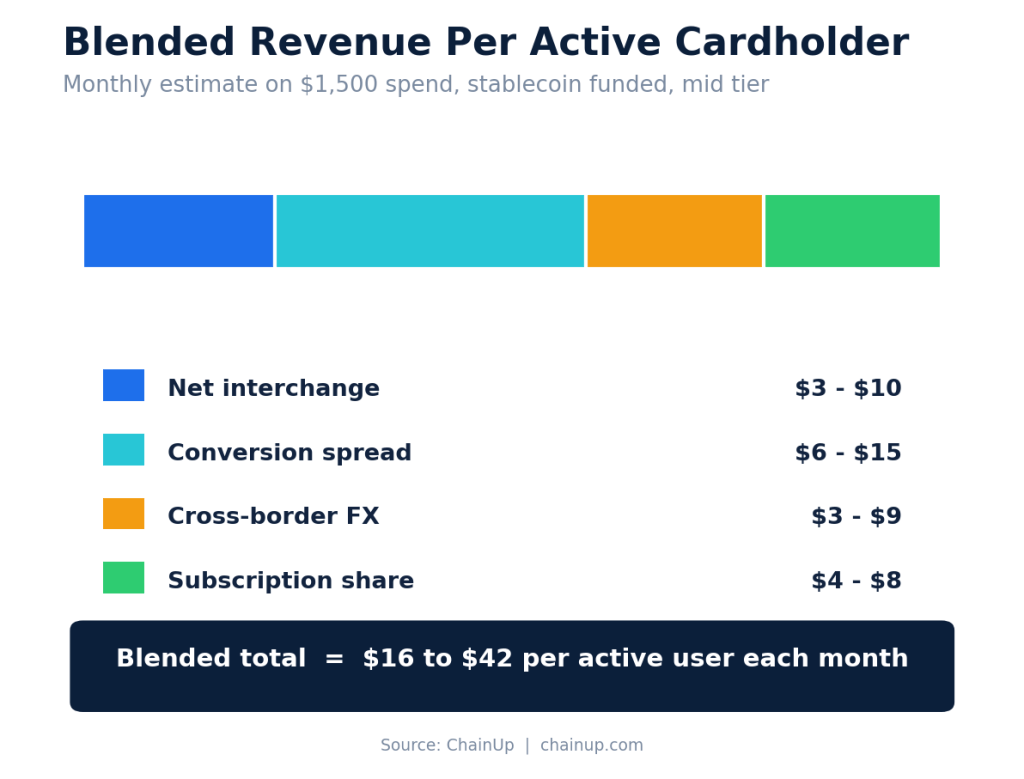
Numbers only mean something when they are combined, so here is a simple blended view of one engaged cardholder. Assume $1,500 in monthly spend, a fifth of it cross-border, funded mostly by stablecoins, on a mid subscription tier.
| Revenue Source | Monthly Estimate |
| Net interchange | $3 to $10 |
| Conversion spread | $6 to $15 |
| Cross-border FX margin | $3 to $9 |
| Subscription share | $4 to $8 |
| Blended total | $16 to $42 |
The lesson is not the exact figure, which will move with your user mix, but the shape. Interchange is the smallest slice, spread and FX together are the largest, and the subscription smooths the whole thing into something predictable.
A program built on this stacked logic, the approach any serious guide to building a crypto card business recommends, can reach $20 to $40 per active user each month. A program that leans on interchange alone will struggle to clear the cost of serving that same person.
What A Crypto Card Program With 1,000 Users Could Earn
Per-user math is useful, but most founders want to see the model at real scale. To make it concrete, picture a program with 1,000 registered users, since not everyone who signs up becomes a regular spender, and blend the per-user revenue from the section above. The table below sketches three scenarios that differ mainly by how many users stay active and how much they spend.
| Scenario | Active Users | Blended Revenue Per Active User | Monthly Revenue | Annual Revenue |
| Conservative | 400 | $18 | $7,200 | Around $86,000 |
| Base | 600 | $28 | $16,800 | Around $202,000 |
| Strong | 800 | $40 | $32,000 | Around $384,000 |
Two things stand out. First, activation rate moves the outcome as much as spend does, so the work of turning sign-ups into habitual spenders is where much of the value is won.
Second, even a modest base of 1,000 users can produce six figures a year once all three revenue engines are firing, which is why a card often earns more than the exchange or wallet feature it sits beside.
Scale those same assumptions to ten thousand or a hundred thousand users and the model compounds in a straight line, since the marginal cost of each additional active cardholder is low once the core infrastructure is in place.
What Launch Costs And Break-Even Really Look Like
Those earnings are real, but they arrive only after you have paid to stand the business up, and the setup cost is where many card projects stall.
Standing up a card program from scratch means assembling a BIN sponsor, a processor, network membership, compliance and KYC, card manufacturing, and a full ledger and conversion stack, and each of those pieces carries its own cost and its own timeline.
The path you pick shapes both the bill and how long you wait before a single card ships, so it is worth being clear-eyed about the options before committing.
- A white label launch on top of an existing platform starts in the low six figures and can go live in roughly six to twelve weeks, which keeps break-even within reach.
- Assembling a BIN sponsor and processor in-house runs into the low millions and adds many months of integration before a single card ships.
- Pursuing your own license and direct network membership can pass fifteen million dollars and stretch across multi-year timelines, a route reserved for programs already at real scale.
Seen next to the earnings above, the takeaway is sobering and clarifying at once. A program can absolutely earn six figures a year at a thousand users, but the in-house and licensed routes can burn far more than that before the first transaction ever clears, which is why the buildout, not the interchange rate, is what usually decides whether a card ever becomes profitable.
This is where having a community changes everything. If you already run an exchange, a wallet, or a fintech app with an engaged audience, the fastest way to put a card in their hands is to launch white label rather than build the rails yourself.
A white label card program hands you the BIN sponsorship, processing, compliance tooling, conversion engine, and card issuing as a single managed stack, so you plug in your brand and your users instead of spending a year and a fortune assembling infrastructure.
You keep the customer relationship and the revenue engines while a partner carries the licensing and the heavy lifting, and you reach break-even far sooner because your fixed cost starts low and your active user base is already there.
For a platform with demand in hand, that trade is what turns a card from a capital-intensive gamble into a fast, fundable extension of the business you already run.
Optimizing Card Unit Economics with ChainUp
Turning a crypto card from a break-even utility into a high-margin product requires complete control over your transaction routing, spread configurations, and fee architecture. When platforms rely on fragmented point solutions, intermediary fees compound quickly, eroding the net margins that make card issuing commercially viable.
For exchanges, wallets, fintechs, and Web3 operators launching crypto-funded card programs, ChainUp White-Label Crypto Card Infrastructure is purpose-built for exactly this moment. Users top up with USDT (TRC20 and ERC20) or USDC and spend globally across virtual and physical cards, online and offline, on an aggregated issuer network that removes the setup complexity most issuers hit when they try to build this stack themselves.
Everything a program needs arrives wired in from day one.
- Multi-chain stablecoin support, with USDT (TRC20 and ERC20), USDC, and other mainstream stablecoins spendable at any merchant that accepts Visa or Mastercard.
- Worldwide acceptance across 180-plus countries on Visa and Mastercard rails, with Apple Pay and Google Pay support and ATM withdrawals included.
- Ultra-low fees through an aggregated issuer network, which means competitive transaction costs and no top-up fees for end users.
- Flexible launch models spanning direct card issuance, fully white-labeled programs, co-branded partnerships, and dual-BIN infrastructure for operators running both B2C and B2B card products.
- Compliant and secure by default, with integrations to leading KYC and KYB, KYT, and AML providers built into the program rather than bolted on after launch.
By unifying issuing connectivity, asset custody, and multi-asset conversion into a single technological foundation, ChainUp allows operators to preserve their margins and scale active cardholder revenue from day one.
Contact ChainUp today to model your card program’s revenue potential and launch in weeks.