

Key Takeaways
- A crypto card program connects digital asset wallets to Visa and Mastercard networks, allowing users to spend stablecoins across 150+ million merchants worldwide without the merchant handling digital assets.
- Programs scale through distinct niches—from RedotPay’s emerging-market focus (surpassing 9 million users) to Ether.fi’s DeFi liquid-staking yield model and Kraken’s exchange liquidity integration.
- White-label infrastructure compresses go-to-market timelines from 12–24 months down to weeks by bundling BIN sponsorship, compliance engines, MPC custody, and card lifecycle management into one stack.
Building a crypto card program means uniting a stablecoin wallet, a licensed issuer, and a Visa or Mastercard BIN into one seamless product that lets users spend digital assets like fiat cash. Behind that straightforward tap at the checkout counter, however, lies the fastest-growing real-world utility in Web3.
Tracked crypto card payment volume has surged past $750 million to hit $1.04 billion in July, with stablecoins like USDT and USDC driving over 70% of total transactions. High-profile consumer programs have already proven the massive commercial upside, with multi-currency issuers like RedotPay reportedly eyeing a confidential U.S. IPO at a valuation between $4 billion and $5 billion.
Yet for the crypto exchanges, Web3 protocols, and neobanks entering the space today, the strategic equation has fundamentally shifted: capturing this sticky, recurring transaction volume no longer requires spending millions of dollars and two years building issuing rails from scratch.
What Is a Crypto Card Program and How Does it Work
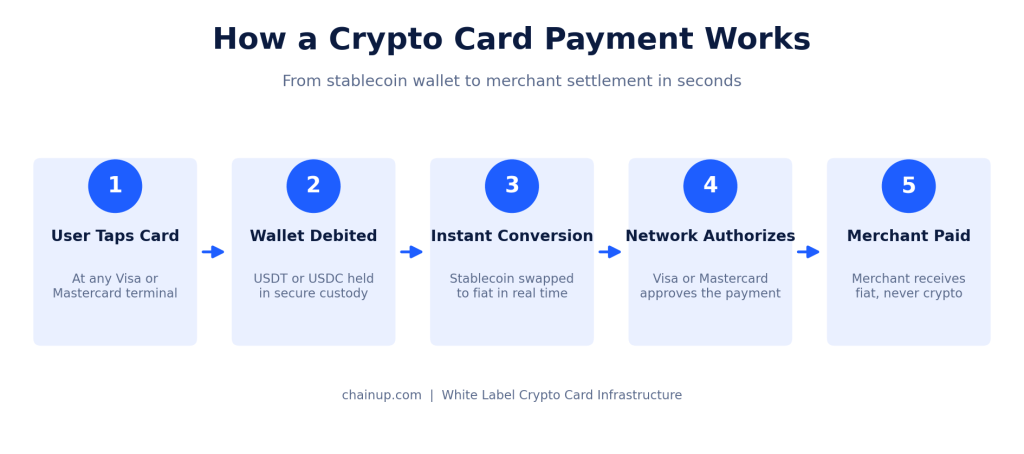
A crypto card is a Visa or Mastercard payment card funded by digital assets instead of a conventional bank deposit balance. Users first deposit crypto, usually USDT or USDC, into a wallet linked to the card. When they tap the card, the platform converts the needed amount to fiat in real time and settles with the merchant through the card network. The merchant never touches crypto.
With Visa supporting more than 160 stablecoin-linked card programs and payment volumes up nearly 200% year-over-year, crypto debit cards have transitioned from niche crypto-native perks into everyday consumer spending instruments.
Proven Growth Models: How Top Card Issuers Scale
Different issuers achieve scale by tailoring their card mechanics to specific user behaviors rather than launching generic payment products. Three distinct models lead the market today:
1. The Emerging-Market Super App (RedotPay)
In emerging markets, users often rely on stablecoins to protect savings from local currency inflation and execute cross-border payouts. RedotPay addressed this by combining a multi-currency stablecoin wallet with physical and virtual Visa cards, peer-to-peer transfers, and yield features. Backing its distribution with a Big Four audit, independent AML/CFT reviews, and regional licensing, it scaled to millions of users across 100+ countries.
2. The DeFi-Native Yield Model (Ether.fi Cash)
Ether.fi targeted liquid restaking and decentralized finance participants by allowing cardholders to spend against staked balances or borrow against collateral without unstaking their assets. This mechanic eliminates the opportunity cost of spending crypto, driving monthly card purchase volume past $100 million.
3. The Centralized Exchange Liquidity Anchor (Kraken)
Centralized exchanges use cards primarily to curb off-platform capital flight. By linking card spending directly to spot exchange balances, Kraken observed user payment frequency more than double year-over-year to 8.3 weekly transactions per active user, turning trading accounts into primary day-to-day transaction hubs.
Traction Benchmark: Leading Crypto Card Programs
| Program | Issuance & Positioning Model | Core Traction & Operating Metrics |
| RedotPay | Global Multi-Currency Visa Card | Emerging-market focus; high-volume consumer adoption across 100+ countries |
| Ether.fi Cash | DeFi Liquid Restaking / Credit Card | Surpassed $100M in monthly card purchase volume |
| KAST | Cross-Border Stablecoin Payment Card | Reached ~$89.6M in monthly cross-border volume |
| Kraken (Krak Card) | Exchange-Linked Debit Card | Average weekly transaction frequency reached 8.3 payments/user |
| Binance Card (Regional) | Exchange-Linked Debit Card | 80%+ volume growth across regional active cohorts |
| Coinbase One Card | Subscription & Loyalty Tier Card | Average active cardholder spends ~$3,000/month across assets |
Spending across these programs is anchored in everyday utility: supermarket groceries, rideshares, food delivery, and digital subscriptions. This non-cyclical volume keeps user balances sticky across both bull and bear market cycles.
6 Core Components Every Crypto Card Program Needs
Every card program, whether from RedotPay or a new entrant, runs on the same ecosystem of banks and card networks working behind the scenes. Here are the six building blocks you must secure.
| Component | What It Does |
| BIN sponsorship | A licensed issuing bank lends you its Bank Identification Number so your cards work on Visa or Mastercard |
| Wallet and custody | Holds user stablecoins securely, ideally with MPC key management |
| Conversion engine | Swaps crypto to fiat at the moment of authorization |
| Compliance stack | KYC, KYB, KYT, and AML screening keep regulators and banking partners satisfied |
| Card management | Issues physical and virtual cards, sets limits, and enables Apple Pay and Google Pay tokenization |
| Settlement layer | Reconciles funds between your platform, the issuer, and the network daily |
These six pieces do not operate in isolation. Custody feeds the conversion engine, the conversion engine feeds the settlement layer, and the compliance stack sits underneath all of it, screening every top up, conversion, and payout in real time.
Miss one link, whether that is a wallet that cannot settle fast enough or a compliance system that is not integrated with the issuer, and the whole card stops working at the point of sale.

White-Label Platform vs Building In-House: How Do They Compare?
Before writing a single line of code, decide how much of the stack you want to own. The comparison below shows why most teams choose a white label crypto card solution over direct issuance.
| Factor | Build In-House | White-Label |
| Time to market | 12 to 24 months | 2 to 8 weeks |
| Licensing | Your own EMI or bank partnerships | Covered by the provider’s issuer network |
| Upfront cost | Millions in setup and legal fees | Low or zero setup fees |
| Compliance burden | Fully on you | Built into the platform |
| Card production | Direct vendor negotiation and minimum order quantities | Bundled into the provider’s issuer network |
| Customer support and disputes | Your own support desk and chargeback process | Often included or available as an add on |
| Adding new markets | Repeat licensing per country | Added through the provider’s existing network |
| Branding | Full control | Full control with your logo and app |
Direct issuance only makes commercial sense at massive enterprise scale. Even high-volume consumer issuers initially scaled on partner rails before deepening their own direct licensing footprints.
Five Steps to Launch Your Crypto Card Program
The steps below assume you are launching on a white label platform rather than building your own issuing infrastructure. If you are going the in-house route, each step expands into its own multi month project, starting with securing an EMI license or bank partnership before you can even test a transaction.
1. Define the product and business model. Beyond choosing prepaid, debit, or credit style cards, decide how the card earns and retains users. Most programs start prepaid, funded directly by crypto debit cards holding USDT and USDC.
Others tie spending to staked assets, letting a user’s card draw down while the underlying balance keeps earning yield. Credit based models extend a line against collateral, which adds underwriting and risk decisions on top of the infrastructure questions.
Reward structures, cashback in a native token, and tiered card designs are business decisions worth locking down before integration begins.
2. Select an infrastructure partner. Evaluate issuer coverage, supported regions, fee structure, and API depth.
3. Integrate wallets and payments. Connect your stablecoin payments infrastructure so top-ups, conversions, and settlements run automatically.
4. Pass compliance onboarding. Complete KYB checks with the issuer and configure KYC and transaction monitoring for your users.
5. Launch and iterate. Start with virtual cards for instant distribution, then add physical cards, ATM access, and rewards.
How Crypto Card Programs Generate Revenue
Revenue is only half the case for a card program. The bigger benefit is that a card turns your platform from a place users visit into a place where they hold and spend their money.
Cardholders return far more often than traders do. Kraken reported that weekly payments per user on its Krak Card more than doubled in a year to 8.3, and average card tickets across the market rose from $59 to $86 as users shifted to groceries, rides, and subscriptions.
Every one of those purchases is funded from a balance that stays on your platform. That deepens liquidity, raises assets under custody, and gives users a reason to keep funds with you instead of moving them to a competing exchange or wallet. It also creates daily touchpoints to cross-sell earn, swap, and payout products.
On top of that engagement, the card opens several new revenue streams. The main sources are listed below.
- Interchange share. You earn a portion of the fee merchants pay on every swipe.
- Conversion spread. A small margin on each crypto to fiat conversion scales with volume.
- Card fees. Issuance, monthly, and ATM fees add predictable income.
- Float and deposits. Stablecoin balances held for spending create treasury opportunities.
Global Crypto Card Regulatory Considerations by Key Market
Licensing requirements dictate where your program can legally operate. A white-label provider with an established issuer network absorbs most of this burden, as cards are issued under partners already licensed in each region:
| Region | Regulator | What It Means for Card Programs |
| European Union | ESMA and national authorities under MiCA | CASP authorization plus e-money rules for stablecoin balances |
| Hong Kong | HKMA and SFC | Stablecoin issuer licensing regime in force, home turf of RedotPay |
| Singapore | MAS | DPT license required under the Payment Services Act |
| UAE | VARA | Dubai licensing covers crypto payment and transfer services |
A white-label provider with an established issuer network absorbs most of this burden, since cards are issued under partners already licensed in each region.
How Much Does It Cost to Launch a Crypto Card
Budget depends heavily on your chosen operating model. Reviewing upfront capital requirements versus recurring operational expenses prevents costly mid-development roadblocks.
An in-house build stacks up costs before a single card ships. An EMI license or bank partnership can run from the low hundreds of thousands into the millions in legal and application fees, depending on jurisdiction.
Visa or Mastercard principal membership carries its own fees and minimum volume commitments on top of that. Compliance staffing, covering KYC, KYT, and AML specialists, typically means three to six full time hires before you can onboard your first user.
Card manufacturing adds minimum order quantities that often run into the tens of thousands of units, and 12 to 24 months of engineering payroll sits on top of all of it.
A white label launch shifts most of this from fixed to variable cost. Setup fees range from low to zero depending on the provider, and card printing, KYC verification, and processing are usually bundled into a per user or per transaction fee.
Providers typically earn through revenue share on interchange and conversion spread rather than large upfront charges, though some set a minimum monthly volume once the program is live.
| Cost Category | In-House Build | White-Label |
| Licensing and bank partnership | Hundreds of thousands to millions upfront | Included through the provider’s issuer network |
| Network membership | Direct Visa or Mastercard fees | Bundled into the program fee |
| Compliance team | Three to six full time hires | Included in the platform |
| Card manufacturing | Minimum order quantities in the tens of thousands | Per card fee, typically no minimums |
| Engineering | 12 to 24 months of payroll | Integration only, days to weeks |
Ongoing costs look similar under either model once cards are in the market. Card production, KYC verification per new user, customer support, and program management all scale with your user base rather than hitting you before launch.
Accelerating Time-to-Market with Proven Infrastructure
Building proprietary card rails from the ground up requires navigating years of banking agreements, network certifications, and complex ledger engineering. For most operators, the strategic priority is distribution, user retention, and monetization—not reinventing financial plumbing.
ChainUp provides the enterprise technology framework that bridges digital asset platforms with global Visa and Mastercard rails. Backed by core infrastructure that powers more than 700 digital asset exchanges, financial institutions, and Web3 enterprises worldwide, ChainUp’s white-label card solution packages:
- Institutional-grade MPC wallet security and automated liquidity conversion engines.
- Comprehensive card management software (CMS) with custom velocity rules and multi-tier fee structures.
- Turnkey alignment with licensed card issuers and automated AML/CFT compliance modules.
Whether expanding an exchange ecosystem or launching a DeFi spend product, platforms can deploy a customized, secure card program in weeks rather than years.
Contact ChainUp today to launch your branded crypto card in weeks instead of years.