


Key Takeaways
- Circle has moved well beyond being a stablecoin company. Its stock trades at a ~98x forward P/E because investors are pricing in a blockchain (Arc), a federal bank charter (Circle National Trust), a payments network processing ~$23B annualized volume, and an AI agent payments stack — not just USDC reserve income.
- The institutional signal is hard to ignore. A $222M token presale backed by a16z, BlackRock, Apollo, and Standard Chartered before a mainnet even launches tells you the demand for regulated stablecoin infrastructure is real and deep.
- Circle’s product mix is diversifying fast — USDC at $73.3B in circulation, EURC as the largest digital euro, USYC growing 10x to $3B as the largest tokenized money market fund, and crypto card spending hitting $7.8B monthly with USDC powering over half of it.
- For builders, the takeaway isn’t the stock price. It’s that the rails, charters, and tooling now exist to build exchanges, wallets, and settlement products on regulated stablecoin infrastructure — and the barrier to doing so is lower than it has ever been.
The Circle Initial Public Offering (IPO) was old news. Shares priced at 31 dollars in June 2025, and by late August 2026 CRCL traded near 89 dollars with a market capitalization above 22 billion dollars and a 52 week range that ran from about 50 dollars to almost 160 dollars. The debut mattered, yet it no longer explains the stock.
What explains the stock is valuation math that only works if Circle keeps expanding beyond stablecoins. CRCL has carried a forward price to earnings ratio near 98, many times the roughly 17 typical of capital markets peers.
A number like that is not a bet on interest income from reserves alone. It is a bet that Circle is becoming a broad financial infrastructure company that issues a digital dollar, runs its own blockchain, holds a bank charter, and powers payments for both people and machines.
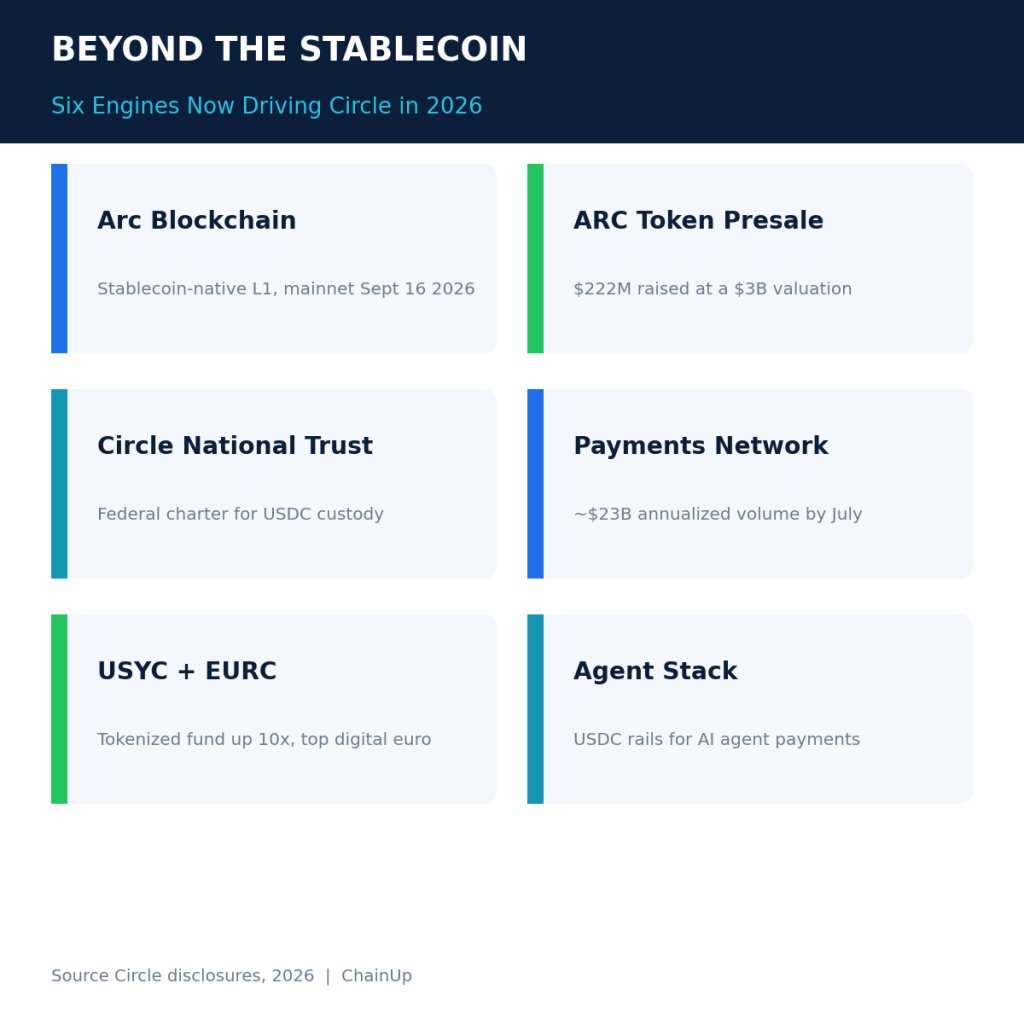
Arc: Circle’s Stablecoin-Native Blockchain Infrastructure
Circle is no longer just an issuer operating on external chains. Arc is a stablecoin-native Layer-1 blockchain built specifically for regulated, institutional finance.
- Native Gas Model: Uses USDC as its native gas token, eliminating the price volatility of paying network fees in speculative crypto assets.
- Performance & Compliance: Features sub-second finality, full Ethereum Virtual Machine (EVM) compatibility, and opt-in privacy controls tailored for regulated entities.
- Mainnet Launch: Slated to go live on September 16, 2026, Arc allows Circle to capture value directly at the settlement layer.
The ARC Token Presale That Wall Street Lined Up For
Arc also introduced a brand new revenue line and a striking signal of institutional confidence. In May 2026, Circle sold 740 million ARC tokens at 30 cents each and raised 222 million dollars at a 3 billion dollar fully diluted valuation. This was the first token sale ever conducted by a company registered with the Securities and Exchange Commission, which made it a landmark on its own.
The buyer list is the real headline, because it reads like a roster of traditional finance rather than a crypto only crowd. The table below shows who stepped in and why it matters.
Presale detail | Figure |
Total raised | 222 million dollars |
Tokens sold | 740 million ARC at 30 cents |
Implied valuation | 3 billion dollars fully diluted |
Lead investor | a16z at 75 million dollars |
Notable backers | BlackRock, Apollo, Intercontinental Exchange, Ark Invest, Standard Chartered Ventures, SBI Group, Janus Henderson |
When asset managers and exchange operators of that size commit capital before a mainnet even launches, it tells investors the institutional demand for regulated stablecoin infrastructure is real and deep.

Bringing USDC Under Federal Oversight via Circle National Trust
Circle also moved into banking, which changes how safe and how regulated its core product looks to institutions. After the Office of the Comptroller of the Currency granted a federal trust bank charter, Circle opened Circle National Trust on July 24, 2026.
The entity provides fiduciary digital asset custody, and it is structured so that management of the USDC reserve can eventually sit under direct federal supervision.
For banks and asset managers, that federal wrapper matters more than any marketing claim. It puts custody and reserves inside a recognized regulatory perimeter, which is often the precondition large institutions need before they will build stablecoin infrastructure for banks on top of USDC. The charter turns Circle from a fintech into a supervised counterparty.
Circle Payments Network (CPN) Scales Toward Everyday Money
The Circle Payments Network is where all of this becomes real revenue and real volume. CPN lets banks, payment providers, and fintechs settle in USDC across borders, and adoption has climbed sharply through 2026.
Annualized transaction volume reached nearly 15 billion dollars on a trailing basis at the end of the second quarter and about 23 billion dollars by July 31, with well over one hundred financial institutions enrolled.
That trajectory reframes Circle as a payments company with a compliant network effect, not just a token issuer.
Firms studying their own build usually start with the same stablecoin payment rails and then look at the cross-border settlement patterns already reshaping markets in Asia. The more volume CPN carries, the more the current valuation starts to look justified.
USDC, EURC, And USYC Broaden The Product Engine
Circle is also widening its product mix so it does not depend on a single token. This diversification is a quiet but important part of the growth case, and the pointers below show how each piece contributed in the second quarter of 2026.
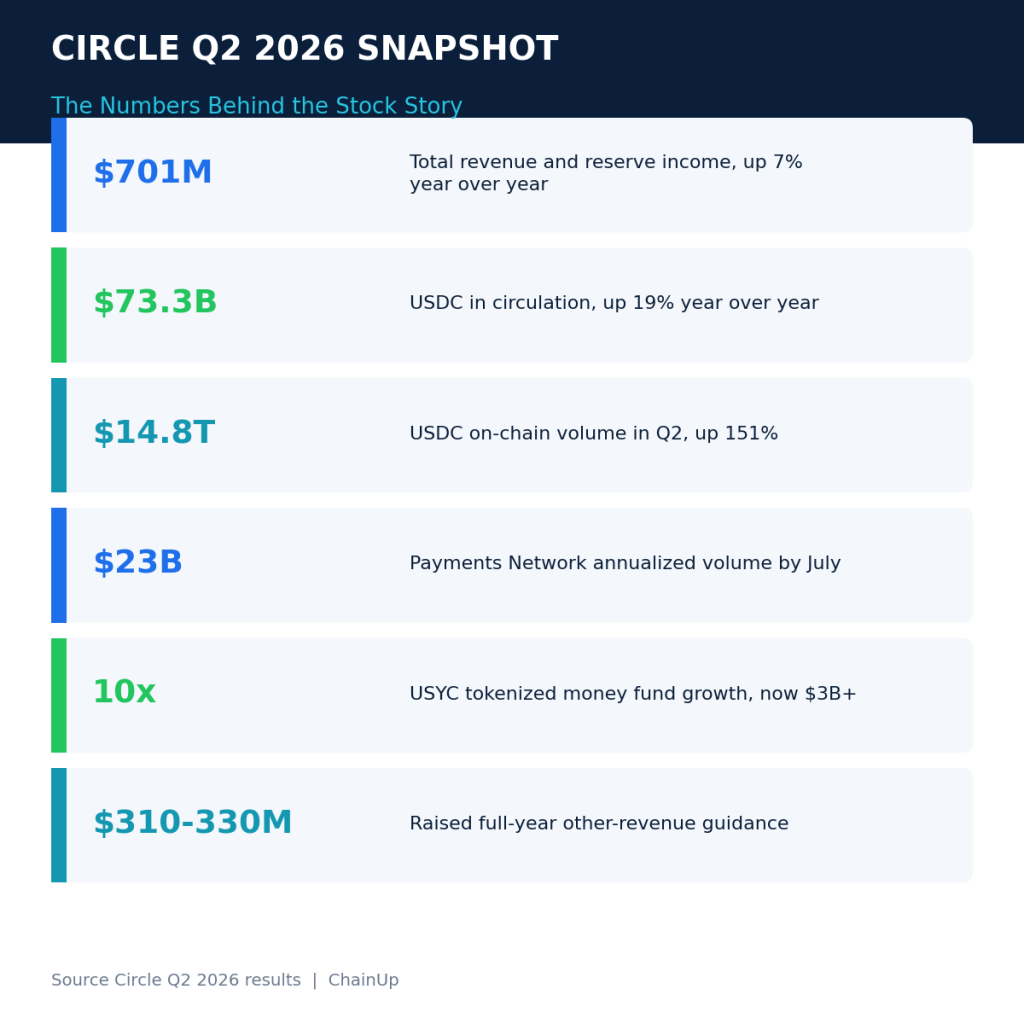
- USDC in circulation reached 73.3 billion dollars, up 19 percent year over year, while on chain transaction volume hit 14.8 trillion dollars, a 151 percent jump.
- EURC grew about 2.2 times year over year and remains the largest digital euro in the world, giving Circle a real foothold in European settlement.
- USYC, Circle’s tokenized money market fund, grew roughly tenfold to more than 3 billion dollars and stands as the largest product of its kind, which ties Circle directly into the tokenization of regulated assets.
Taken together, these lines show a company building a family of regulated on chain products rather than leaning on one stablecoin. That is the difference between a single feature and a platform.
Crypto Card Spending Turns Stablecoins Into Daily Purchases
Another driver sits closer to consumers than most people realize. Stablecoins are moving into everyday purchases such as groceries, ride hailing, and food delivery through crypto linked payment cards.
Monthly crypto card volume hit 7.8 billion dollars in May 2026, up about 230 percent year over year, and card spending topped 1 billion dollars in the single month of July.
USDC sits at the center of that shift, accounting for just over half of July card volume, and Visa alone runs more than 130 stablecoin linked card programs across over 50 countries.
As dollar backed tokens become a normal way to pay, Circle benefits from steady, real world demand for USDC rather than demand driven only by trading.
Agentic Finance Positions Circle For Machine-To-Machine Payments
The most forward looking driver is agentic finance, and it is where Circle is planting a flag for the next decade. In May 2026, Circle launched the Agent Stack, a set of tools that let autonomous AI agents hold assets, discover services, and pay one another in USDC.
The stack includes Circle CLI, Agent Wallets, an Agent Marketplace, and nanopayments powered by Circle Gateway that support gas free USDC transfers as small as one millionth of a dollar.
If machine to machine commerce grows the way its backers expect, a payment rail built for tiny, high frequency, automated transactions could become a large market, and Circle wants USDC to be its default currency. Investors treat this as long dated optionality, and it helps explain why the stock trades on a growth multiple rather than a payments utility multiple.
What Q2 2026 Earnings Reveal About The Real Story
Earnings tie the narrative together and show why the story is now about growth engines, not the IPO. In its second quarter results, Circle reported 701 million dollars in total revenue and reserve income, up 7 percent year over year, which came in a touch below the roughly 717 million dollars analysts wanted. The more telling detail was the guidance move.
Circle nearly doubled its full year outlook for other revenue, meaning revenue outside reserve interest, lifting the range from 150 to 170 million dollars to 310 to 330 million dollars, and it credited recognized ARC token presale revenue as part of that jump.
In other words, the newer businesses are already showing up in the numbers. The snapshot below captures the quarter.
Translating Macro Shifts into Exchange Architecture
The takeaway for operators is not to trade the stock. It’s to recognize what Circle’s multi-year expansion reveals about where the industry has moved: regulated stablecoin infrastructure is no longer experimental, and every major product Circle scales—from cross-border settlement rails and tokenized funds to AI agent payment stacks—runs on underlying plumbing that didn’t exist a couple of years ago.
That same infrastructure shift is what makes it possible for independent businesses to launch their own exchanges, wallets, and financial products today. However, “possible” and “practical” are two entirely different things. Each layer Circle built—a proprietary blockchain, a federal trust bank charter, a global payments network, and institutional-grade custody—required years of heavy engineering and complex regulatory navigation. Most operators do not need to spend millions re-engineering those foundational layers from scratch. They need a modular stack built to leverage them.
This is where the infrastructure decision becomes a core business decision. An exchange aiming to settle institutional USDC flows requires native wallet architecture that handles multi-chain token dynamics seamlessly. A platform rolling out tokenized fund products needs custody standards that satisfy strict regulatory audits. A business scaling cross-border operations needs compliance tooling—real-time KYT screening, Travel Rule data exchange, and automated sanctions monitoring—embedded directly into the transaction pipeline rather than patched on as an afterthought. Disjointed components, such as a matching engine disconnected from custody or a wallet blind to the compliance layer, create systemic vulnerability under volume.
ChainUp unifies these critical layers into a single enterprise-grade ecosystem. It combines high-throughput white-label exchange engines, institutional-grade MPC wallet that eliminates single points of failure, and AI-powered Trustformer KYT that screens thousands of tokens across strict risk categories before transactions ever settle. Coupled with deep liquidity aggregation, asset tokenization rails, and crypto card infrastructure, over 700 enterprises already power their platforms on this stack—not because they couldn’t build individual components over years, but because true scalability requires end-to-end integration from day one.
Circle’s trajectory maps out the future of global finance. ChainUp’s infrastructure provides the blueprint to get there without building every layer yourself. Talk to our team to discover how our integrated stack applies directly to your product roadmap.


