


Key Takeaways
- Spot trading is table stakes—the exchanges winning active flow in 2026 are shipping copy trading, margin and derivatives, grid trading, and Over-the-Counter (OTC) as revenue features, not just user tools. Each drives a distinct income stream: performance commissions, borrowing fees and funding rates, high-frequency trading fees, and premium institutional margins.
- Copy trading turns your platform into a community by connecting beginners to experienced traders through leaderboards and follower mechanics, lifting session time and lowering churn. Margin trading pulls in experienced traders who generate outsized volume through leveraged positions. Grid bots keep order books active with steady automated trades during quiet markets. OTC desks capture institutional relationships, with 72% of spot OTC flow now coming from institutions at $50–60 billion in daily volume.
- All four advanced features require robust risk controls, deep liquidity, and secure custody. Building them modularly on purpose-built white-label infrastructure is faster and safer than custom in-house development.
Spot trading alone no longer sets a digital asset exchange apart. Because almost every platform offers basic spot markets, the real competitive battle is fought over advanced trading features.
To everyday users, these are tools that help them trade smarter; to platform operators, they are revenue engines that generate diverse fees and maximize user lifetime value. Two dominant market trends separate platforms that capture active flow from those that stall: algorithmic automation, which accounts for the vast majority of crypto volume, and derivatives trading, where leveraged instruments have become a baseline expectation for serious participants.
For any business building a centralized crypto exchange, deploying advanced tools like copy trading, margin, grid bots, and OTC desks is the fastest path to attracting active traders and retaining them against heavy competition.
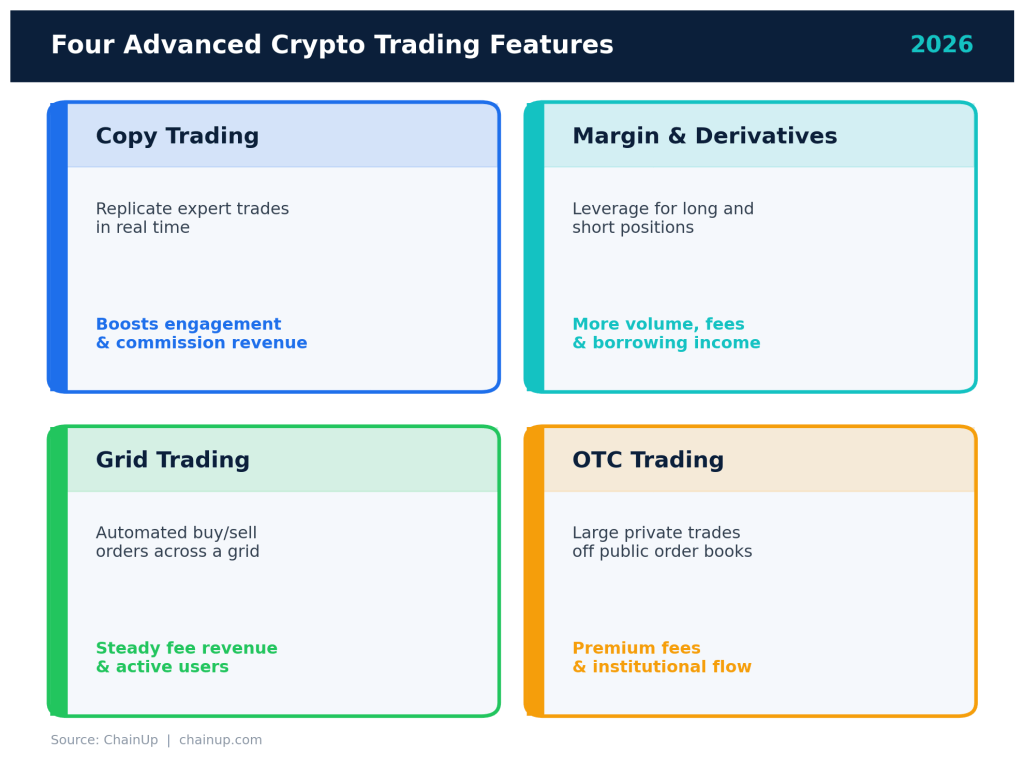
What Is Copy Trading and How It Grows Your User Base
Copy trading allows users to replicate the trading strategies and execution moves of experienced professionals in real time. It flattens the learning curve for retail beginners, who can follow seasoned traders without needing deep market knowledge of their own.
The model is spreading fast. The broader social and copy trading market is valued at roughly 2.82 billion dollars in 2026, with copy trading alone projected to grow past 10 billion dollars by 2034.
For exchanges, the primary value is community development. Copy trading connects novice participants with veteran traders, creating an active environment where strategies are shared openly. Followers monitor leaderboards, tweak risk settings, and discuss performance, which significantly increases session time and lowers churn.
- Monetizing expertise. Reward top-performing traders with performance-based commissions, which keeps experts loyal while pulling in less experienced users who want to follow them.
- Higher engagement. Followers actively watch copied trades, adjust risk settings, and explore other parts of the platform, which reduces churn.
- Transparency and trust. Displaying detailed metrics such as drawdowns, win ratios, and long-term trends builds credibility and gives new users the confidence to start.
Effective copy trading depends on customization. Adjustable stop-loss levels, risk caps, and trader analytics let users tailor their exposure, which makes the platform feel personal and drives adoption.
What Is Margin Trading and How Leverage Boosts Volume
Margin trading allows users to borrow capital from the platform to increase their position sizes, amplifying both potential gains and losses. It appeals directly to experienced traders comfortable managing leverage risk, driving larger trade sizes and deeper platform liquidity.
That larger flow deepens liquidity and creates revenue from interest and fees. Sound implementation, however, requires robust risk controls to protect users and the platform during volatile conditions.
Leverage is usually written as a ratio such as 2:1 or 10:1, which shows how much a trader can borrow relative to their own capital. The table below walks through a 5:1 example so the mechanics are clear.
| Item | Amount Example |
| Trader capital (margin) | $1,000 |
| Leverage ratio | 5:1 |
| Borrowed funds | $4,000 |
| Total trading position | $5,000 |
| Result of a 10% price rise | +$500 profit (a 50% return on margin) |
| Result of a 10% price drop | -$500 loss (five times the unleveraged loss) |
The same 10 percent move that would earn only 100 dollars without leverage now earns 500 dollars, and the downside scales in exactly the same way. That two-sided reality is why margin products live or die on risk management.
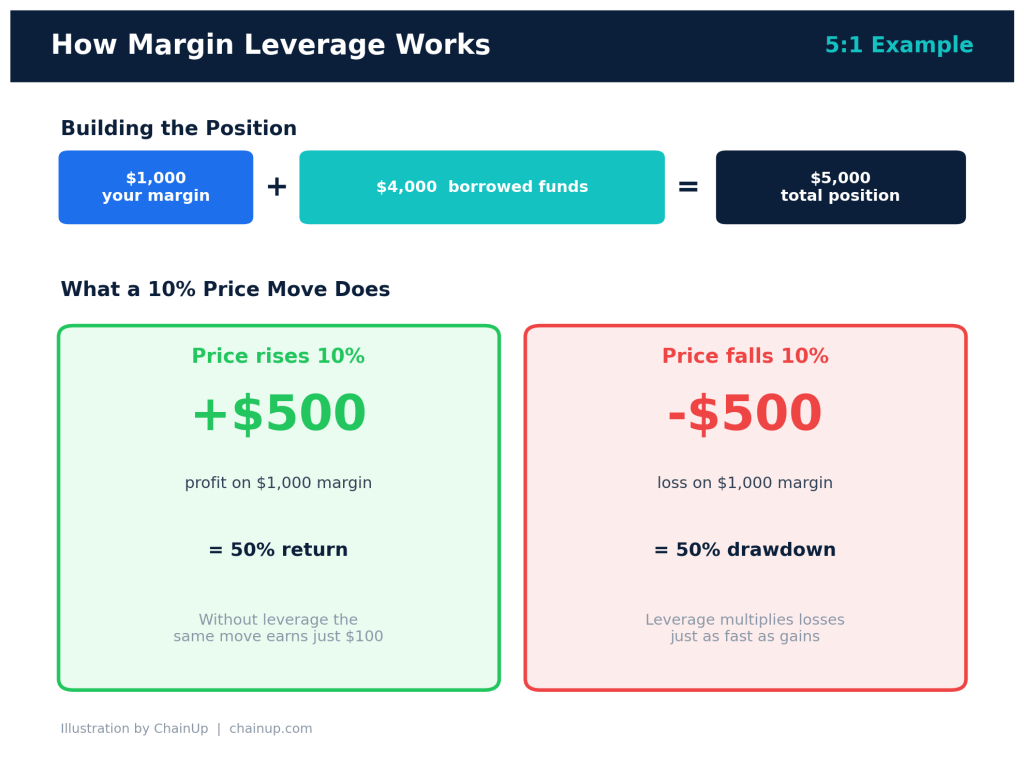
The advantages for operators are significant when the controls are in place.
- Higher trading volume. Larger leveraged trades increase liquidity and generate more transaction-based fees.
- Diversified revenue. Platforms earn on multiple fronts here, including interest and borrowing fees charged every time a trader takes out funds, funding rates on perpetual positions, and liquidation penalties, all of which add income even during quieter markets.
- Advanced-user appeal. Sophisticated leverage options and risk tools draw the professional traders who trade most often.
To keep margin products safe and profitable, platforms should invest in AI-powered margin call systems, real-time analytics on leverage usage, and dynamic interest rates. These same fundamentals of fees, security, and liquidity separate resilient platforms from fragile ones.
What Is Grid Trading and How Automation Drives Fees
Grid trading is an automated trading strategy that places buy and sell orders across predefined price intervals, forming a geometric grid of orders that profits from market volatility. Because the system executes without constant manual supervision, users capture small price fluctuations around the clock.
For exchanges, grid trading generates continuous, automated transaction volume, keeping order books active and producing steady fee revenue even during low-volatility periods. Providing robust backtesting tools, AI-optimized grids, and user-friendly configuration panels turns basic trading bots into high-retention product differentiators.
What Is OTC Trading and How It Attracts Institutions
Over-the-counter (OTC) trading handles large-scale transactions directly between buyers and sellers away from public order books. Executing block trades off-book prevents sudden price slippage, maintaining discretion and market stability for high-net-worth individuals and institutional clients.
The institutional wave is now the dominant story in crypto. The OTC market clears an estimated 50 to 60 billion dollars in average daily volume in 2026, institutions account for roughly 72 percent of spot OTC flow on leading desks, and more than 55 percent of institutional OTC trades are priced by AI-driven models. Building a credible desk is one of the surest ways to capture that flow, and dedicated OTC desks have become a meaningful B2B revenue line for exchanges.

The advantages of a strong OTC offering are clear.
- Higher profit margins. Large trades often carry premium fees, which creates outsized revenue opportunities.
- Deeper institutional relationships. Dedicated account managers and tailored support build trust and lasting partnerships with high-value clients.
- Greater market stability. Moving large trades off public exchanges prevents disruptive price swings and keeps conditions predictable.
A successful desk needs more than a matching engine. It requires secure and scalable infrastructure, enhanced KYC and AML protocols, white-glove service, and seamless connections to liquidity providers for fast execution. Integrating deep liquidity through smart order routing helps a desk fill large tickets at competitive prices.
4 Advanced Trading Features at a Glance
Each feature serves a different trader and drives revenue and engagement in its own way, so most platforms benefit from offering the full set rather than choosing one. The summary table gives a quick view of who each feature targets, how it earns, and how it keeps users active.
| Feature | Best for | How it drives revenue | How it boosts engagement |
| Copy trading | Beginners and community builders | Performance commissions and higher trade activity | Social leaderboards and follower interaction that lift session time |
| Margin and derivatives | Experienced active traders | Interest, borrowing fees, funding rates, and liquidation penalties | Long and short strategies that bring traders back to manage positions |
| Grid trading | Retail and algorithmic traders | Steady, high-frequency trading fees | Always-on automation that keeps accounts active around the clock |
| OTC trading | Institutions and high-net-worth clients | Premium fees on large tickets | Dedicated relationships that turn into repeat institutional flow |
Layering these features on flexible white-label trading platforms lets a business launch quickly and monetize each stream as demand shifts.
Reliable blockchain API integration then keeps wallets, settlement, and data flowing across every product, so more activity means more fee revenue rather than more operational strain.
Build a Centralized Exchange That Traders Will Not Leave
Advanced trading features are the sharpest edge a centralized exchange has in 2026.
They are what convince an active trader to fund an account and stay, and they turn a plain order book into a business with copy trading commissions, margin and derivatives income, steady grid fees, and premium OTC margins all working at once. Spot trading gets a user in the door, but these features are what make them profitable to keep.
This is exactly where a purpose-built centralized exchange solution pays off.
ChainUp provides operators a full feature stack out of the box, with copy trading, margin and derivatives, grid trading, and OTC ready to launch on secure and scalable infrastructure, backed by the risk controls and deep liquidity that make each feature safe to run at volume.
If you want to see how the leading providers stack up, our overview of the best white-label crypto exchange providers is a useful starting point.
Your competitors are already shipping these features. When you are ready to move faster than them, reach out to ChainUp today and let our team help you launch a centralized exchange that wins active traders and keeps them.


