

Key Takeaways
- BTC-USDT and ETH-USDT anchor the global crypto derivatives market, controlling roughly 69% of aggregate perpetual open interest ($34.81B and $22.95B, respectively).
- Altcoin perpetuals are the growth story: XRP (+42.3%) and DOGE (+40.8%) posted the fastest weekly open interest growth, driven by ETF speculation and retail momentum.
- SOL-USDT is the third pillar of crypto derivatives at $4.33B open interest, with Solana-native perp DEX volume hitting $105.6B in Q1 2026.
- Perpetual futures now account for ~97% of all crypto derivatives activity, with total volume growing from $4.14T (Jan 2024) to $7.24T (Jan 2026) — a 75% jump even as market cap fell 40%.
- For exchange operators, offering a competitive perpetual engine is no longer optional — the top 5 contracts alone represent $65B+ in live open interest and the strongest fee-generation opportunity in crypto derivatives.
Perpetual contracts now account for roughly 75% of all trading activity on centralized exchanges, and that figure keeps climbing. Combined crypto perpetual futures volume surged from $4.14 trillion in January 2024 to $7.24 trillion by January 2026.
What makes this growth remarkable is that it happened against a backdrop of shrinking market capitalization, proving that perpetual contracts thrive on volatility in both directions.
For exchange operators, quantitative desks, and institutional brokers, evaluating derivatives performance requires analyzing the metrics behind capital allocation, funding efficiency, and order book depth.
What Are Perpetual Contracts and How Does Open Interest Measure Capital Conviction?
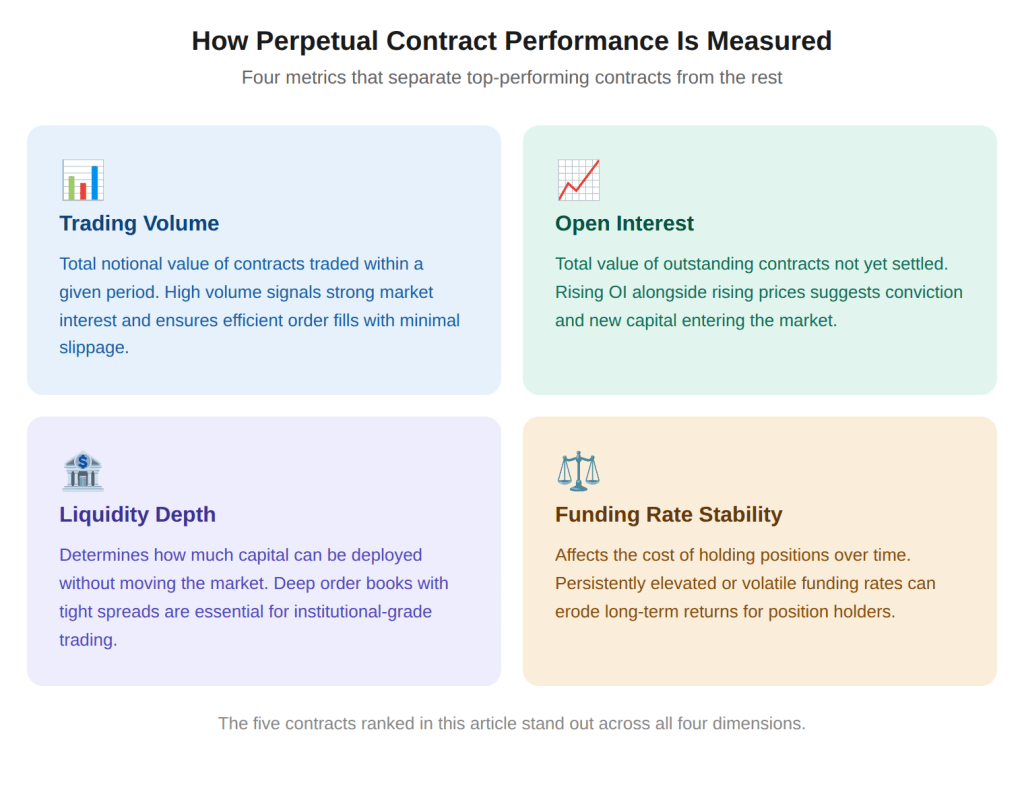
Before ranking individual contracts, it is worth clarifying the metrics that define performance. Trading volume reflects market interest and fee generation potential.
Open interest reveals how much capital is actively committed. Liquidity depth determines how efficiently large orders execute. Funding rate stability affects the cost of holding positions over time.
What Are Perpetual Contracts?
Perpetual contracts are a type of derivative that lets traders gain long or short exposure to an asset without owning it directly and without dealing with an expiry date.
Unlike traditional futures, which settle on a fixed date, perpetuals remain open indefinitely as long as the trader maintains enough margin to support the position.
This structure makes them especially popular in crypto, where traders want continuous exposure without rolling contracts forward every few weeks or months. Perpetual contracts are typically traded with leverage, which means a trader can control a larger position with a smaller amount of collateral. That also means gains and losses are amplified.
To keep the contract price close to the underlying spot price, perpetual markets use a funding rate mechanism. When the perpetual trades above spot, longs usually pay shorts. When it trades below spot, shorts usually pay longs. This creates an economic incentive that helps keep the market aligned.
In practice, perpetual contracts are widely used for speculation, hedging, and tactical portfolio management because they combine flexibility, leverage, and continuous market access in one instrument.
What Is Open Interest?
Open interest refers to the total number of active derivative contracts that remain open in the market and have not yet been closed, expired, or settled. In perpetual futures, it represents the total value or number of positions currently being held by traders.
It is important not to confuse open interest with trading volume. Volume measures how much trading happened during a given period. Open interest measures how much exposure is still live in the market at a specific point in time.
For example, if one trader opens a long position and another takes the short side, open interest rises because a new contract has been created. If one of those traders later closes the position and the contract is removed, open interest falls.
Open interest matters because it helps show how much capital and conviction are behind a market. Rising open interest often suggests that new money is entering and positions are building.
Falling open interest can indicate that traders are reducing exposure or that momentum is weakening. In articles about top-performing perpetual contracts, open interest is useful because it shows not just which markets moved, but which ones attracted sustained trader participation.
Top 5 Perpetual Contracts by Open Interest

| Rank | Contract | Open Interest (Early 2026) | OI Weekly Growth | 7D Funding Rate (Annualized) |
| 1 | BTC-USDT | $34.81B | +9.1% | ~10–15% |
| 2 | ETH-USDT | $22.95B | +8.8% | ~3.75% |
| 3 | SOL-USDT | $4.33B | +12.5% | ~2.08% |
| 4 | XRP-USDT | $2.21B | +42.3% | ~7.70% |
| 5 | DOGE-USDT | $1.00B | +40.8% | ~0.63% |
1. BTC-USDT: The Benchmark of Crypto Derivatives
Bitcoin’s perpetual contract is the single most traded derivative instrument in crypto. On Binance alone, BTC perpetual volume consistently runs five to ten times higher than spot, with the ratio spiking above 20x during volatile periods.
Binance holds approximately 29–30% of all Bitcoin futures open interest, followed by Gate, Bybit, and Bitget in the 11–14% range.
What keeps BTC perps dominant is the convergence of deep multi-venue liquidity, institutional adoption through products like CME Bitcoin futures, and Bitcoin’s role as the market-wide hedging benchmark. Stable funding rates also make BTC the preferred pair for cash-and-carry arbitrage strategies favored by institutional desks.
2. ETH-USDT: The Backbone of DeFi Hedging
Ethereum holds the second-largest share of perpetual open interest at roughly $22.95 billion. The ETH perp benefits from a healthy upward-sloping funding term structure, with the 7-day annualized rate at 3.75% and the 180-day rate climbing to 4.45%. This signals sustained demand for leveraged long ETH exposure over time.
Beyond speculation, ETH perpetuals serve as the primary hedging tool for the massive DeFi ecosystem. Protocols managing billions in TVL use ETH perps for delta-neutral strategies and vault risk management.
This structural demand creates a consistent activity floor that makes ETH perps less dependent on pure retail momentum. On decentralized perpetual exchanges like Hyperliquid and dYdX, ETH is the second-most-popular market after BTC.
3. SOL-USDT: The High-Beta Altcoin Leader
Solana’s perpetual contract has earned its place as the third pillar of crypto derivatives. SOL open interest surged 12.5% in a single week in early 2026, reaching $4.33 billion. On-chain perpetual trading volume on Solana itself hit $105.6 billion in Q1 2026, driven by platforms like Jupiter Perps and Drift Protocol.
SOL perps attract active traders seeking directional volatility rather than basis arbitrage. The 30-day funding rate compressed to near zero, limiting carry opportunities, but the contract’s high-beta nature delivers outsized moves during trending markets.
Exchange operators offering SOL perpetuals should invest in robust risk management and liquidity infrastructure to handle the contract’s sharper drawdown profile.
4. XRP-USDT: The ETF Speculation Play
XRP staged a remarkable derivatives comeback in early 2026. Open interest surged 42.3% in one week to $2.21 billion as speculation around a spot XRP ETF approval intensified. The 7-day annualized funding rate reached 7.70%, the highest among all major perpetual contracts during that period, reflecting aggressive long-side positioning.
The XRP perp’s performance is largely event-driven. Regulatory catalysts, ETF filings from major financial institutions, and cross-border payment milestones create sharp volume spikes.
For sophisticated traders, the elevated funding premium creates opportunities for delta-neutral funding capture strategies. For exchange operators, XRP perpetuals drive high engagement during catalyst-heavy windows.
5. DOGE-USDT: The Retail Engagement Driver
DOGE-USDT perpetual open interest surged 40.8% in early 2026 to reach the $1 billion milestone.
While meme coins might seem unconventional for institutional-grade platforms, the numbers tell a different story. DOGE perps consistently rank among the most actively traded altcoin derivatives on major exchanges.
The DOGE perpetual thrives on narrative momentum, social media catalysts, and retail accessibility. Funding rates are more volatile than large-cap pairs but remain manageable during calmer periods.
For exchanges targeting retail demographics, the DOGE-USDT perpetual is a proven engagement driver that keeps traders active on the platform.
Liquidity Fragmentation: Evaluating True Execution Quality Behind the Metrics
Headline open interest figures do not always translate to clean execution. A perpetual pair may display impressive aggregate volume while liquidity remains split across isolated venues, order books, and Layer 1/Layer 2 ecosystems.
In practice, fragmentation usually appears in three ways: open interest is split across venues instead of concentrated in one deep market, prices diverge across exchanges during volatility, and apparent liquidity depends too heavily on a small number of market makers.
A contract can look strong on headline metrics while still becoming expensive to trade when market conditions tighten.
For traders, this means performance alone is not enough. A perpetual contract with impressive momentum but shallow or fragmented liquidity may carry higher slippage, faster liquidation cascades, and more unstable funding behavior than a deeper market.
For operators and institutions, it also raises the importance of aggregation, oracle quality, and venue selection when evaluating where real liquidity actually sits.
Why Cash-and-Carry Arbitrage Signals a Mature Perp Market
Cash-and-carry arbitrage is one of the clearest indicators that a perpetual market has matured. The trade typically involves buying the underlying asset in the spot market and shorting the perpetual contract when the perp is trading at a premium.
If funding stays positive, the trader collects funding on the short side while using the spot leg to offset directional market exposure.
This strategy works best on top-tier perpetual contracts because those markets usually provide the conditions professional desks need:
- deeper liquidity
- tighter spreads
- more stable funding behavior
- stronger open interest and market participation
The logic is straightforward:
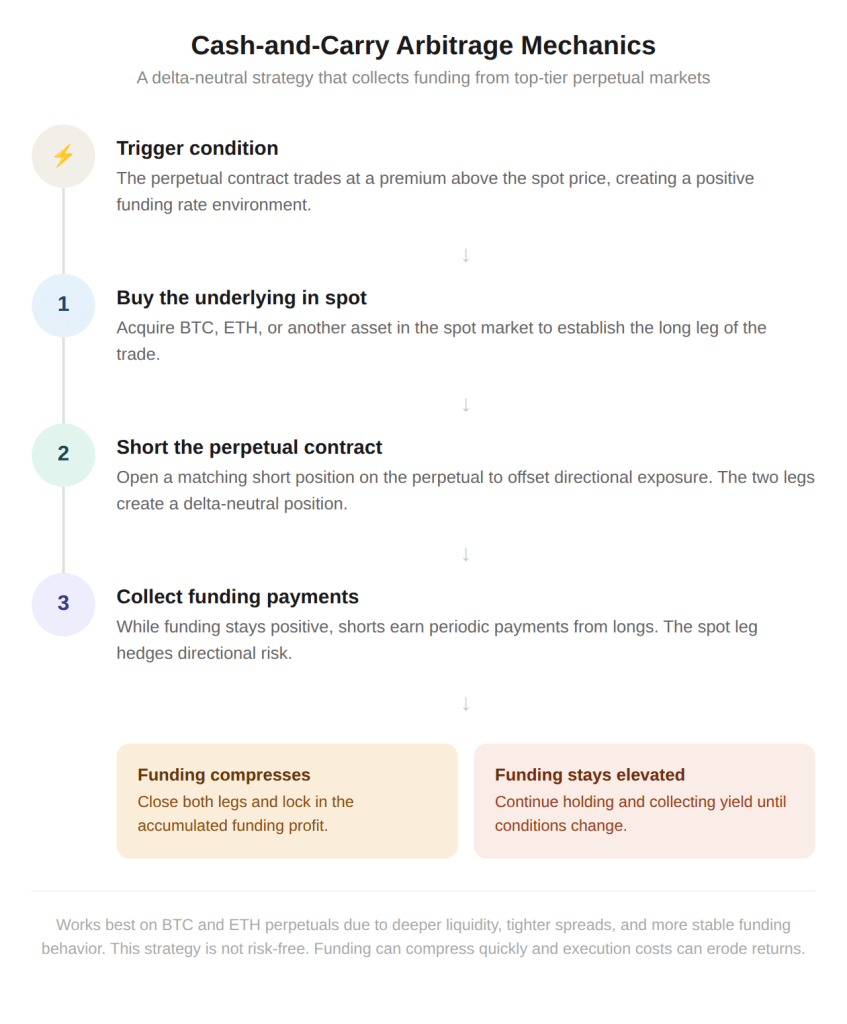
The trade is not risk-free. Funding can compress quickly, execution costs can erode returns, and the basis relationship can shift during periods of stress.
Even so, cash-and-carry remains one of the most important strategies in institutional derivatives markets because it helps anchor perpetual prices back toward spot and attracts more disciplined professional liquidity.
The Rise of Real-World Asset (RWA) Perpetual Futures
One of the most closely watched areas in crypto derivatives is the emergence of perpetual contracts linked to real-world assets, or RWAs.
Instead of limiting perpetual exposure to crypto-native assets, newer markets are beginning to explore synthetic or tokenized exposure to Treasury yields, commodities, equities, private credit, and foreign exchange.
The appeal is clear. RWA perpetuals could extend the always-on, globally accessible nature of crypto derivatives into markets that have traditionally been limited by geography, market hours, and legacy settlement systems.
For traders, that creates new ways to gain exposure and hedge risk. For platforms, it opens the door to a broader product mix that may attract institutions already familiar with those underlying asset classes.
The opportunity, however, depends on infrastructure. RWA perpetuals require accurate oracle design, stronger compliance controls, and legally durable links between the on-chain contract and the off-chain reference asset.
The concept is advancing faster than the market is fully maturing, but the direction is increasingly clear. As tokenization expands and on-chain market structure improves, RWA perpetuals are becoming one of the next major frontiers in derivatives innovation.
Scaling Institutional Derivatives: What Operators Need to Compete
Three macro forces are reshaping the perpetual contract landscape in 2026. Decentralized perpetual DEX volume jumped roughly eightfold in two years, with Hyperliquid alone processing $625.3 billion in Q1 2026.
Real-world asset perpetuals now track commodities, stock indices, and individual equities. And regulatory frameworks from the CFTC, MiCA, and SGX are creating structured pathways for compliant derivatives trading.
With perps accounting for nearly 97% of all derivatives activity, offering a robust perpetual trading engine is the defining feature that separates competitive exchanges from those falling behind.
Building an enterprise derivatives platform in-house requires solving immense architectural challenges: matching engine microsecond throughput, real-time multi-asset margin calculation, automated liquidation engines, and multi-protocol API connectivity (REST, WebSocket, FIX 4.4).
As an enterprise financial technology provider, ChainUp delivers end-to-end, institutional-grade white-label exchange and derivatives infrastructure:
- High-Throughput Matching Engine: Engineered to process hundreds of thousands of transactions per second with microsecond-level latency, preventing execution lag during extreme volatility.
- Advanced Risk & Margining Systems: Real-time calculation of tiered maintenance margin, cross/isolated collateral management, and multi-tier liquidation safeguards that prevent bad debt.
- Global Liquidity Network: Turnkey connectivity to deep global liquidity pools, ensuring tight spreads and institutional depth across 2,000+ spot and derivatives pairs from day one.
- Integrated MPC Custody & Compliance: Enterprise Multi-Party Computation wallet security coupled with built-in KYT/AML transaction monitoring.
Whether expanding an existing exchange into leveraged contracts or launching a dedicated derivatives platform, deploying proven institutional infrastructure ensures operational resilience, capital protection, and sustainable market leadership.
Request a demo today and discover how ChainUp can power your exchange infrastructure.