

Key Takeaways
- Kalshi reached a $22 billion valuation in May 2026 on three pillars: a CFTC license, 87% sports volume share driving $39.7B trailing-year volume, and distribution rented from retail brokers like Robinhood (which alone generated 50%+ of Kalshi’s flow).
- The US prediction market is now effectively locked by four barriers: CFTC licensing timelines, Kalshi’s $14.1B 30-day liquidity lead, pre-committed distribution partners, and over 20 active lawsuits plus a pending Supreme Court case.
- Sports dominate because of event frequency, parlay stackability (38% of Kalshi’s July volume), and seasonal spikes — the FIFA World Cup alone drove $31B in a single month.
- Untapped market share remains outside the US across local football leagues (Europe, LatAm), cricket (South Asia), and esports (Southeast Asia)—regions where global platforms lack localization and local payment rails.
- Existing exchanges and brokerages hold the primary asset Kalshi had to rent: a pre-KYC’d retail base. Deploying turnkey white-label infrastructure compresses launch timelines from 12–18 months down to 4–8 weeks while cutting initial capital expenditure.
On September 24, 2026, a PitchBook report on Kalshi’s valuation placed the company’s worth between $22.8 billion and $42.1 billion. Days earlier, reports surfaced that Kalshi was raising new capital at a $40 billion valuation. Both milestones trace back to one key turning point.
In May 2026, Kalshi closed a $1 billion Series F at a $22 billion valuation, doubling its valuation in just five months.
The NFL season accelerated activity further. Over the weekend of October 24 and 25, prediction markets traded more than $14 billion in notional volume, the largest two-day total on record. Kalshi generated $10.06 billion of it, including more than $442 million on NFL games that Sunday.
Kalshi achieved this scale through three primary advantages: it holds a CFTC license, built its liquidity engine on high-frequency sports contracts, and rented distribution from the largest retail brokerages in the US.
For exchange operators and brokers evaluating prediction markets as a revenue line, this model provides the roadmap.Institutional and retail demand is proven, and significant white space remains in regional and vertical-specific markets.
Kalshi Valuation Timeline From $2 Billion to $22 Billion
Kalshi’s valuation grew elevenfold in less than a year. The table below tracks each step.
| Date | Funding Event | Valuation |
| June 2025 | Funding round | $2 billion |
| October 2025 | Funding round | $5 billion |
| December 2025 | $1 billion Series E | $11 billion |
| May 2026 | $1 billion Series F led by Coatue | $22 billion |
| September 2026 | Reported new raise | $40 billion (unconfirmed) |
Sequoia Capital, Andreessen Horowitz, IVP, Paradigm, Morgan Stanley, and ARK Invest participated in the Series F.
According to Kalshi’s Series F announcement, annualized trading volume more than tripled in six months, rising from $52 billion to $178 billion. Institutional volume rose 800% over the same period, and Kalshi claimed more than 90% of US prediction market activity. The company also told Bloomberg that annualized revenue had passed $1.5 billion.
The Three Factors Behind Kalshi’s $22B Valuation
Kalshi combined three distinct moats that solved the primary cold-start barriers facing new prediction venues:
- A CFTC license. Kalshi is the only CFTC-regulated prediction market operating at scale in the US. That status locks out most competitors from offering event contracts and gives Kalshi legal certainty that Polymarket and offshore venues can’t match. The license took years to secure — a timeline new entrants cannot compress.
- Sports volume. About 87% of Kalshi’s $39.7B trailing-year volume came from sports contracts — a category built on daily event frequency, parlay stackability, and seasonal spikes. Those three dynamics recycle capital into new positions constantly, which is why Kalshi’s volume compounded faster than any other prediction market in 2026.
- Rented distribution. Rather than build consumer apps, Kalshi plugged into existing user bases at Robinhood, Coinbase, Webull, and FanDuel. Robinhood alone has generated more than half of Kalshi’s volume. The customer acquisition cost that would normally take years and millions to build was effectively subsidized by partners.
Together, these factors explain Kalshi’s trajectory—and why the domestic US market is now heavily consolidated against late entrants.

Why Sports Contracts Drive 87% of Kalshi’s Volume
According to the Congressional Research Service, about 87% of Kalshi’s $39.7 billion in trailing 12-month volume through early 2026 came from sports contracts.
Polymarket’s sports share was closer to 38%. Kalshi executives argue the share has since dropped toward 70%, but independent trackers still place sports and parlays in the 85% to 90% range.
Three structural factors explain why sports dominate.
- Event frequency. Games settle every day, so capital recycles into new positions quickly.
- Combos and parlays. Multi-leg sports contracts made up 38% of Kalshi volume in the 30 days ending July 8, 2026.
- Seasonal peaks. The FIFA World Cup pushed Kalshi past $31 billion in June 2026 alone.
The lesson for operators is simple. Prediction market volume follows the categories with the highest event frequency and the strongest local fan base.
Outside the US, those categories look different. Football in Europe and Latin America, cricket in South Asia, and esports in Southeast Asia all carry the same daily cadence that powered Kalshi.
How Robinhood, Coinbase, and DraftKings Distribute Kalshi’s Markets
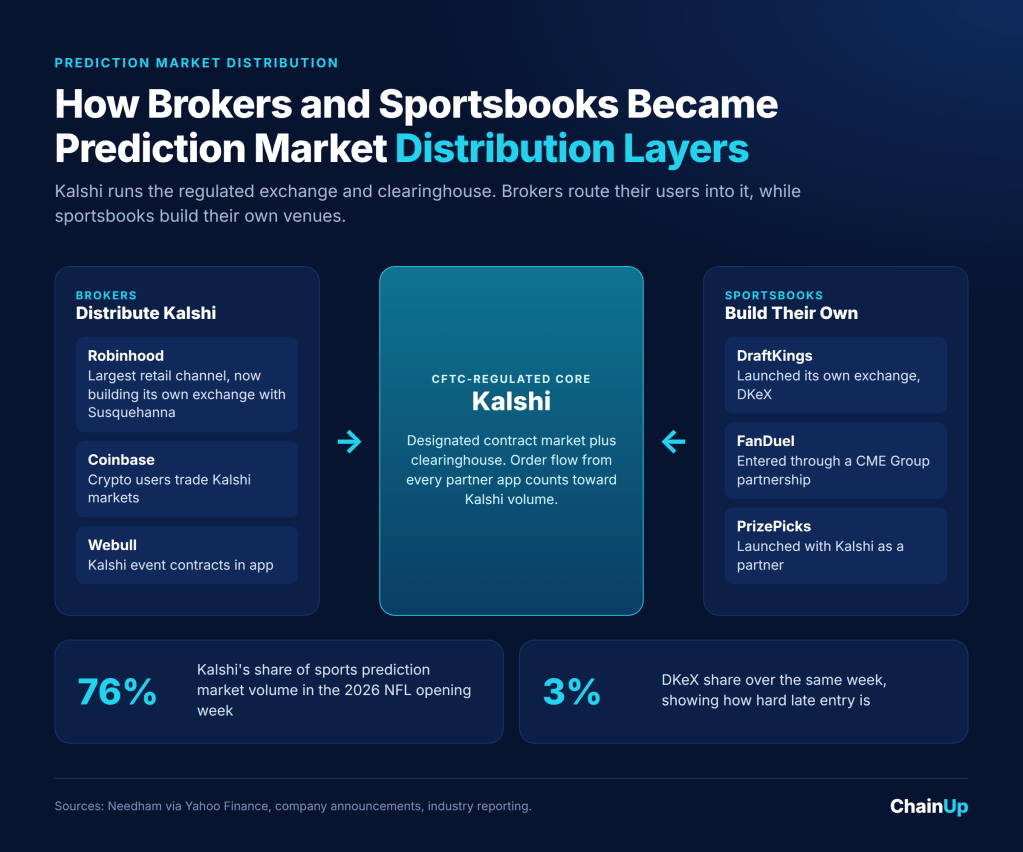
Kalshi operates as a regulated exchange and clearinghouse. Most of its retail flow arrives through partner apps rather than its own front end. Industry reporting in late 2025 found that Robinhood alone generated more than half of Kalshi’s volume.
The table below shows how the largest US consumer brands entered the category.
| Company | Type | Prediction Market Model |
| Robinhood | Retail broker | Distributes Kalshi contracts and is building its own exchange with Susquehanna |
| Coinbase | Crypto exchange | Distributes Kalshi markets to crypto users |
| Webull | Retail broker | Offers Kalshi event contracts in app |
| DraftKings | Sportsbook | Launched its own exchange, DKeX |
| FanDuel | Sportsbook | Entered through a partnership with CME Group |
Late entry has proven difficult. Needham data showed Kalshi captured 76% of sports prediction market volume in the 2026 NFL opening week, while DKeX took just 3%. Even a sportsbook with millions of users struggled to pull liquidity away from an established venue.
Why Prediction Market Demand Still Has Room to Grow
Demand for prediction markets is real, and it is still accelerating. The ceiling is defined by supply — how many venues, categories, and jurisdictions can serve the demand — not by whether users want these products. Right now, supply still trails demand in every market outside US sports.
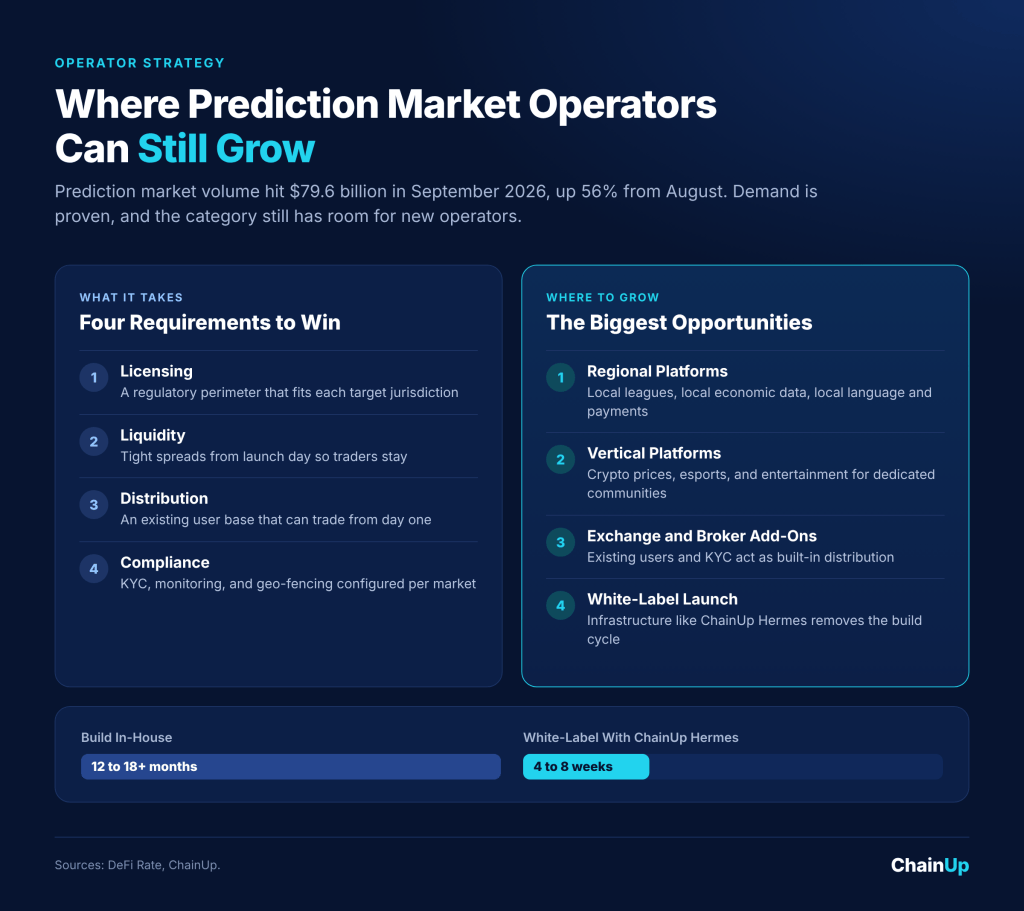
The DeFi Rate volume tracker shows volume across tracked venues reached $79.6 billion in September 2026, up 56% from August. The 30 days ending October 28 passed $119 billion as the NFL, college football, and the World Series overlapped.
Growth is also spreading beyond one venue. Kalshi held 76% of that 30-day volume, while Polymarket US grew to 12%. DraftKings Predictions reached $684 million over the October 24 weekend, up from $567 million the week before. New venues win volume when they bring their own users.
Capturing that growth comes down to four requirements.
- Licensing. A regulatory perimeter that fits each target jurisdiction.
- Liquidity. Tight spreads from launch day so traders stay.
- Distribution. An existing user base that can trade from day one.
- Compliance. KYC, transaction monitoring, and geo-fencing configured per market.
Operators who already meet the distribution requirement start with the hardest piece in place.
Where the Biggest Prediction Market Opportunities Are
The next wave of growth sits in markets where no single venue owns local events, local payments, or local users. Operators can capture it through three models.
| Model | Focus | Why It Works |
| Regional platforms | Local leagues, central bank decisions, local economic data | Global venues rarely list these events or support local languages and payments |
| Vertical platforms | Crypto prices, esports, entertainment | Dedicated communities bring high event frequency |
| Exchange and broker add-ons | Event contracts inside an existing app | Existing users and completed KYC provide built-in distribution |
The third model carries the clearest lesson from Kalshi. Robinhood’s user base became Kalshi’s biggest growth engine.
A crypto exchange or broker with an active user base already holds the asset Kalshi had to rent. Operators comparing paths can review prediction market solutions for operators to weigh building against white label.
How White-Label Infrastructure Speeds Up Prediction Market Launch
Building a prediction market in-house takes 12 to 18 months or more and millions in upfront spending. A white-label deployment reaches the market in four to eight weeks, significantly lowering engineering overhead and total cost of ownership.
ChainUp white-label prediction market platform is built for this path, delivering the core infrastructure needed to win and retain volume:
- Feature parity with Kalshi and Polymarket from day one. 1:1 spec match — CLOB engine, CTF condition tokens, full pro order types (Limit, GTC, FOK, FAK), gasless trading via relayer. Launch with the same capabilities as market leaders, not a stripped-down v1.
- Day-one liquidity solves the cold start problem. A shared liquidity pool absorbs opening volume and keeps spreads tight, so first users don’t bounce on bad fills. See our guide to prediction market liquidity.
- Instant payouts earn repeat trades. Oracle-verified settlement pays users within seconds, versus the one-to-six-hour delay market leaders still carry. Capital recycles faster, lifetime value climbs.
- Four revenue streams in one platform. Trade and settlement fees, market-making spreads, yield on collateral float, B2B listing fees for sponsored markets.
- Full operator control. Granular fee engine (event, category, platform level), event creation wizard, content curation, lifecycle grouping for sports seasons and election cycles. You run the business, not the vendor.
- Enterprise risk and ops built in. Role-based admin, audit logs, automated cash-out risk engine, multi-channel alerting, and real-time dashboards for revenue, volume, and oracle status.
Kalshi’s $22 billion valuation came from a license, a high-frequency category, and distribution at scale. Exchange operators and brokers already own distribution, and ChainUp supplies the rest in weeks instead of years. Talk to the ChainUp team to launch a branded prediction market built for your region.