
Key Takeaways
- RegTech is the essential software layer that enables crypto platforms to automate anti-money laundering (AML), Know Your Customer (KYC), sanctions screening, and Travel Rule compliance at scale.
- The regulatory environment has tightened drastically in 2026, highlighted by the full enforcement of the EU’s Markets in Crypto-Assets (MiCA) framework and the Financial Action Task Force reporting that 83% of surveyed jurisdictions have codified the Travel Rule.
- The scale of illicit risk requires automated defenses, with illicit addresses receiving $154 billion in 2025 (representing under 1% of total attributed volume), alongside billions lost to hacks and fraud.
- Point-solution fragmentation creates operational risk, pushing modern platforms to adopt unified infrastructure that embeds compliance directly into onboarding, custody, and transaction layers.
- Proactive RegTech protects both users and operators by safeguarding banking relationships, preventing the inadvertent handling of tainted capital, and keeping platforms licensed across global jurisdictions.
If you have ever had a crypto withdrawal held for review or a deposit blocked out of nowhere, you have already run into RegTech without knowing its name. It is the invisible system that decides, often in seconds, whether the money moving through your account looks clean or risky.
That system matters more to everyday users than most people realize. In 2025 alone, people in the United States reported $11.4 billion in crypto-related fraud losses to the FBI, and hackers stole roughly $3.4 billion more across the wider ecosystem.
The rules meant to catch that activity keep tightening, and RegTech is what quietly puts them to work on the apps and exchanges you use every day.
You feel it every time a platform asks for more identification, delays a withdrawal, or blocks a transfer from a high-risk wallet.
What Is RegTech and Why It Matters for Crypto
RegTech, short for regulatory technology, is the use of modern software to help companies meet legal and regulatory obligations more accurately and at lower cost. It lives at the intersection of finance, law, and technology, and in day-to-day practice it does four jobs.
It monitors transactions for suspicious patterns in real time, checks customers against global sanctions and watchlists, automates regulatory reporting and audit trails, and helps firms prove to regulators that they are following the rules.
The category is not small anymore. Analysts at Fortune Business Insights value the global RegTech market at around $23 billion in 2026 and project it to reach roughly $105 billion by 2034, a signal of how quickly regulated firms are moving compliance work into software.
RegTech first gained traction in heavily regulated sectors like banking and insurance, and as crypto volumes exploded and rules tightened, the same ideas moved into exchanges, wallets, brokers, and decentralized finance gateways.
Why Crypto Platforms Need RegTech More Than Ever
Public blockchains are programmable, borderless, and transparent. While those characteristics drive massive adoption, they also attract bad actors looking to exploit digital channels, forcing regulators to tighten requirements around user onboarding, transaction monitoring, and suspicious activity reporting.
The scale of risk is well-documented by blockchain forensics. Illicit cryptocurrency addresses have pulled in massive multi-billion-dollar figures annually, driven heavily by advanced nation-state sanctions evasion, coordinated crypto heists, and sophisticated online scams. For instance, high-profile exchange exploits—such as the multi-billion-dollar breach incidents targeting major platforms—underscore how aggressively adversaries target custody infrastructure. On the fraud front, global scam losses drain billions from retail participants every year.
The reassuring counterpoint is that illicit transfers consistently represent a minor fraction of total crypto volume, meaning the vast majority of network activity is legitimate. However, without automated RegTech tools, an exchange processing millions of daily transactions would have no realistic way to separate clean volume from dangerous capital.

How Crypto RegTech Workflows Operate Behind the Scenes
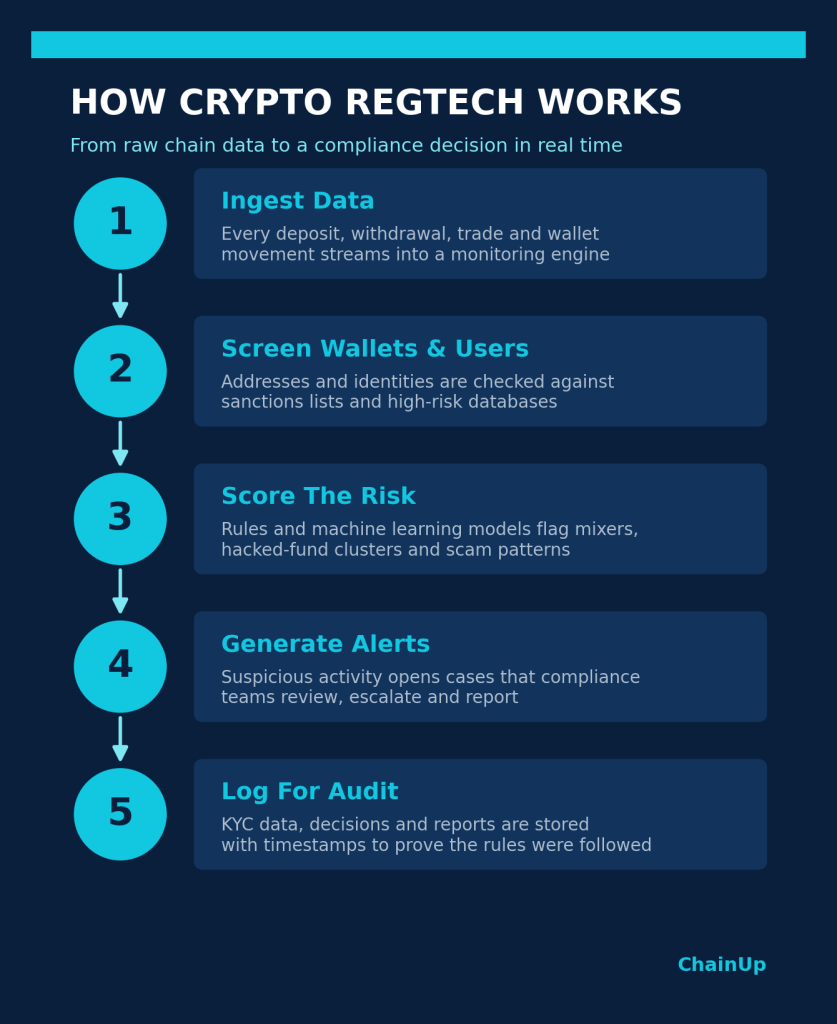
Most RegTech systems process data through a standardized operational pipeline. Understanding this sequence helps clarify why compliance checks occasionally introduce user friction:
| Pipeline Stage | What Happens Backend | What You Experience |
| Ingest data | Every deposit, withdrawal, trade, and wallet movement flows into a monitoring engine in real time | Nothing, this runs silently |
| Screen wallets and users | Addresses and identities are checked against sanctions lists and high-risk jurisdiction databases | Requests for ID or source of funds |
| Score the risk | Rules and machine learning models flag mixers, hacked-fund clusters, and classic scam patterns | Some deposits clear instantly, others pause |
| Generate alerts | Suspicious activity opens cases that compliance teams review, escalate, and report | Occasional account reviews or questions |
| Log for audit | KYC data, decisions, and reports are stored with timestamps | Indirect benefit through a stable, licensed platform |
That friction does not come from random paranoia. It comes from these systems doing their job so the platform can stay licensed and keep serving customers.
Blockchain Analysis vs Blockchain Analytics Explained
A lot of crypto RegTech runs directly on public blockchains, and it helps to separate two layers that people often blur together.
Blockchain analysis is forensic, technical work. It clusters addresses, traces funds through mixers and bridges, and builds graphs of which wallets interact with which services.
RegTech providers plug into this layer by running large-scale tracing across multiple chains, tagging wallets linked to hacks, scams, darknet markets, and sanctioned entities, and updating their heuristics as attackers change tactics.
Blockchain analytics is the product layer that compliance and security teams actually use. It converts on-chain patterns into risk scores such as high mixer exposure or hack-related funds, then feeds those scores into the monitoring tools that sit inside exchanges and fintech apps.
In short, vendors take raw chain data, enrich it through analysis, and deliver it as actionable analytics that platforms and even law enforcement rely on to flag risky deposits and trace stolen funds after a hack.
The 6 Core Types of Crypto RegTech Tools
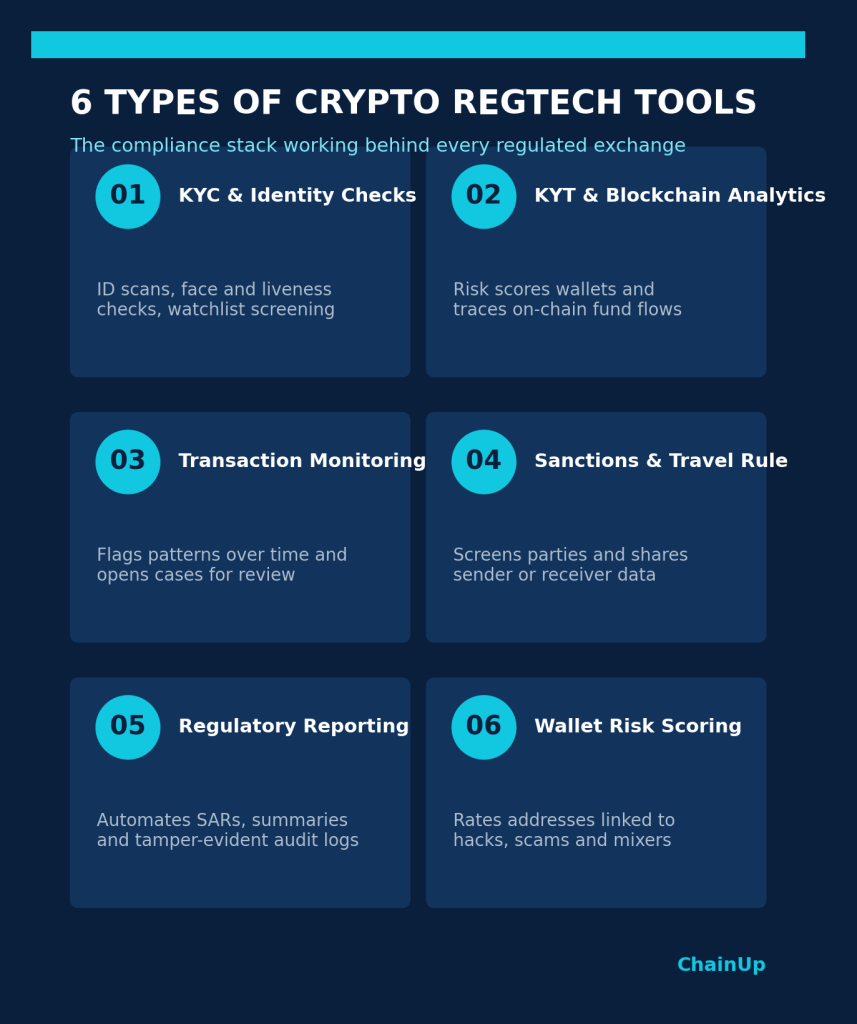
Compliance architectures in the digital asset sector generally rely on six core categories of software tooling:
| Tool | Core Job | How You Experience It |
| KYC and identity verification | Confirms who you are at signup and during reviews | The upload your ID and take a selfie flow |
| KYT and blockchain analytics | Scores each transaction by where funds came from | Some transfers clear, others get questioned |
| Transaction monitoring and case management | Watches behavior over time for suspicious patterns | Account reviews after unusual activity |
| Sanctions and Travel Rule solutions | Controls who a platform can transact with | Blocked destinations, extra checks on large sends |
| Regulatory reporting and audit tools | Automates filings and tamper-evident logs | Rarely visible, keeps the platform operational |
| Wallet and address risk scoring | Rates specific addresses for contamination | A clean wallet moves smoothly, a flagged one stalls |
A few of these deserve a closer look because they shape the user experience the most.
KYC and identity verification handles the identity checks when you sign up and during periodic reviews. Behind the scenes it validates your document, runs face-matching and liveness checks to confirm a real person is present, and cross-references your details against government and commercial databases before screening you against watchlists. Straightforward cases get auto-approved while edge cases go to human reviewers.
KYT, which stands for know your transaction, focuses on the money rather than the person. It analyzes on-chain activity, clusters addresses, and assigns each deposit and withdrawal a risk score based on where the funds came from and who they touched.
Low-risk flows pass automatically while high-risk flows trigger deeper checks, which is why one transfer clears instantly and another gets held.
Sanctions and Travel Rule solutions control where funds can legally go. Screening engines compare customers against sanctions and politically exposed person lists, while Travel Rule tools attach sender and receiver information to covered transfers between regulated firms.
This matters more each year, since FATF now reports that most surveyed jurisdictions have adopted the Travel Rule even though only about 40 percent are actively enforcing it, leaving an uneven global patchwork that platforms have to navigate carefully.
Key Benefits of RegTech for Crypto Users
Most users see RegTech as something that makes life harder with more forms, more delays, and more hoops. It does add friction, but it also protects you in three concrete ways.
- Safer platforms. Firms that invest in solid RegTech detect and remove scammers faster, block tainted funds before they mingle with user deposits, and stay on the right side of regulators and banking partners. That reduces the risk of surprise freezes or sudden shutdowns.
- Less chance of handling dirty coins. If you unknowingly receive stolen or sanctioned funds and forward them, you can get caught in a mess that is not your fault. Good analytics and sanctions screening flag high-risk flows before they land and give exchanges tools to isolate tainted funds.
- Clearer rules for the long term. RegTech gives regulators confidence that crypto businesses can follow rules at scale, which makes banks more willing to serve exchanges and helps governments move from blanket bans toward risk-based frameworks. Over time that tends to mean more reliable on-ramps and off-ramps and fewer debanking shocks.
Protect Your Platform With Integrated Infrastructure
RegTech is the backbone of modern digital asset compliance, ensuring the platforms you rely on stay secure and operational as transaction volumes grow. For founders and platform operators, choosing the right infrastructure partner determines whether compliance is a constant operational headache or a seamless native feature.
Platforms built on institutional-grade infrastructure—such as the exchange and wallet solutions provided by ChainUp—integrate advanced KYT monitoring, automated sanctions screening, and institutional-grade custody natively from day one. By baking compliance directly into the transaction layer, businesses protect their users, satisfy global regulators, and scale securely into new markets without friction.