

Key Takeaways
- The Liquidity Cold-Start Problem: New crypto exchanges struggle primarily due to a self-reinforcing loop: thin order books lead to high slippage, which drives active traders away and keeps books empty.
- How Aggregation Solves It: Liquidity aggregation breaks this cycle by linking an exchange’s matching engine to deep external venues, streaming synthetic depth and routing orders via Smart Order Routing (SOR).
- Core Evaluation Benchmarks: Founders should evaluate aggregation vendors based on order book depth within 0.1% to 1% bands under stress, tail latency (P99) from quote to fill, and cross-border regulatory compliance (including the FATF Travel Rule).
Liquidity is the first fight a new crypto exchange often loses. In the September 2026 TokenInsight exchange liquidity report, Binance and MEXC each held about $1.35 million in combined BTC and ETH spot depth within 0.01% of the mid-price.
Traders treat that level of depth as their baseline when testing a new platform. A new exchange launching with a blank order book cannot replicate this depth through organic trading volume alone—and few survive long enough to try.
Liquidity aggregation resolves this challenge by plugging a newly launched exchange into deep, external liquidity pools from day one.
The Cold-Start Problem in Crypto Exchange Liquidity
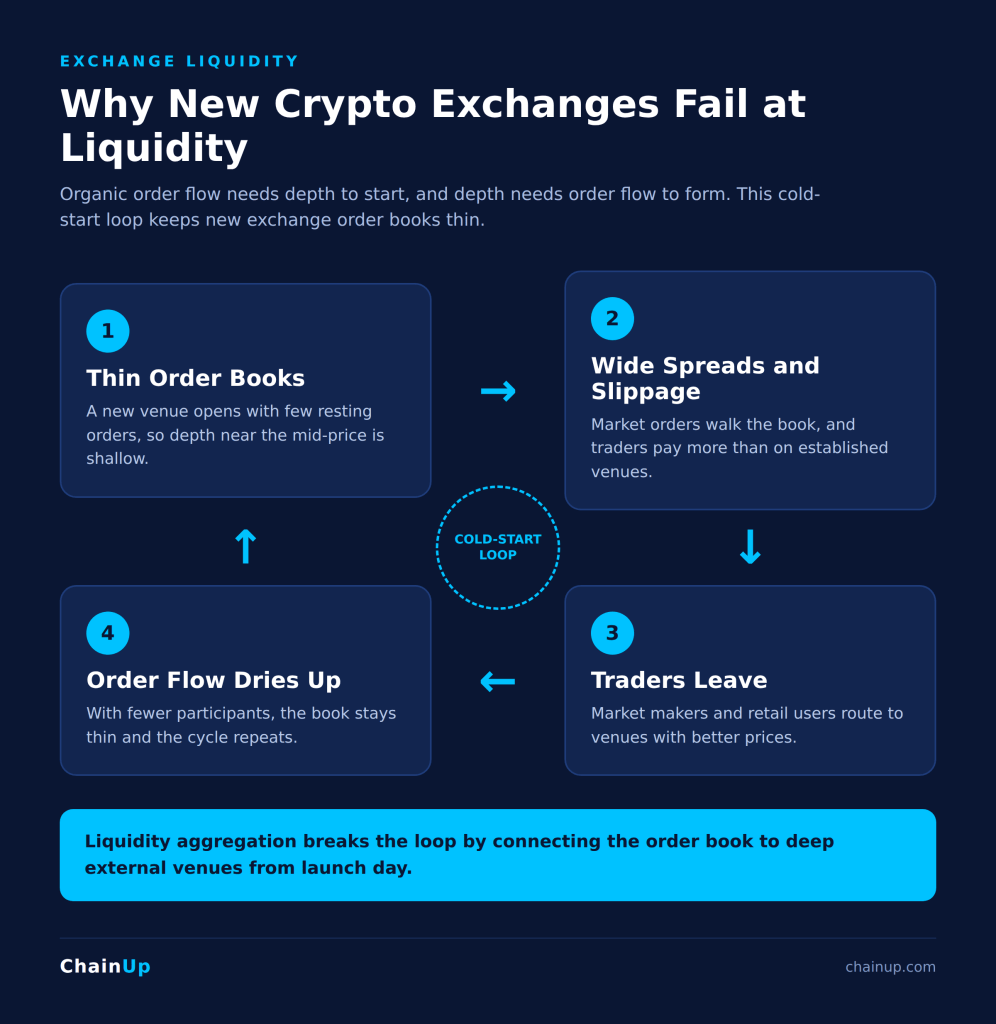
New crypto exchanges rarely fail because of their trading interface or token listings. They fail because traders arrive, see thin order books, and leave before liquidity can form. This is the liquidity cold-start problem, and it follows a predictable loop.
The cycle below shows how thin liquidity reinforces itself at an early-stage exchange.
- Thin order books. A new venue opens with few resting orders, so depth near the mid-price is shallow.
- Wide spreads and slippage. Market orders walk the book, and traders pay more than they would on an established venue.
- Traders leave. Market makers and retail users route to venues with better prices, often after their first few trades.
- Order flow dries up. With fewer participants, the book stays thin and the cycle repeats.
Traders compare execution, not branding. A regional exchange in Southeast Asia or Latin America competes on price with Binance, OKX, and Bybit the moment a user checks a quote.
Thin liquidity also drags down the exchange’s standing on data aggregators such as CoinGecko and CoinMarketCap, which factor liquidity into their exchange rankings.
Why Organic Order Flow Cannot Bootstrap a New Exchange
Most founders try to buy their way out of the cold start before they consider aggregation. Each common tactic solves part of the problem, but none creates durable depth on its own. The table below shows where each one breaks down.
| Tactic | What It Does | Why It Breaks Down |
| Zero-fee and rebate campaigns | Attracts short-term trading volume | Volume leaves when incentives end, and depth rarely follows |
| A single market maker | Posts two-sided quotes on selected pairs | Coverage stays narrow, spreads widen in volatility, and counterparty risk sits with one firm |
| Treasury-funded market making | Uses the exchange’s own capital to quote | Locks up capital across every pair and exposes the balance sheet to inventory risk |
| Organic user growth | Builds real, sticky order flow | Takes months or years, and users churn before it compounds |
The core issue is structural. Depth is a network effect, and incumbents already own the network. An early-stage exchange cannot out-wait that advantage, so it needs a way to borrow depth while its own community grows. Market making still matters, but it works best on top of an aggregated book rather than as a replacement for one.
How Crypto Liquidity Aggregation Works Under the Hood
Liquidity aggregation technology connects a new exchange to order books at external venues and presents that combined depth to users as the exchange’s own market. It manages and routes liquidity rather than holding user funds.
The four layers below describe what happens between a user placing an order and that order being filled.
- Connect. The aggregator links to major exchanges, OTC desks, and crypto liquidity providers through API and FIX connections, streaming their order books in real time.
- Consolidate. It normalizes prices, fees, tick sizes, and symbols, then mirrors the best bids and asks onto the exchange’s crypto matching engine.
- Route. Smart order routing decides whether to fill an order internally or send it out, and it splits large orders across venues to limit slippage.
- Hedge and control risk. When an order fills against the exchange’s own book, the system places offsetting trades externally, and a risk engine tracks exposure, balances, and connectivity in real time.
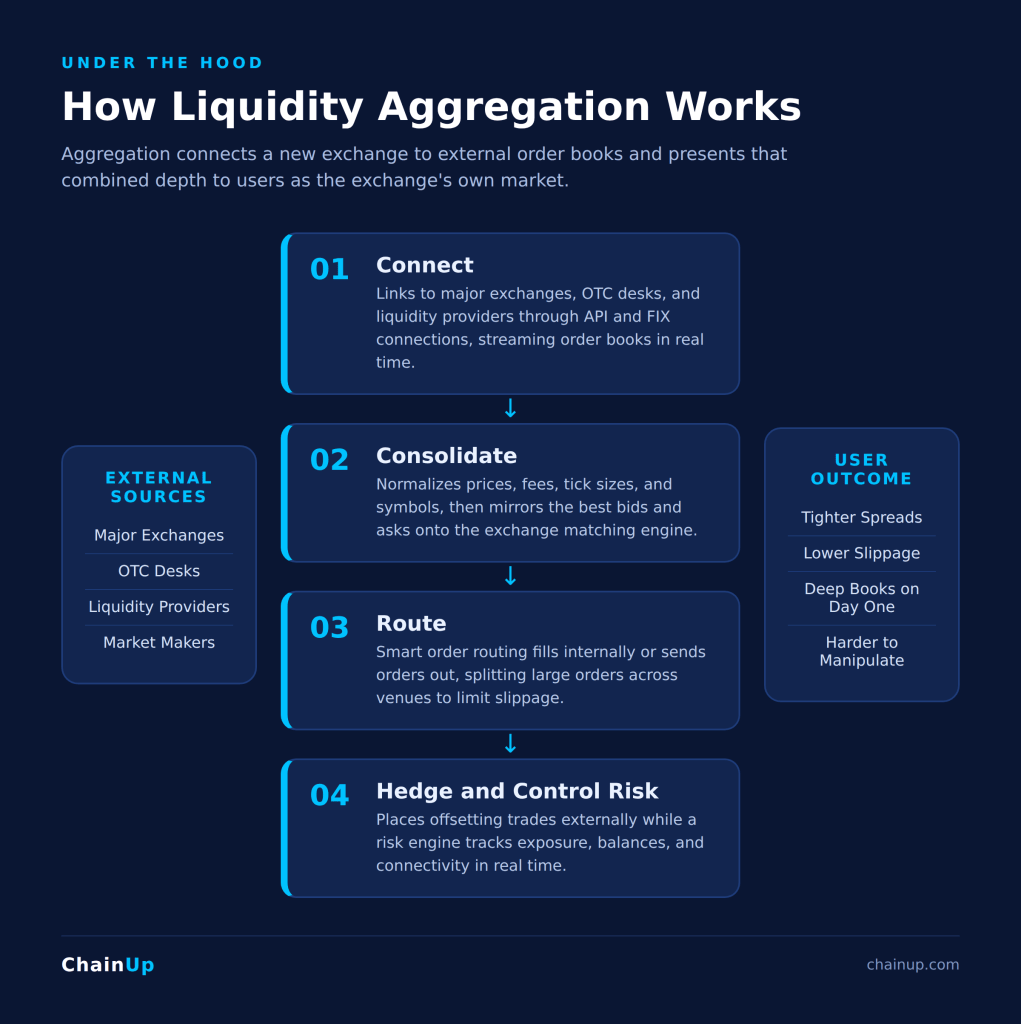
The result is that users on day one see spreads and depth close to those of a top-tier venue, even though the exchange has little native order flow. As real users arrive, internal matching takes a larger share of fills, and the exchange keeps more of the spread.
Aggregation also brings the benefits of cross-exchange liquidity, because spreading volume across venues makes the book far harder to manipulate than a thin, isolated market.
How to Evaluate Crypto Liquidity Aggregation Providers
Aggregation vendors vary widely in the depth and execution quality they deliver once live. Founders and operations leads should test three areas before signing, and each area maps to a specific failure mode.
1. Usable Depth, Not Headline Volume
Headline trading volume says little about what a trader can actually execute. Ask for depth within 0.1% and 1% of the mid-price for every pair you plan to list, including long-tail tokens, and ask how that depth holds up during volatility. Median and P90 slippage are more honest measures than averages because they show how execution degrades in bad conditions.
2. Latency From Quote to Fill
Aggregated liquidity is only useful if it is current. Every millisecond between an external venue updating its price and your book reflecting it opens a window for stale quotes, and arbitrage bots will pick off those quotes at your expense. Ask for quote refresh rates, p99 latency from user order to external fill, and where the provider hosts its infrastructure relative to connected venues.
3. Compliance Coverage Across Jurisdictions
Liquidity sourced from the wrong counterparty creates regulatory exposure. The FATF’s seventh targeted update on virtual assets, published in July 2026, shows that more jurisdictions have passed Travel Rule legislation and are moving toward supervision and enforcement.
Your provider should support Travel Rule data exchange, wallet screening, sanctions checks, and full audit trails, and it should let you switch venues on or off by jurisdiction.
The checklist below turns these areas into direct questions for any provider.
| Criteria | Question to Ask | Red Flag |
| Depth | What is the depth within 0.1% and 1% of mid for each of my pairs? | Only headline volume or top-pair figures are shared |
| Slippage | What are median and P90 slippage for a standard order size? | Only average slippage is reported |
| Latency | What is p99 latency from user order to external fill? | No measured latency data or single-region hosting |
| Coverage | How many venues and pairs are connected, and can I add more? | Depth relies on one or two upstream venues |
| Compliance | Which licensed venues are used, and how are Travel Rule and KYT handled? | Unclear counterparties or no audit trail |
| Integration | Does it plug directly into my matching engine and risk tools? | Custom middleware is required for every pair |

Solving Liquidity with White-Label Exchange Infrastructure
Leading operators treat liquidity as an architectural requirement rather than a growth problem to solve after launch. Two different solutions often get grouped together here, so it helps to define each one clearly.
- A white-label crypto exchange is a pre-engineered exchange software platform that an operator licenses, brands, and deploys. It includes the core matching engine, custody architecture, admin suite, and compliance modules.
- Liquidity aggregation is a dedicated infrastructure layer that interfaces with an exchange’s order book to supply multi-venue external depth. It operates alongside custom or white-label stacks.
Liquidity holds up best when the core parts of the exchange are designed to work together. The table below shows what each part does and how it affects liquidity.
| Component | What It Does | How It Helps Liquidity |
| Matching engine | Matches buy and sell orders on the exchange’s own book | Processes user orders and mirrored external quotes fast enough to keep the book current and fills accurate |
| Liquidity aggregation | Pulls depth from external venues into the order book | Gives users tight spreads and deep books before organic order flow exists |
| Risk management | Monitors exposure, balances, and connectivity in real time | Stops the exchange from carrying unhedged positions when aggregated orders fill |
| Compliance tools | Run KYC, AML, Travel Rule checks, and wallet screening | Keep users and liquidity counterparties within the rules of each market, so regulatory action does not cut off depth |
A white-label crypto exchange does not create liquidity by itself. It removes the obstacles that slow down liquidity at a new venue, in four main ways.
- Faster launch. A proven platform goes live in weeks rather than years, so the exchange starts building order flow sooner instead of spending its runway on development.
- Pre-integrated liquidity. When the liquidity layer already connects to the matching engine and risk tools, operators skip the custom middleware, added latency, and testing that come with stitching separate vendors together.
- Capital redirected to growth. Budget saved on engineering can go into market maker programs, token listings, and user acquisition that build organic depth.
- Proven performance under load. A battle-tested engine keeps matching and routing stable during volatility, when traders are most likely to judge an exchange on execution.
Aggregation gives the exchange depth on day one. The white label platform makes sure that depth is matched, hedged, and kept compliant without extra integration work. For more tactics beyond aggregation, see how to improve liquidity on a crypto exchange.
Building a Resilient Exchange with ChainUp Liquidity
New crypto exchanges fail because an empty order book cannot compete with incumbents on price, and organic order flow cannot fill it fast enough. Liquidity aggregation closes that gap by borrowing depth from external venues, routing every order to the best available price, and hedging exposure in real time. Testing providers on usable depth, latency, and compliance coverage separates a stable launch from a costly relaunch.
ChainUp has customized and launched more than 500 exchanges worldwide. ChainUp Liquidity Technology functions as an embedded module within ChainUp’s white-label exchange or as an API-driven layer for bespoke matching engines:
- Smart order routing scans connected venues and executes trades at the most competitive available price.
- Market-making bots mirror market movements, keep bid-ask spreads tight, and keep order books populated even during low-volume periods.
- Symbol-specific hedging lets operators set A-book and B-book execution per trading pair with preset parameters.
- Real-time risk monitoring covers 30 risk types with tiered alerts across positions, funding, market irregularities, and connectivity.
- Fee bypass and price exploitation protection keeps pricing fair and protects exchange revenue.
- A non-custodial design means the technology manages and routes liquidity without holding exchange or user funds.
- Liquidity consultation includes support to improve the exchange’s visibility and ranking on crypto data aggregators.
Talk to ChainUp’s team to discover how our liquidity infrastructure can power your order books from day one.