

Key Takeaways
- The crypto brokerage model gets you to market faster by routing orders through third-party liquidity, but it caps your revenue at a fixed spread and puts your pricing, custody, and user experience in someone else’s hands. The crypto exchange model requires more infrastructure upfront but gives you full control of the order book, fee structure, and margin expansion as volume grows.
- The model you choose locks in your compliance architecture — exchanges must operate custody, AML screening, and Travel Rule data exchange as native infrastructure, while brokerages inherit much of this from their liquidity providers but sacrifice visibility and control over the transaction pipeline.
- With global crypto adoption crossing 560 million users and MiCA fully enforceable across Europe, the decision isn’t just product strategy — it determines your licensing path, your unit economics at scale, and whether you own enough of the value chain to survive margin compression as the market matures.
Launching a crypto trading platform starts with one structural decision that shapes everything after it. Will you run a brokerage model or an exchange model?
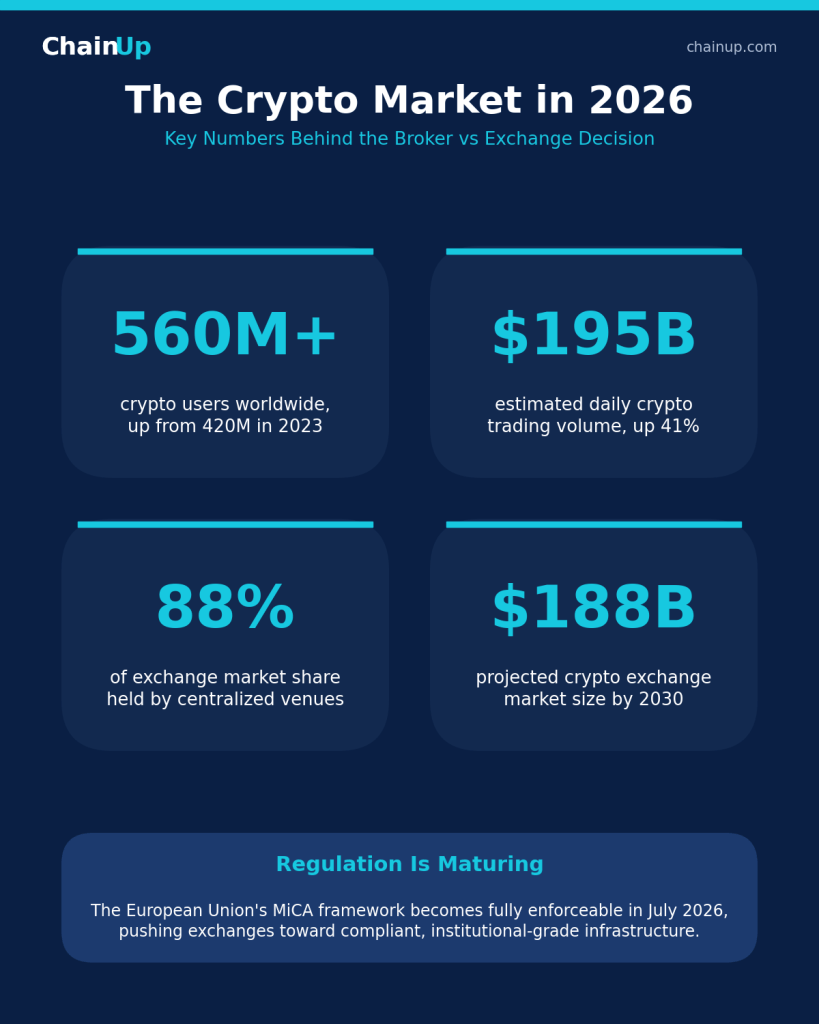
The stakes are higher than they look. The crypto market now settles an estimated 195 billion dollars in trades every day, and global crypto adoption has climbed past 560 million users, up from 420 million in 2023.
As spot Bitcoin ETFs mature and the European Union’s Markets in Crypto-Assets (MiCA) rules become fully enforceable, the window for well-built platforms is wide open. The model you pick determines who you can serve, how you earn, how heavy your compliance load becomes, and how far you can grow before you hit a ceiling.
Crypto Brokerage vs. Crypto Exchange: Understanding the Core Differences
Before weighing the build decision, it helps to define each model in plain terms. A brokerage sources crypto from exchanges or liquidity providers and resells it to customers at a fixed, quoted price.
The platform absorbs the complexity of finding the best available price in the background and presents the user with a single number to accept or decline, which keeps the experience simple and predictable. An exchange works differently. It runs an order book where users trade directly with one another, and prices move in real time as buy and sell orders meet. When two orders match, the trade executes at that market price.
That structural difference cascades into everything else, from how you price and earn to how much control you hold. Centralized exchanges still dominate trading and are expected to hold roughly 88 percent of exchange market share in 2026, though decentralized venues continue to grow.
The table below maps how the two models compare across the factors that matter most when you are deciding what to build.
| Factor | Brokerage Model | Exchange Model |
| Pricing | Fixed quote with a built-in spread | Live prices set by market supply and demand |
| Revenue | Spread markups and packaged services | Trading fees, listing charges, and API or data access |
| Control | Limited, relies on third-party liquidity | Full control of assets, fees, and the order book |
| Ownership | Often CFD based, no client custody | Direct custody and asset ownership |
| Time to launch | Faster, lighter infrastructure | Longer, requires core trading systems |
| Best for | Fast market entry and beginner audiences | Scale, institutional volume, and long-term growth |

How Each Crypto Platform Model Generates Revenue
Revenue is where the two models separate most clearly, so it deserves a closer look before you commit your engineering budget. A crypto brokerage earns revenue through the spread it adds to each asset quote, alongside packaged value-added services such as copy trading or managed portfolios.
While this model is simple to reason about, the spread sets a natural ceiling on what you can earn per trade, and margins compress quickly as competitors undercut one another.
An exchange earns from a much wider and more scalable mix:
- Trading fees: Charged on both sides of the order book (maker/taker fees), scaling directly with platform volume.
- Listing fees: Charged to token projects and issuers wanting their assets available to your user base.
- Institutional data and API revenue: Monetizing high-speed market data feeds and premium institutional access endpoints.
As each new active trader deepens liquidity and attracts more participants, a healthy exchange benefits from a powerful network effect that a brokerage cannot easily replicate. That compounding revenue model is the difference between a business capped by its spread and one that grows exponentially more valuable as it scales.
Why Growing Platforms Choose to Build a Crypto Exchange
For teams focused on speed to market, the brokerage model has real appeal. It requires less infrastructure and lets you launch quickly on third-party liquidity, which suits a beginner audience that values a clean, guided experience.
The trade-off is control. You depend on outside pricing, capture a thinner margin, and cannot easily expand into custody, staking, or institutional services later.
The exchange model asks for more upfront and rewards it with ownership of the full trading layer. You decide which assets to list, how fees are structured, and which liquidity sources power the book. You control execution quality and latency, which matters the moment professional traders arrive.
You also hold custody, which strengthens your offer for clients who expect real asset ownership, and you can add fiat on-ramps to smooth the path between traditional currency and digital assets.
From there the product can expand naturally into staking, lending, and crypto derivatives without rebuilding the core. This room to grow is why platforms building for the long term tend to gravitate toward the exchange model, even when they launch with simpler features first.
Crypto Security and Regulatory Compliance in 2026
Security and compliance now sit at the center of the model decision, especially for platforms courting institutional clients. 2025 was the most damaging year on record for crypto theft, with roughly 3.4 billion dollars stolen across hacks and exploits, a reminder that custody and platform security cannot be afterthoughts.
A single breach can end a young platform’s credibility overnight, so security architecture belongs in the earliest design conversations rather than a later hardening phase.
Regulation is tightening in parallel, and two shifts stand out for anyone building this year.
- MiCA is now enforceable. The European Union’s Markets in Crypto-Assets framework becomes fully binding across 27 member states in July 2026, creating one of the most comprehensive regimes in the world and a clear rulebook for platforms operating in Europe.
- Institutional-grade standards are the baseline. Custody, settlement, audit trails, and reporting are increasingly expected before serious clients will onboard, not bolted on afterward.
A brokerage with traditional finance roots often arrives with compliance built in, which lowers the entry bar. An exchange carries heavier obligations, yet a well-run exchange with strong controls can meet the same standard while serving a far larger and more valuable market.
Essential Components Required to Build a Crypto Exchange
Choosing the exchange model means standing up several core systems that must perform reliably under heavy market load:
- A high-performance matching engine to pair orders at scale with low latency, since execution speed becomes a competitive feature as volume grows.
- Deep liquidity and market-making relationships so spreads stay tight and large orders fill without heavy slippage.
- Robust KYC and AML compliance to meet tightening global rules and satisfy the due diligence institutional partners run before they connect.
- Secure custody and wallet infrastructure to protect client assets, with layered controls and clear separation between hot and cold storage.
- Risk and surveillance systems to watch for manipulation, manage exposure, and keep the platform stable during volatile swings.
Industry analysts project the global cryptocurrency exchange platform market to scale significantly over the next few years, crossing multi-billion-dollar valuations as institutional participation matures. The platforms winning long-term treat compliance, liquidity, and reliability as foundational architecture rather than superficial features.
Build vs. Buy: Launching Your Exchange Infrastructure
Building every core trading component completely in-house is possible, but it is slow, expensive, and pulls core engineering focus away from your product differentiation and go-to-market strategy.
This is why many modern fintech teams choose a white-label infrastructure route, where a proven technology partner supplies the matching engine, secure wallet infrastructure, integrated liquidity, and compliance tooling, allowing the platform to layer its own brand, user experience, and growth marketing on top.
The custom-build path offers maximum architectural flexibility for teams with deep engineering resources and multi-year runways. The white-label buy path trades marginal custom adjustments for speed, letting a team launch a secure platform in a fraction of the time on infrastructure already stress-tested at scale.
Launch Your Crypto Platform With ChainUp
The core decision comes down to speed versus long-term control. A brokerage opens an accessible door and gets you to market fast, while an exchange hands you the liquidity, custody control, and revenue depth needed to scale and capture institutional volume.
For platforms with serious long-term ambitions, the exchange model provides a superior foundation, and the right enterprise infrastructure partner removes the technical overhead that once made deployment difficult.
Behind every fast, secure, and fully compliant trading platform lies robust institutional infrastructure, and that is where ChainUp comes in. ChainUp delivers white-label crypto exchange solution and non-custodial MPC wallet architecture that trading platforms rely on, delivering the performance, liquidity, and security that keep markets moving.
If you are building a platform of your own, talk to the ChainUp team to map the right model for your business and launch on an enterprise foundation trusted by providers worldwide.